49 works in this view — arrow keys or swipe to move between them.
Dance in Art
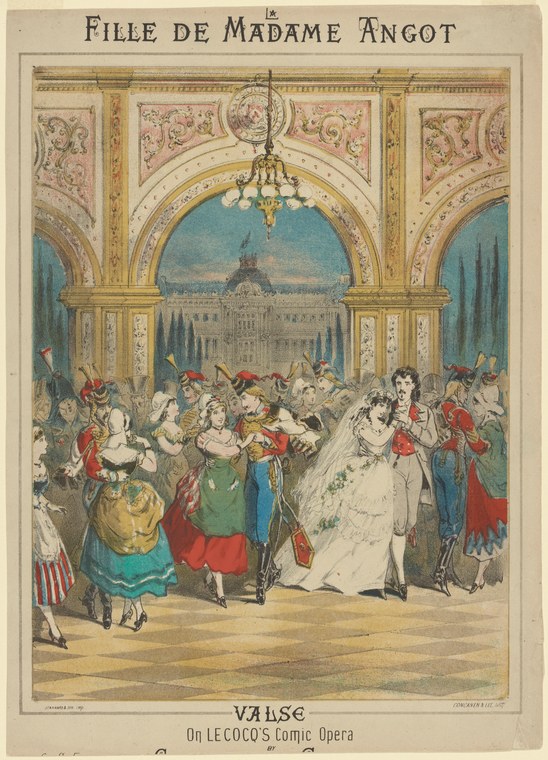
La fille de Madame Angot valse, on Lecocq's comic opera
Unknown artist
- Collection:
- Prints depicting dance
- Source:
- New York Public Library
- Rights:
- Public domain — free to use, share and adapt.
- Recorded as:
- Public Domain
The print documents the waltz during its peak social and theatrical prestige in the 1890s, showing how opera and theater promoted and celebrated the dance to mass audiences. It also reveals what was considered worth illustrating about dance in this period: formal elegance, social ritual, and the woman's gown, rather than footwork, partnering technique, or individual performance. For historians of social dance and theater, it is evidence of how dance was consumed, remembered, and marketed.
What you are looking at
A grand ballroom scene set beneath a barrel-vaulted ceiling with ornate neoclassical decoration in gold and pale colors. Through tall arched windows at the back, the Eiffel Tower is visible across the Paris skyline. The foreground is crowded with fashionably dressed figures in late 19th-century attire—women in elaborate gowns of green, yellow, and red with full skirts, men in dark tailcoats and dress uniforms with decorations. The composition centers on a couple in the middle distance: a woman in a white wedding dress or formal gown, attended by a man in dark coat. Surrounding them on all sides are other elegantly dressed guests, some dancing, some standing in conversation, creating a scene of sophisticated social revelry. The illustration uses hand-coloring over what appears to be a lithographic base, with careful attention to the architectural detail and the gradations of light across the ballroom.
The dancing
The figures are upright and formally positioned, moving through a promenade or slow processional rather than engaged in vigorous dancing. Several couples appear to be in a closed ballroom hold or near-contact position, moving together with a measured pace. The woman in white at center is the focal point, her skirt rendered with voluminous fullness typical of 1880s–90s formal dress. The surrounding crowd shows varied positions—some bodies turned toward the central couple, others in profile, creating a sense of social occasion rather than synchronized group choreography. No acrobatic or ornamental footwork is evident; the movement reads as the stately circulation of dancers in a formal ballroom.
The dance depicted
This is a valse—the waltz in its theatrical or ballroom context, as the title explicitly states. The piece was based on Edmond Lecocq's *La fille de Madame Angot*, a comic opera premiered in 1872. The publisher Lecocq (bottom of print) issued many such souvenir prints depicting dance numbers and scenes from operatic productions; this would have been circulated to theater audiences and dance enthusiasts. The composition shows the waltz as a predominantly vertical dance of formal social position: couples move through space with restraint and grace, the woman's full gown the primary visual marker of the dance, while the ballroom itself—its architecture and luxury—frames the dance as a mark of social standing rather than technical virtuosity. The Eiffel Tower dates the print to 1889 or later.
How it was made
The work is a hand-colored lithograph or chromolithograph, a commercial print process that allowed rapid reproduction and distribution. The base image shows fine linear work suggesting either lithographic crayon or a transferred design; the coloring is applied in translucent washes over the printed lines, allowing the drawing to remain visible. This technique was standard for theatrical and operatic souvenir prints in the late 19th century, making them affordable and collectible for middle-class audiences. The detail visible in the architectural ornament and the precision of the figure drawing suggest a skilled commercial atelier rather than a fine-art original. The print format ensured circulation far beyond the theater, reaching dance students, enthusiasts, and general readers.
About this work
This is a souvenir print commemorating a dance scene from Lecocq's comic opera *La fille de Madame Angot*, showing an elegant Parisian ballroom waltz frozen at a moment of formal social ritual. The work belongs to the rich tradition of 19th-century theatrical ephemera—prints that documented operatic and ballet performances for a theater-going public and served as both mementos and aids to memory. It reveals how the waltz functioned not as a display of footwork or individual virtuosity, but as a marker of social status, feminine elegance, and metropolitan sophistication. The work sits at the intersection of opera illustration, ballroom dance documentation, and commercial print culture.
For a gallery of dance in art, this print is valuable precisely because it is *not* a fine-art work: it captures how ordinary people encountered theatrical dance, what aspects of dancing were worth preserving and circulating, and how the waltz was imagined and sold to 19th-century audiences. The Eiffel Tower in the background anchors the scene to Paris and the Belle Époque, a moment of confidence in technological progress and social spectacle.
How to look at it
Attend to the formal verticality of the figures and the slow, processional quality of the movement—this is a waltz rendered as social ritual rather than as spectacle of technique. Notice how the woman in white at center dominates the composition not through gesture or footwork but through the volume and formal dignity of her gown. The architectural frame—the vaulted ceiling, the arched windows, the Parisian skyline—is part of what makes the dance legible; the waltz is a dance for luxury interiors. The print's hand-coloring and its commercial finish tell you something important too: this is not a view from a painter's studio but a mass-produced souvenir designed to be affordable and portable.
The artist
The print is uncredited, which is typical for commercial theatrical prints of the period. The publisher Lecocq (visible at bottom) was the primary distributor and likely commissioned the design from a commercial illustrator or print house atelier. Such prints were produced rapidly to capitalize on the popularity of a show and were not signed in the manner of fine art. The style is consistent with Parisian chromolithographic practice of the 1880s–90s.
The period
The waltz had been the dominant ballroom dance across Europe for nearly a century by the 1870s–90s, but it reached peak cultural prestige and visibility in the Belle Époque. The opera-comique was a major form of public entertainment, and scenes of dancing—particularly elegant waltzes—were popular both onstage and in the prints that advertised them. The Eiffel Tower, visible in the background, was erected for the Exposition Universelle of 1889 and became a symbol of modern Paris; its presence in a ballroom print signals the work's date to 1889 or shortly after. This was the era when the waltz, once controversial for its close partnering and speed, had become thoroughly respectable and was performed in ballrooms and opera houses across the continent as the dance of refined society.
Where it lives
The print is part of the NYPL's collection of prints depicting dance, held as a representative example of 19th-century theatrical ephemera. It bears a publisher's mark for Lecocq and likely dates to the 1890s, when such souvenir prints were a standard form of theater merchandise and popular collecting.
Dance in this work
Questions about this work
What is a valse and how does it differ from other dances shown in this collection?
A valse is a waltz—a triple-time ballroom dance in closed position, danced in a turning motion around the floor. Unlike contredanses or quadrilles, which involve formation and figure-work, the waltz emphasizes smooth rotational movement and intimate partnering. In theatrical contexts like this opera, the waltz was used to signal elegance, modernity, and romantic or social sophistication. The print shows the waltz as a ballroom spectacle of formal dress and social position.
Who was Edmond Lecocq and why was his opera important for dance?
Lecocq (1832–1918) was a major composer of French opera-comique, a lighter operatic form that often included choreographed dance numbers. *La fille de Madame Angot* (1872) was one of his most popular works and was performed across Europe. Opera and operetta were major venues for theatrical dance in the 19th century, and prints like this one show that theatrical dance reached audiences far beyond the ballet proper.
Why is the Eiffel Tower in a ballroom scene?
The Eiffel Tower was erected for the 1889 Exposition Universelle in Paris and quickly became iconic. Its presence in this ballroom print signals both the location (Paris) and the approximate date (1889 or later). By including the tower, the printer tells viewers: this is a scene of modern, sophisticated Parisian elegance. The ballroom itself becomes a space where metropolitan progress and social refinement meet.
How was this print made and who would have bought it?
This is a hand-colored lithographic or chromolithographic print, a commercial process that allowed rapid, affordable reproduction. Theater-goers would purchase such prints as souvenirs after attending a performance, and they were also sold through print shops and collected by dance enthusiasts. The process was fast and economical, making it possible to issue new prints celebrating current hits within weeks of a premiere.
More dance artwork





