49 works in this view — arrow keys or swipe to move between them.
Dance in Art
Danse ecossaise, composed for the piano-forte by Fred. T. Baker
Unknown artist
- Collection:
- Prints depicting dance
- Source:
- New York Public Library
- Rights:
- Public domain — free to use, share and adapt.
- Recorded as:
- Public Domain
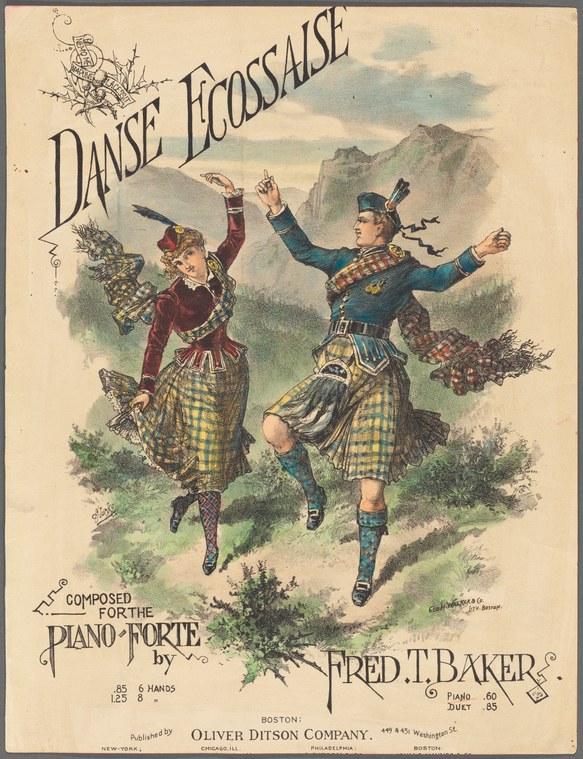
Sheet-music cover art is a primary document of how dance was imagined and sold to non-dancers; it shaped public understanding of both dance genres and national identity. This image is particularly valuable because it shows the gap between the ballroom écossaise (a formalised, European social dance) and its Romantic re-imagining as wild Highland celebration—a shift that tells us how 19th-century audiences wanted Scotland to feel, even when they danced to it.
What you are looking at
Two figures in Scottish Highland dress leap exuberantly across a mountainous landscape, their bodies captured mid-spring in a moment of uninhibited joy. The dancer on the left wears a burgundy jacket over a yellow-and-green tartan kilt, arms flung wide; the figure on the right, in blue jacket and matching tartan, bounds forward with equal energy, one arm raised and the other gesturing. Both wear sporrans, knee-high socks, and dancing shoes. The setting is wild and rural—rocky outcrops and sparse vegetation frame the dancers against a misty Highland backdrop. The composition emphasizes lightness and abandon: both dancers are clearly airborne, their feet well clear of the ground, in a pose that belongs to folk celebration rather than formal ballroom. The hand-coloured lithographic process has rendered the landscape in soft greens and greys, while the tartans and jackets are rendered in bright, saturated colour. This is the cover of sheet music, and the title *Danse Écossaise* arcs across the top in bold type.
The dancing
Both dancers are in a high, wide-legged jump, with the torso upright and arms extended or raised—a pose that conveys exhilaration rather than any closed or ballroom hold. Their weight appears to be generated from the lower body in a springing motion rather than the travelling steps of social dance. The raised arms, particularly the left figure's outflung gesture, suggest either a folk celebration or a theatrical interpretation of Highland spirit. Neither dancer shows the frame or arm position characteristic of standard ballroom technique; instead, the movement reads as expressive, spontaneous, and grounded in folk vernacular.
The dance depicted
This is billed as an *Écossaise* (Scottish dance), a social dance form that enjoyed significant popularity in 19th-century European ballrooms and concert halls. The écossaise had its roots in Scottish country dance but became stylised as a lively quadrille-variant in the Regency and Victorian periods. However, this image departs significantly from the measured, couple-based travelling steps of the ballroom écossaise: the high leaps, splayed legs, and abandoned gesture suggest either a theatrical or folk interpretation, or possibly the artist's own romantic vision of Highland wildness. The music was composed for piano by Fred. T. Baker, suggesting this was intended for domestic or concert use rather than dance-hall repertory. The image thus documents not the dance as it was performed in ballrooms, but as it was *imagined* and marketed to sheet-music audiences.
How it was made
This is a hand-coloured lithograph, a process that allowed mass production of illustrated sheet-music covers and made coloured imagery affordable for middle-class households. Lithography's capacity to render tone and texture made it ideal for landscape and costume detail; the artist has used this to great effect in the tartan patterns and the misty Highland scenery. The hand-colouring adds vibrant accent to the printed image. As sheet-music cover art, this object circulated in homes, music rooms, and shops across the English-speaking world—a form of popular visual culture that shaped how readers imagined both Scottish identity and the experience of dance.
About this work
This is a lithographed sheet-music cover for a piano *Écossaise* composed by Fred. T. Baker, published in Boston by Oliver Ditson Company in the 19th century. It depicts two Highland dancers in a moment of exuberant leap against a Scottish mountain landscape. The image captures not the ballroom écossaise (a Regency-era social dance) but a theatrical or Romantic vision of Highland wildness—the kind of Scotland that appealed to Victorian audiences hungry for picturesque exoticism. The bright costumes, energetic pose, and wild setting speak to a broader cultural fascination with Scottish identity that animated both visual culture and musical composition in this period.
How to look at it
Observe the moment the artist chose: not a step, but a leap—a suspended instant of weightlessness and joy. This is not how the ballroom écossaise was danced (it was a travelling dance in couples), but rather how a Victorian artist imagined Highland celebration would *feel*. Notice the complete absence of constraint: no frame, no closed hold, no downward gravity. The outflung arms and wide-splayed legs are visual shorthand for freedom and feeling. This is Romantic aesthetics applied to dance imagery—the body as a vehicle for emotion rather than a vehicle for step.
The artist
The artist is unrecorded; the cover bears only the composer's name (Fred. T. Baker) and publisher information. This was common for sheet-music cover art, which often involved anonymous or uncredited illustrators working for music publishers. The Boston publisher Oliver Ditson Company was a major American music publisher of the 19th century, issuing hundreds of pieces with similar illustrated covers. The image style—hand-coloured lithography, romantic landscape, theatrical dress—is consistent with the house style of sheet-music covers of the 1860s–1890s.
The period
The écossaise enjoyed a second life in the 19th century, long after its Regency popularity had waned. Scottish themes and imagery saturated Victorian visual culture, particularly after the royal family's association with Balmoral Castle and the Highlands. Simultaneously, theatrical and concert-hall dance was increasingly drawing on "national" and "folk" themes, often filtered through Romantic aesthetics that prioritised emotion, wildness, and authenticity over the measured steps of ballroom convention. This cover sits at the intersection of those trends: it markets a fashionable, commercially viable piano piece by wrapping it in imagery of Highland Romanticism, appealing to middle-class consumers who wanted to feel a connection to exotic, emotional, authentically "national" experience.
Where it lives
This object is held in the New York Public Library's collection of prints depicting dance, catalogued as a music cover. It represents one of thousands of such pieces produced by American music publishers in the 19th century, and was likely acquired as part of a broader effort to document dance in visual culture.
Dance in this work
Questions about this work
What is an écossaise?
An écossaise is a lively Scottish-derived dance that became popular in European ballrooms during the Regency and Victorian periods. In its formal ballroom version, it was danced by couples in groups, with measured travelling steps and a tempo similar to a polka. This image, however, depicts a Romantic theatrical vision of Highland dance rather than the actual ballroom form. The difference between the two tells us how music publishers marketed Scottish identity to their audiences.
Who was Fred. T. Baker?
The composer is recorded only as Fred. T. Baker; little is known of him beyond this publication. He was one of many composers of lightweight piano pieces for the Victorian parlour market, working in a tradition that produced thousands of now-forgotten works. Such pieces were often paired with illustrated covers to boost sales.
Why are the dancers so exuberant?
This reflects Victorian Romantic aesthetics, which valued emotion, authenticity, and "natural" feeling over formality. By depicting dancers in a wild leap rather than in measured steps, the artist suggests that Scottish dance is about feeling rather than technique—a common marketing strategy that associated national identity with emotional authenticity. The result is more poetry than documentary.
What does this tell us about how Victorian audiences understood dance?
Sheet-music covers like this one were primary sources for how ordinary people learned about dance they might never perform or see. This image suggests that Victorians were more interested in the *idea* of dance—wild, passionate, national—than in accurate depiction of how dances were actually done. Dance was a vehicle for fantasy and identity, not just for physical technique.
More dance artwork





