49 works in this view — arrow keys or swipe to move between them.
Dance in Art
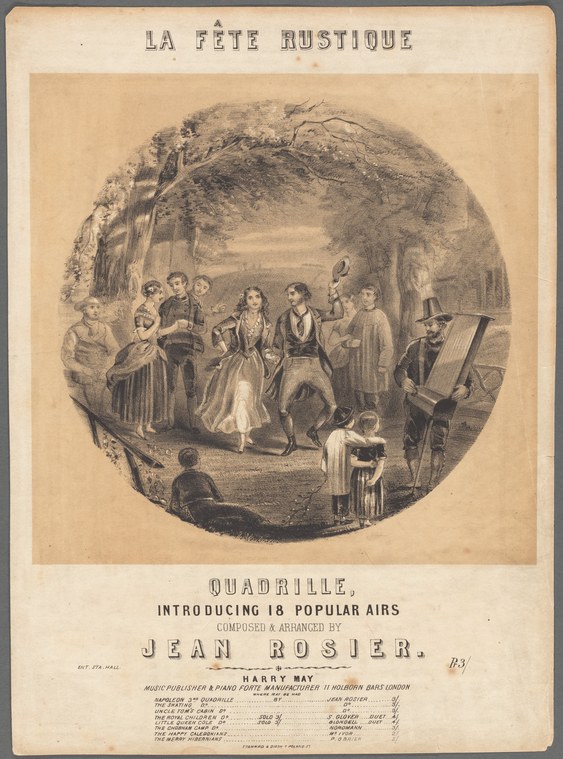
La fête rustique quadrille ... composed & arranged by Jean Rosier
Unknown artist
- Collection:
- Prints depicting dance
- Source:
- New York Public Library
- Rights:
- Public domain — free to use, share and adapt.
- Recorded as:
- Public Domain
For dance historians, this engraving provides direct evidence of how the quadrille looked in performance and how it was understood and marketed to the public. The informality of the setting and the emphasis on social participation over technical precision reveals attitudes toward dance that differ from later ballroom standardization. For dancers and teachers, the image offers a record of deportment, posture, and the relationship between partners in mid-19th-century social dance—essential information for historically informed reconstruction of the form.
What you are looking at
This engraved illustration depicts a lively outdoor gathering in a wooded setting, with dappled light filtering through overhead branches. A group of elegantly dressed figures stands in a clearing, arranged in the loose formation typical of a country dance or quadrille. The central figures—a woman in a full skirt and a man in dark coat and hat—appear to be leading or demonstrating the dance, while other couples and observers cluster around them. The scene captures a moment of social merriment: some figures are in active motion with raised arms, others watch attentively, and a child sits in the foreground. The clothing is period—mid-19th century urban dress rendered incongruous with the rustic natural setting—which creates the deliberate contrast of the title's 'fête rustique' (rustic feast). The composition is circular, drawing the eye inward to the dancing figures at the center, and the engraver has used fine cross-hatching to suggest the movement of fabric and the play of light through trees.
The dancing
The dancers are positioned in a loose quadrille formation rather than a rigid geometric alignment. The woman in the center wears a light-colored dress with a full skirt; her posture is upright and her arms are slightly raised, suggesting she is either turning or acknowledging her partner. Her male partner stands beside her in profile, wearing a dark coat and top hat. Other figures around them display varied arm positions—some raised, some at their sides—indicating they are mid-movement through a figure of the dance. The overall impression is of animated, social movement rather than formal ballroom precision; the bodies lean and turn naturally rather than maintaining the stiff frame of strict dancesport.
The dance depicted
This is a quadrille, the most fashionable social dance of the mid-19th century, here presented as a country or outdoor variant (hence the 'rustique' of the title). The quadrille was danced by four couples arranged in a square formation, progressing through a series of figures with specific music and choreography. This engraving illustrates one moment—possibly an introduction or a simple figure—rather than a complex movement sequence. The informality of the setting and the loose arrangement of figures suggests this depicts the quadrille as it might have been danced in rural or semi-private contexts, away from the ballroom formality. The composition emphasizes the social pleasure of the dance—the watching, the gathering, the moment of demonstration—over technical virtuosity.
How it was made
This is a hand-colored engraving, a form of print well-suited to popular distribution in the mid-19th century. The fine parallel lines (cross-hatching) create tone and shadow, particularly visible in the foliage and the figures' clothing; the engraver has been careful to differentiate textures—the roughness of tree bark, the flow of fabric, the solidity of bodies. The printed outline has then been hand-colored with watercolor or similar wash, adding warmth and naturalism. This technique was standard for popular dance illustrations, sheet music covers, and instructional materials of the period, which means the work was likely intended for wide circulation—either as a standalone print, as a cover for published music, or as an illustration in a dance instruction book. The quality of the engraving and coloring suggests a professional publisher rather than an amateur.
About this work
This is a mid-19th-century engraved illustration of a quadrille—specifically, Jean Rosier's composition titled 'La Fête Rustique,' framed as a 'quadrille introducing 18 popular airs.' The work sits at the intersection of dance instruction, popular entertainment, and genre printing. Quadrilles were the dominant social dance of the period, and printed images like this one served multiple purposes: they could illustrate published sheet music, instruct dancers in the style and deportment expected of the form, and circulate images of fashionable leisure to a broad public. The engraver has captured not just the steps but the social context—the gathering, the observation, the pleasure—that made the quadrille central to 19th-century social life. The work is housed in the New York Public Library's collection of prints depicting dance, where it documents both the dance itself and the visual culture that promoted and preserved it.
How to look at it
Attend first to the composition: the circular arrangement of figures draws the eye inward to the dancing couple, while the woodland setting frames and contains the scene. The engraver has frozen a moment of relative stillness—not the height of movement, but a moment of presentation or transition—which allows the viewer to read the figures' postures and relationships clearly. Notice the variety of arm positions and body angles among the surrounding figures: this is not a synchronized, locked formation but a more fluid social dance where individual expression and conversation could coexist with collective movement. The light-and-shade work in the foliage suggests movement and liveliness through means other than the dancers' bodies alone.
The artist
The work credits composition and arrangement to Jean Rosier, a 19th-century musician and dance composer. Harry May is listed as the publisher. The quadrille 'introducing 18 popular airs' suggests Rosier's role was to arrange existing melodies—a common practice in quadrille composition, which often drew on popular songs, opera airs, and folk tunes. Rosier appears to have been a commercial composer working in the popular music and dance market, though detailed biographical information is limited.
The period
The quadrille dominated social dancing from the 1830s through the end of the 19th century, and this print dates to that era of peak popularity. In the 1840s–1860s, when this work likely appeared, the quadrille was being formalized and codified through instruction manuals and published music. At the same time, prints and engravings of dance scenes were becoming increasingly common as a form of popular entertainment and instruction. The juxtaposition of fashionable urban dress with a rural setting reflects a broader 19th-century interest in 'rusticity' as a theme—the fantasy of civilized leisure in natural settings. Rosier's composition, which strings together 18 popular melodies, was typical of how quadrilles made use of existing popular culture to appeal to amateur dancers.
Where it lives
The work is held by the New York Public Library in its collection of prints depicting dance. The presence of publisher and composer credits, along with the finished quality of the hand-coloring, suggests this was a commercial print, likely sold separately or bound with sheet music. The work's inclusion in NYPL's dance collection indicates its recognized value as a historical document of 19th-century dance practice.
Dance in this work
Questions about this work
What is a quadrille and why was it so popular?
A quadrille is a square dance for four couples, performed to a set sequence of figures and melodies. It dominated social dancing throughout the 19th century because it was orderly enough to fit any ballroom, simple enough for amateurs to learn, and flexible enough to accommodate new music and variations. Quadrilles made dancing accessible to the middle class while maintaining an air of elegance and formality.
What does 'rustique' mean in this context?
The term suggests a country or outdoor variant of the quadrille, though the formal dress of the figures makes clear this is a fantasy of rusticity rather than an actual peasant dance. The contrast between the sophisticated urban clothing and the woodland setting reflects a 19th-century aesthetic that found charm and authenticity in 'natural' settings, even when the dancers themselves embodied refined city manners.
How was this image used?
Hand-colored engravings like this one typically served multiple purposes: they adorned sheet music covers, illustrated dance instruction manuals, and circulated as standalone prints to be framed or collected. They were affordable enough for middle-class homes and sophisticated enough for sale to dance masters and musicians, making them important vectors for the dissemination of dance fashion and technique.
More dance artwork





