49 works in this view — arrow keys or swipe to move between them.
Dance in Art
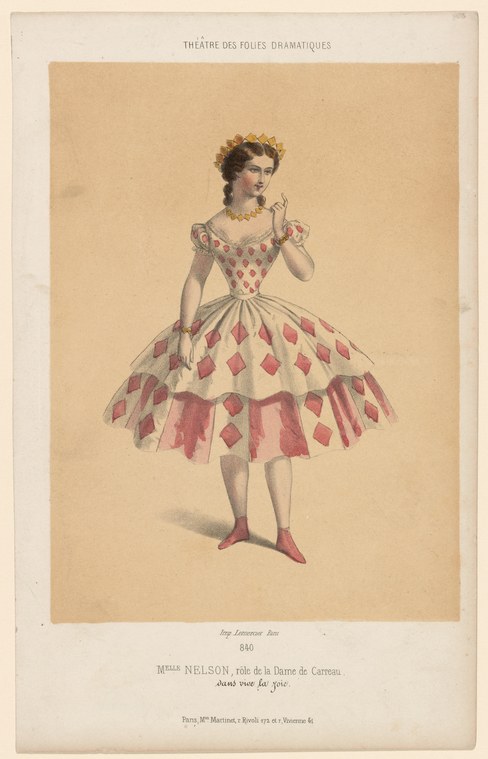
Melle Nelson, rôle de la dame de Carreau, dans Vive la joie
Unknown artist
- Collection:
- Prints depicting dance
- Source:
- New York Public Library
- Rights:
- Public domain — free to use, share and adapt.
- Recorded as:
- Public Domain
This image documents a specific performer and production in a European theatrical tradition now largely inaccessible through other means, providing visual evidence of costume design, production spectacle, and the appearance of a named performer in a historical role. For historians of 19th-century stage practices, costume design, and the visual culture of theater, such prints are primary sources documenting what actually appeared on stage and how it was marketed to audiences. The work also illustrates the emergence of mechanical reproduction as a tool for theatrical publicity and the creation of performance celebrity.
What you are looking at
A young woman in a theatrical costume stands alone against a pale tan background, posed in a moment of arrested motion. She wears a short dress with a striking geometric pattern: the bodice is cream with red diamond shapes, and the voluminous skirt is constructed of alternating panels of cream and red, cut to create a scalloped or castellated hem that suggests movement. The skirt's construction—with its layered, flounced panels—creates strong vertical and horizontal lines that emphasize the dress's theatrical quality. She holds a small object (possibly a handkerchief or fan) in her raised right hand and gazes downward and to the side, captured in a moment of coquettish engagement rather than active dancing. Her dark curled hair is pinned up in the style of the late 19th or early 20th century, and she wears heeled shoes in a warm tone. The figure is rendered with hand-coloring applied to what appears to be a lithographic or chromolithographic print, creating soft modeling of flesh tones and fabric.
The dancing
The dancer stands in a relaxed, three-quarter pose with her weight settled onto one leg in a stance that suggests ease and composure rather than active exertion. Her posture is upright but not rigidly formal; her shoulders are level and natural. The raised hand holding a small accessory signals a moment of playful interaction or coquetry rather than a technical dance position. There is no closed hold with a partner visible, and no indication of balletic turnout or lift. The gesture and bearing are those of a theatrical character in a moment of repose or social interaction rather than active technique demonstration.
The dance depicted
This appears to be a theatrical costume design or performance image from a 19th-century European stage production, most likely French given the text in French at the base. The title indicates this represents Mademoiselle Nelson in the role of 'the Queen of Diamonds' (Dame de Carreau) in a production called 'Vive la joie' ('Long Live Joy'). The geometric diamond motif on the costume is a direct visual pun on the playing-card suit. This is not a ballet in the classical sense—the costume and pose suggest comic opera, pantomime, or theatrical spectacle of the Parisian stage. The emphasis is on character, costume, and theatrical presence rather than on balletic line or technique. Without more context it is impossible to determine whether the production featured significant dance or was primarily theatrical performance with costume as its primary visual language.
How it was made
This is a hand-colored lithograph or chromolithograph, a reproductive print technique that allowed for multiple copies to circulate widely. The base image was printed in black or color from stone, then hand-finished with watercolor or gouache to enhance the costume's vivid reds and create modeling on the flesh tones. This technique was the standard method for theatrical costume and character prints in the 19th century, allowing theaters and publishers to market images of popular performers and productions to the theater-going public. The hand-coloring visible here, with its somewhat loose application and the individual character of each copy's execution, is typical of the period. Such prints were inexpensive and collectible, part of a thriving industry documenting stage performance.
About this work
This hand-colored theatrical print documents a performer—identified as Mademoiselle Nelson—in costume as the Queen of Diamonds character from a 19th-century production titled 'Vive la joie.' The image is a costume design document as much as a dance record: the bold geometric patterning of the dress and the performer's fashionable presentation are the center of interest. The print is from the collection of the New York Public Library's holdings of dance-related imagery, where it sits among thousands of similar documents capturing the visual culture of theatrical performance in the 19th century. The work represents a moment when photographic reproduction and theatrical marketing created unprecedented circulation of images of stage performers and their costumes, building a visual archive of performance styles and fashions that would otherwise be lost to memory.
How to look at it
Notice first the costume's visual wit: the diamond-patterned dress makes the character's identity legible at a glance, transforming the performer's body into a playing card. Look at the scalloped hem and the construction of the skirt in separate panels—this would have created movement and visual interest in performance, catching light and creating silhouettes quite different from the static print. The performer's pose captures a moment between movements: relaxed, engaged, and directed outward toward an imaginary audience or scene partner rather than toward the viewer. This is a moment of character rather than technical display, which tells us something about what kind of performance this was and what skills were being celebrated.
The artist
The artist is not recorded in the catalogue. The print is credited at the base to 'Théâtre des Folies Dramatiques' and printed in Paris by Martinet; Arrault (the Paris publisher and printer are identified but not the designer or lithographer). This is typical of theatrical prints of the period, where the focus was on documenting the performance and costume rather than celebrating the artist's hand. Such prints were produced as a commercial operation tied directly to theater marketing and sales.
The period
This print dates from the era of the Parisian Folies Dramatiques theater, a venue known for light, comedic, and spectacular musical theater in the mid-to-late 19th century. The style of dress, hair, and theatrical presentation places this in the 1860s–1880s. This was the period of expanding public entertainment and the emergence of theatrical star-making through mechanical reproduction. The costume's bold geometric patterning and theatrical silhouette are consistent with the comedy and spectacle traditions of mid-Victorian stage design, where visual impact and comedy often took precedence over narrative dance technique. Concurrently, this was a period when ballet was being redefined in Paris through the Romantic tradition, but this production appears to belong to a different theatrical tradition—one closer to pantomime, comic opera, or vaudeville.
Where it lives
This print is held in the New York Public Library's collection of prints depicting dance and theater. It is part of a larger holding of 19th-century theatrical and costume prints documenting European stage performance. Such images were commercial products sold to theater audiences and collectors during and after the initial run of a production.
Dance in this work
Questions about this work
Who was Mademoiselle Nelson?
The catalogue provides no information beyond her appearance in this production. Mid-19th-century theatrical prints often identified performers by name, but few additional biographical details survive. She may have been a performer with the Folies Dramatiques or a visiting guest performer; such information would have been known to contemporary audiences but is now lost.
What is the Dame de Carreau role?
The 'Queen of Diamonds' (Dame de Carreau) is a character drawn from playing-card symbolism. The costume makes this identity explicit through its bold diamond patterning. This suggests the production used characters based on tarot or playing-card imagery, a common source of theatrical comedy in 19th-century Paris.
Was this a ballet or a play with dance?
Based on the costume, pose, and theatrical context, this was most likely comic opera, pantomime, or theatrical spectacle rather than ballet. The emphasis is on character and costume rather than on classical balletic technique. The production title 'Vive la joie' (Long Live Joy) suggests a light, comedic work.
Why is the print hand-colored if it's a print?
This is a hand-colored lithograph, the standard theatrical print technique of the 19th century. The base image was printed in black from stone, then finished by hand with watercolor to enhance colors and add detail. This allowed for multiple copies while preserving the appearance of individual attention to each print, making them attractive to collectors and audiences.
More dance artwork





