49 works in this view — arrow keys or swipe to move between them.
Dance in Art
Le Ranelagh
Unknown artist
- Collection:
- Prints depicting dance
- Source:
- New York Public Library
- Rights:
- Public domain — free to use, share and adapt.
- Recorded as:
- Public Domain
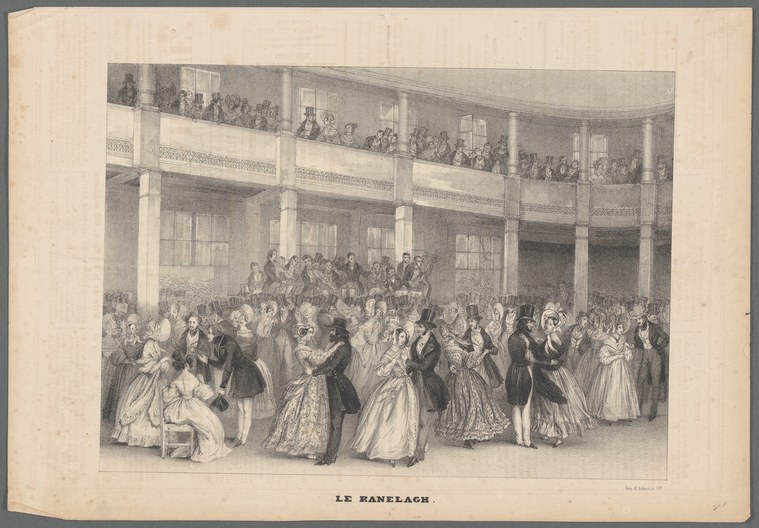
Ranelagh Gardens were the epicentre of 18th-century London ballroom culture, and this print is direct visual evidence of how the gentry actually danced and assembled socially—not the rarefied theatrical world of professional dancers, but the ordinary formal dancing of the period. For historians of ballroom dance and social history, it documents the cotillion era at its height and the architectural and sartorial context in which late Georgian ballroom dancing took place.
What you are looking at
A grand ballroom scene depicts a formal dance assembly in a large, elegant interior with tiered galleries above. The floor is crowded with dancers in 1780s–1790s dress: men in dark coats and breeches, women in high-waisted pale gowns with long skirts, many holding fans. The composition suggests a moment of active social dancing—couples are paired and scattered across the floor in various configurations, some mid-turn, others standing in conversation. The ceiling is coffered and supported by tall columns; the tiered galleries are filled with spectators observing the scene. The lighting is even and the print quality suggests this is a formal record of a fashionable venue or occasion. The title 'Le Ranelagh' indicates this depicts the Ranelagh Gardens in Chelsea, London, a famous pleasure garden and social assembly space.
The dancing
The dancers hold each other in closed positions characteristic of late 18th-century ballroom dancing, with upright posture and extended arm lines. No individual footwork is legible, but the scattered placement of couples and their varied orientations suggest multiple dances occurring simultaneously or a social gathering between dances. The women's bodies show the high-waisted silhouette and long skirts of the period; several skirts are rendered with movement lines suggesting motion. The men stand with weight forward, supporting their partners' hands in the formal frame of the time.
The dance depicted
This depicts social dancing at Ranelagh Gardens, London's most fashionable public assembly venue of the 1770s–1780s. The dominant dance form shown appears to be the cotillion or contredanse, dances requiring paired or group formation on the ballroom floor characteristic of this period. The print documents ballroom practice rather than theatrical performance: this was recreational dancing by the gentry and upper middle classes, with dancing master-led cotillions being the social norm. The variety of couple positions suggests either multiple simultaneous cotillions or the transitional moments between figures that structured these dances.
How it was made
This is a copperplate engraving, a medium suited to detailed interior scenes and fine social documentation. The technique allows precise rendering of architectural detail, dress, and the spatial arrangement of many figures, and the even tone suggests skilled hand-engraving or mixed technique. Engravings of this quality and subject were typically hand-coloured for sale to the fashionable public as records of contemporary social life, and evidence of wear on the plate suggests this was a commercial print that circulated widely. The inscription 'Le Ranelagh' and the absence of a dated signature suggest this was a popular subject reproduced multiple times.
About this work
This engraving documents social dancing at Ranelagh Gardens, London's premier pleasure garden, in the late 18th century. It captures the ballroom social world of the period—the dress, the formal partnerships, the tiered seating for spectators, and the architectural grandeur that made these venues destinations for the fashionable. Rather than illustrating a specific dance technique, the print records how and where people danced socially during the Age of Enlightenment. It is a historical document of ballroom culture as much as a work of art.
The print belongs to a tradition of fashionable interior scenes and social documentation common in London printmaking of the 1770s–1790s. Works depicting Ranelagh, Vauxhall, and other pleasure gardens were popular souvenirs and records of contemporary leisure, aimed at the same social circles who frequented these venues. This engraving captures a world of regulated social performance and display.
How to look at it
Observe the architectural framing and tiered galleries: this was a space designed for display, both of the dancers on the floor and of the spectators above. Notice the variety of couple positions and the scatter of groups—there is no single focus, which reflects the simultaneous operation of multiple dancing units typical of cotillion and contredanse. Look at the dress: the high-waisted gowns, the long skirts with movement lines, the men's coats and breeches, the fans—these date the work precisely and show the taste of the moment. The even, orderly nature of the scene, despite its crowding, reflects the formal governance of dance assembly under the direction of dancing masters.
The period
This engraving dates to the height of Ranelagh's fame, the 1770s–1790s, when the Gardens were London's most fashionable public assembly venue. The architecture and dress date securely to this period. Ballroom dance of the era was dominated by the contredanse and cotillion—lively, figure-based dances that required organisation and were led by dancing masters. These were rapidly displacing the minuet in fashionable society, though the formality and geometry of the ballroom remained. The pleasure gardens themselves—Ranelagh, Vauxhall, Marylebone—were central to the social season and democratic in a new way: access was by ticket, not rank, which drew crowds and created demand for prints recording the scene.
Where it lives
This engraving is held in the New York Public Library's collection of prints depicting dance. It is a commercial copperplate engraving, likely coloured by hand, issued as a fashionable souvenir and record of contemporary social life.
Dance in this work
Questions about this work
What is Ranelagh and why does it matter?
Ranelagh Gardens were an 18th-century pleasure garden in Chelsea, London, famous as a venue for fashionable social assembly, concerts, and public dancing. Admission by ticket made them more accessible than private balls and helped democratise the ballroom. They were at the height of their popularity from the 1760s to the 1790s and were the centre of ballroom dance culture in London.
What dances are being shown?
The couples and formations visible suggest contredanses or cotillions—the dominant social dances of the late 18th century. These were lively, figure-based dances performed in sets, often led by a dancing master. They had largely replaced the minuet in fashionable assembly rooms by this date, though formality and strict formation remained.
Is this a record of an actual event or an imagined scene?
It is most likely a generalised view of the kind of scene that occurred at Ranelagh rather than documentation of a specific evening. However, it is drawn from life: the architecture, dress, and ballroom organisation are all accurate to the venue and period, and it serves as a historical record of how people actually danced and assembled socially.
More dance artwork





