49 works in this view — arrow keys or swipe to move between them.
Dance in Art
La tirolienne
Unknown artist
- Collection:
- Prints depicting dance
- Source:
- New York Public Library
- Rights:
- Public domain — free to use, share and adapt.
- Recorded as:
- Public Domain
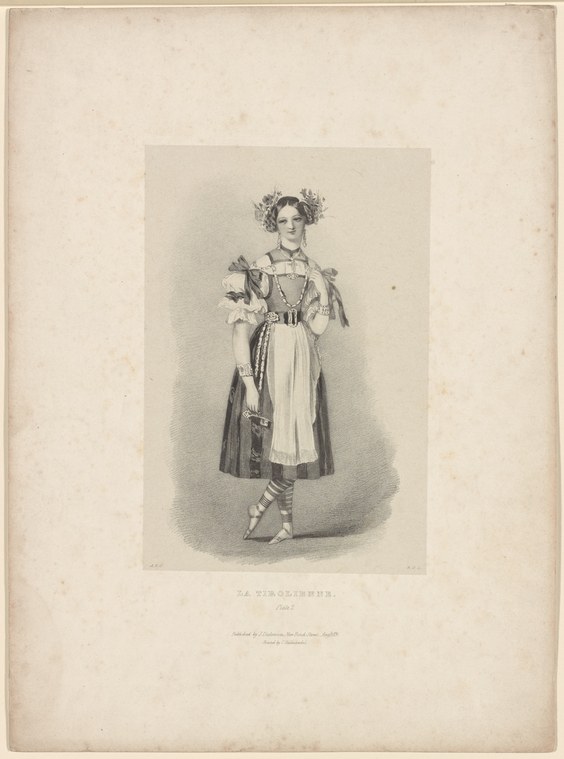
This image documents a crucial moment in dance history when folk forms and regional dances were being adapted, theatricalized, and circulated through mass media to urban audiences. It reveals how 19th-century performers and impresarios used costume, landscape painting, and print culture to create marketable versions of European folk dance, a practice that would shape ballet, concert dance, and theatrical spectacle for generations. For anyone tracing the genealogy of how folk dance became concert dance, this formal, costumed portrait is essential evidence.
What you are looking at
A single female figure stands against a plain background in a three-quarter pose, facing slightly left. She wears a long, full skirt in a light fabric with a decorative apron or overlay, a fitted bodice with ornamental trim or embroidery, and puffed sleeves. Her hair is styled up with flowers or a decorative wreath. Her posture is upright and poised, with one arm raised and bent, the other held at her side. She wears what appear to be striped stockings or leg wrappings and ankle boots or shoes. The figure is rendered in fine linear engraving or lithographic technique, with careful attention to the textures of fabric and the folds of her costume. The composition is a formal portrait-style presentation of a costumed dancer or theatrical performer.
The dancing
A single dancer captured in a moment of stillness rather than active movement. Her weight appears to rest on one leg while the other is slightly advanced. Her raised arm is bent at the elbow in a gesture that could be preparatory or expressive, while her gaze is directed outward. The posture suggests training and control—a performer aware of her presentation—rather than mid-movement. The pose allows full visibility of the costume, which appears to be the true subject of the image.
The dance depicted
The title *La tirolienne* refers to a dance associated with the Tyrol region of the Alps, which became fashionable in European ballrooms and theatrical contexts during the 19th century. The Tyrolean or Tirolienne was a lively folk-derived social dance, often performed with characteristic costumes featuring embroidered vests, full skirts, and folk styling. This image depicts a costumed performer—likely a dancer or actress in a theatrical production—in what appears to be stage dress for such a performance. The costume and the formal presentation suggest this is a theatrical or concert rendition of the folk form rather than documentation of vernacular practice.
How it was made
This is a fine engraving or lithograph, rendered in black ink on paper with careful cross-hatching and linear work to model form and suggest texture. The technique allows for mass reproduction and distribution, suggesting this was a popular or commercially significant image—possibly a souvenir of a theatrical performance, an illustration from a periodical or book, or a standalone print for collectors. The quality of execution and the refined treatment of fabric detail indicate a skilled professional hand. Such prints were common vehicles for publicizing dancers and theatrical performers to a broad audience in the 19th century.
About this work
This is a theatrical portrait of a performer in costume for *La tirolienne*, a Tyrolean-derived folk dance that achieved popularity in European concert halls and stages during the 19th century. The image captures not a moment of dance but a formal presentation of the dancer in full costume, allowing viewers to appreciate both the performer's bearing and the ethnographic or picturesque costume associated with the style. The work sits at the intersection of dance documentation, theatrical promotion, and Romantic-era enthusiasm for folk and exotic forms—a moment when European audiences were fascinated by the dances and cultures of their own margins and neighboring regions.
How to look at it
Look first at the costume: the embroidered or decorated bodice, the full skirt, the wreath or flower crown, the striped stockings, and the careful presentation of these elements. The artist has chosen a moment of stillness and formal display rather than dynamic movement, which tells us this is a costume portrait, not a movement study. The slight turn of the body and the raised gesture create just enough sense of animation to convey that this is a performer, someone trained to present herself. The linear precision of the engraving gives every element—every fold, every trim—equal visual weight, reinforcing the idea that the costume itself is the subject.
The period
The 19th century saw a sustained European fascination with folk, regional, and 'exotic' dance forms, amplified by Romanticism's interest in nature, authenticity, and the picturesque. The Tyrolean dance, associated with Alpine scenery and rustic life, fit perfectly into this aesthetic. Theatrical producers and touring performers—often women dancers who had already trained in ballet—adapted folk dances for stage presentation, costuming them with ethnographic detail (real or imagined) to create spectacle. This practice was part of a broader colonial and nationalistic era during which European artists and impresarios collected, studied, and often repackaged non-urban or non-metropolitan cultural forms as entertainment. The print culture surrounding these performances—including costume portraits, scene illustrations, and program imagery—was integral to their marketing and cultural circulation.
Where it lives
This print is held in the New York Public Library's collection of dance-related prints. The catalogue record is sparse, providing only the title and genre designation, suggesting it may be part of a larger uncatalogued or partially catalogued collection of 19th-century theatrical prints and dance ephemera.
Dance in this work
Questions about this work
What was the Tirolienne and why was it popular?
The Tirolienne was a lively social dance associated with the Tyrol (Tyrol) region of the Alps, which became fashionable in European ballrooms and theaters during the 19th century. It was part of a Romantic-era enthusiasm for folk and 'picturesque' dances from European regions, often performed in stylized form by trained dancers in theaters. Its popularity reflected broader European interest in regionalism, nature, and authenticity during the 1800s.
Is this a real folk dancer or a theatrical performer?
This appears to be a theatrical or concert performer—likely a trained dancer or actress—in costume for a staged production of the Tirolienne. The formal presentation, the refined costume, and the theatrical context of the print all suggest this is a performer presenting a stylized version of folk dance rather than documentation of vernacular practice. By the 19th century, folk dances were commonly adapted for stage by professional performers.
Why was this portrait printed and distributed?
Theatrical prints like this served multiple purposes: they promoted individual performers and upcoming productions, they circulated images of fashionable dances and costumes to a wide public, and they were collected and displayed by consumers interested in theater, dance, and contemporary culture. This print would have been sold in theaters, music shops, or print shops, making it both artistic and commercial.
What does the engraving technique tell us?
Fine engraving and lithography allowed for mass reproduction and relatively affordable distribution, making it possible to reach a broad urban audience. The technical skill evident in this print suggests it was created by a professional workshop and was likely a commercial product of some value—not a hastily made souvenir but a carefully executed artifact.
More dance artwork





