49 works in this view — arrow keys or swipe to move between them.
Dance in Art
Costume de sauvage
Unknown artist
- Collection:
- Prints depicting dance
- Source:
- New York Public Library
- Rights:
- Public domain — free to use, share and adapt.
- Recorded as:
- Public Domain
This image is essential documentation of how European theatrical dance imagined and staged the non-European body in the 18th century. It shows the fusion of Baroque theatrical convention with colonial fantasy—the actual movement vocabulary remained European, while the costume created an illusion of alterity. For dance historians, it is primary evidence of the visual and kinetic language of spectacle in this period, and for scholars of colonialism and representation, it demonstrates how dance and dress were tools for constructing and consuming racial fantasy on the stage.
What you are looking at
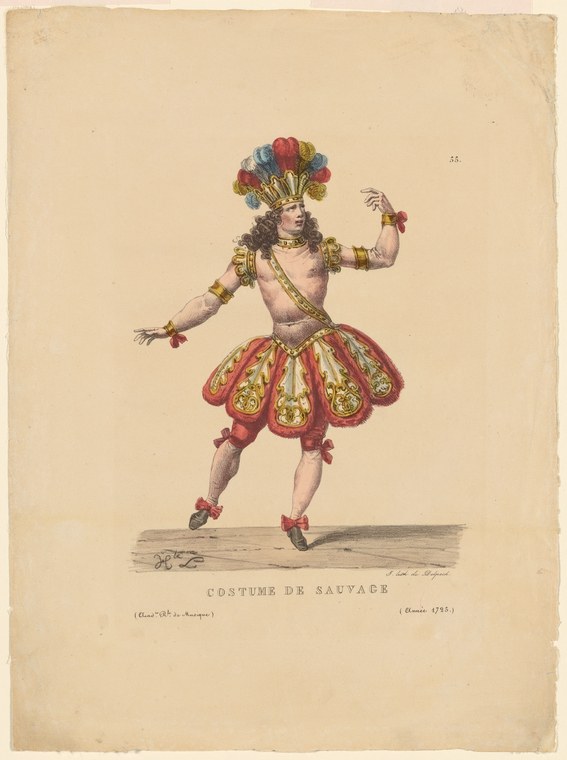
A single figure stands in a theatrical stance against a plain background, dressed in an elaborate costume labeled as "Costume de sauvage" (Savage Costume). The dancer wears a headdress of voluminous colored plumes—red, blue, and yellow—arranged in a dramatic fan shape that frames the face. The upper body is nearly bare, with only decorative gold cuffs at the wrists and upper arms. A wide belt or girdle sits at the waist. The lower costume consists of a striking skirt made of five large petal-shaped or scalloped sections in deep red with ornate gold decorative patterns within each panel, creating a flower-like silhouette. The skirt is quite short, ending well above the knee and exposing the legs. Red stockings or leg coverings and dark shoes complete the outfit. The figure stands in an active, open posture with one arm extended outward and the other raised, suggesting mid-movement. The pose is energetic and theatrical, with weight shifted onto one leg in a small fourth or open position. The entire composition is rendered in hand-colored technique, with delicate line work defining the figure against the cream ground.
The dancing
The single dancer is captured in an open, expansive stance with limbs extended and weight actively displaced. The body shows lifted posture in the torso and shoulders, while the legs are engaged and turned. One arm extends outward at approximately shoulder height with the hand visible and active; the other arm is raised higher, the fingers articulated. The position suggests a moment of turning or traveling movement rather than stillness. The legs appear straight and engaged, with the stance suggesting weight on the back leg and the front leg prepared for action. This is not a closed or supported position but rather a solo performance gesture.
The dance depicted
This is a theatrical or balletic representation of so-called 'savage' or non-European dance from the 18th century, created during an era when European courts and stages used exotic costume and stylized movement to represent colonial fantasies of the Americas and Africa. The work is almost certainly from a printed source documenting stage costumes or choreographed dances for the theatre, likely from a ballet d'action or similar theatrical spectacle. The term "costume de sauvage" appears in French theatrical records, particularly in connection with court ballets and pantomimic entertainments of the 1720s–1780s. The exaggerated, geometricized costume—especially the rigid petal-skirt and massive plume headdress—bears no resemblance to actual indigenous dress and instead reflects European Baroque and Rococo stage design principles. The dancer's pose and extension are consistent with early Baroque or Rococo theatrical movement, not with any indigenous dance form.
How it was made
This is a hand-colored engraving or etching, likely 18th century based on the line technique and coloring method. The primary image is defined by fine, controlled line work typical of copper-plate engraving, with particular attention to the costume details—the feathers, the ornamental patterns on the skirt panels, and the jewelry are rendered with delicate hatching and outline. The coloring is applied by hand in watercolor or gouache over the printed line, a standard technique for such theatrical costume prints. This method of production indicates a work created for circulation among the educated theater-going public, dance masters, and possibly costume designers—not a unique painting but a reproducible image made in multiples. The technique allowed for relatively affordable distribution of costume documentation and theatrical imagery.
About this work
This hand-colored engraving documents a theatrical dance costume from the 18th century, specifically a figure labeled "Costume de sauvage" (Savage Costume). The work is a costume study for stage performance, likely from a French court ballet or theatrical spectacle dating to the mid-to-late 1700s. It represents a moment when European theatrical makers created stylized, fantastical versions of non-European peoples for aristocratic and commercial entertainment, using exaggerated costume silhouettes and movement vocabularies that had nothing to do with actual indigenous or African dance practices.
The work belongs in a dance history collection because it documents both the movement and design vocabulary of a specific theatrical tradition—the ballet d'action and allied forms—and because it reveals how European dance and visual culture used the figure of the colonized body as a vehicle for spectacle and fantasy. The image tells us what choreographers and audiences of the period valued: exotic silhouettes, elaborate plumage, bare skin coded as 'primitive,' and a movement quality that suggested vigor and abandon in contrast to the restraint of court dance.
How to look at it
Attend to the pose: the dancer is captured mid-movement, with extended limbs and active weight shift, in a moment that reads as traveling or turning rather than a held position. This choice of moment—the suspended instant of action—was a central principle of Baroque theatrical representation and engraving. Notice how the costume is designed to move: the petal skirt is engineered to flare and expose the legs, the plumed headdress is massive and would catch air and motion, the open arm positions would display the arms and torso. The artist understood that this was a moving body in a moving costume, and has frozen the image at a point of maximum extension and energy. Observe the European theatrical vocabulary underneath the exotic trappings: the turned-out legs, the lifted posture, the spatial extension are all consistent with trained theatrical movement of the period, not with a representation of any non-European movement practice.
The artist
The artist is not recorded. The work is a costume study from a French theatrical tradition, likely produced in Paris in the mid-to-late 18th century. Such prints were typically created by engravers working from designs by costume masters and choreographers, and were distributed as theatrical documentation and reference material. The quality of the line work and hand-coloring suggests a professional workshop rather than an amateur record.
The period
This print belongs to the era of the ballet d'action and the theatrical innovations of the mid-18th century, when choreographers like Jean-Georges Noverre were reforming ballet to include more elaborate pantomime and narrative. The fashion for exotic and 'savage' characters on stage was part of a broader Enlightenment fascination with non-European peoples, filtered through French Rococo aesthetic principles. Costume prints like this one were instruments of theatrical circulation and professional knowledge-sharing among dancers, choreographers, and designers. The visual language—the geometric petal skirt, the massive headdress, the bare chest—reflects Rococo taste for artifice and exaggeration, not any engagement with actual indigenous aesthetics. This was also the period of expansion of the European slave trade and colonial conquest in the Americas, so the theatrical 'savage' was always shadowed by colonial violence, though the costume print itself records only the fantasy.
Where it lives
This work is part of a collection of prints depicting dance held by the New York Public Library. It is a theatrical costume print, likely created as part of a series documenting stage designs or choreographic works from 18th-century French theatre. The collection includes similar costume studies and dance documentation from the same period.
Dance in this work
Questions about this work
What is a 'costume de sauvage' and where would it have been worn?
A 'costume de sauvage' (savage costume) was a theatrical costume used in 18th-century European stage productions, particularly in court ballets and commercial spectacles, to represent non-European peoples. The costume bore no relation to actual indigenous or African dress; instead, it was an invention of European theatrical designers using exaggerated silhouettes and bare skin to create an impression of exotic difference. Such costumes appeared in elaborate ballet productions in Paris, Vienna, and other major European theater centers.
Did dancers who wore this costume actually dance in the style of indigenous or African peoples?
No. The movement vocabulary remained entirely European—the trained theatrical technique of the period. What the costume created was a visual frame of exoticism around a body moving in the classical European theatrical style. This is a key point in understanding 18th-century spectacle: the fantasy of difference was constructed through costume and narrative, not through genuine engagement with non-European movement practices.
Why is this print valuable as a historical document?
The print documents both the visual and kinetic language of 18th-century theatrical spectacle. It shows us how dancers moved in period costume, what their body line and posture looked like, and what kinds of fantasies European audiences and makers wanted to see on stage. It is also evidence of how colonialism and Enlightenment-era fascination with non-European peoples shaped European culture and entertainment.
How was this print made and distributed?
This is a hand-colored engraving, likely produced in a professional Parisian workshop. The image was created by engraving or etching on a copper plate, then printed on paper and colored by hand. Such prints were relatively affordable and were distributed among theater professionals—dancers, choreographers, costume designers—and among educated theater-goers who wanted to study current productions and fashions.
More dance artwork





