49 works in this view — arrow keys or swipe to move between them.
Dance in Art
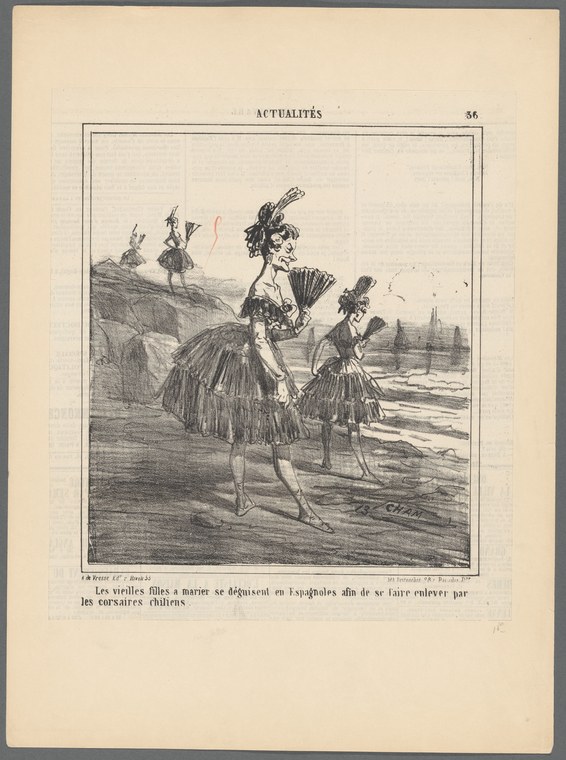
Les vieilles filles a marier se déguisent en Espagnoles afin de se faire enlever par les corsaires chiliens
Unknown artist
- Collection:
- Prints depicting dance
- Source:
- New York Public Library
- Rights:
- Public domain — free to use, share and adapt.
- Recorded as:
- Public Domain
This work reveals the connection between satirical print culture and the visual codes of 18th-century courtly and theatrical movement. For historians of dance and fashion, it shows how exaggerated posture and gesture operated as legible signs of class, nationality, and seductive intent—the very vocabulary that ballet and theatrical dance would formalise. The satirical mode tells us that these posed attitudes were recognised as performative and ridiculous, offering evidence of how contemporaries understood the construction of feminine elegance.
What you are looking at
A satirical engraving showing two young women in exaggerated theatrical costume standing on a beach or shoreline. Both wear elaborate, voluminous skirts with deep pleating or fluting that extends to the ground, and ornate headdresses with feathers or plumes. The woman on the left stands in profile, weight on one leg, gesturing with a fan held at an acute angle. The woman on the right faces slightly toward the viewer, her body in a more frontal pose. Both have the elongated, stylized proportions typical of 18th-century satirical prints. In the background, a distant shoreline and fortifications are visible, suggesting a Mediterranean setting. The title refers to "old maids" disguising themselves as Spanish women to attract the attention of Chilean corsairs—a setup for comedy that plays on contemporary anxieties about seduction, deception, and colonial encounters. The women's exaggerated postures and costumes are the joke.
The dancing
Two figures stand apart on an open ground, not in contact. The nearer woman leans back slightly, one leg supporting her weight while the other extends forward beneath the enormous skirt; her arm holds the fan aloft and away from her body, creating a wide silhouette. The second woman adopts a more upright stance with arms positioned to frame the body. Both have raised heads and composed faces. The poses are studied and artificial rather than naturalistic—a theatrical presentation of feminine elegance meant to be ridiculous. The artist has understood how costume exaggerates and distorts the body's apparent form.
The dance depicted
This is not a dance scene in the functional sense, though the poses derive from theatrical and courtly display conventions of the 18th century. The women are striking attitudes—frozen moments of performed femininity meant to mimic the grace and allure of fashionable Spanish or theatrical dress. The exaggerated proportions of the skirts and the deliberate positioning of the arms and legs echo the vocabulary of ballet and courtly dance, particularly the *port de bras* and stance of classical training, but no actual dancing is occurring. The image is satirical commentary on fashion, courtship, and the performativity of elegance rather than a document of choreographed movement.
How it was made
This is an engraving or etching, rendered in fine black lines on cream paper with light cross-hatching to suggest volume and shadow. The technique allows precise detail in the pleating of the skirts and the ornamental features of dress and headdress. The linear quality and high contrast are typical of 18th-century satirical prints, which could be quickly reproduced and widely distributed. The signature or mark visible in the lower right corner suggests a known printmaker, though it is not clearly legible in this image. The hand-worked quality of the line conveys both the artist's control and the intimacy of the satirical observation.
About this work
This is a satirical engraving from the 18th century depicting two fashionably—or ridiculously—dressed women posed as if to attract corsairs. The work belongs in a dance history context not because it documents choreography but because it draws directly on the visual language of courtly display and theatrical posture that defined movement practice of the period. The exaggerated stance and arm positions, the studied elegance, and the frozen moment all reflect how women of the era understood their bodies as objects of display. The print circulated as popular entertainment, making visible the conventions that governed how women were expected to move and present themselves in society. It is a satirical comment on the gap between the pretensions of fashion and the artificiality of feminine display.
How to look at it
Attend to the posture of the legs within the skirts: the artist has suggested weight and stance through the subtle placement of feet and the way the fabric breaks and folds. The arms are positioned in the classical vocabulary of grace—the fan held as an extension of courtly display. The distance between the two figures and their lack of interaction emphasises that these are separate performances of femininity rather than a coordinated pair. Notice the ornamental headdresses and their precarious angle: they too are part of the comedy, suggesting artifice and instability. The shoreline in the background, with its fortifications, is merely scenery for the real subject: the women's absurd self-presentation.
The period
This engraving dates stylistically to the mid-18th century, a period of intense interest in satirical prints mocking fashion, courtship, and social pretension across Europe. The theme of seduction and disguise was common in theatrical farces and popular comedy of the period. Spanish and exotic costume were fashionable in French and English entertainment and visual culture. The reference to Chilean corsairs places the work in the context of colonial anxieties and fantasies circulating in European society. The exaggerated skirts reflect the enormous panniers and structured undergarments that defined women's silhouette in the 1740s–1760s, making the figure almost abstract—a cone of fabric with a head and two arms emerging from it.
Where it lives
This print is held in the Prints collection of the New York Public Library. It is catalogued as part of a larger collection of satirical prints, likely French or English in origin, depicting social manners and fashion of the 18th century.
Dance in this work
Questions about this work
Is this actually showing a dance?
Not in the sense of choreographed movement, but rather a posed moment of theatrical display. The women are striking attitudes—frozen gestures of elegant femininity—using the vocabulary of courtly and ballet training. The satire lies in how exaggerated and artificial these poses appear when frozen for examination.
What does the title mean?
The title is a joke: unmarried women ('vieilles filles', literally 'old maids') disguise themselves in Spanish costume to seduce corsairs. It combines anxieties about female deception, exotic otherness, and colonial encounters into a comedic scenario. The enormous skirts and headdresses are the visual punchline—the disguise is obviously fake.
Why would this be in a dance collection?
Because it documents the visual and postural conventions that 18th-century society associated with elegance, feminine display, and courtly movement. It shows how standing, walking, and gesture were understood as performative skills that women of fashion were expected to master, and it offers satirical evidence of how those conventions were perceived.
More dance artwork





