49 works in this view — arrow keys or swipe to move between them.
Dance in Art
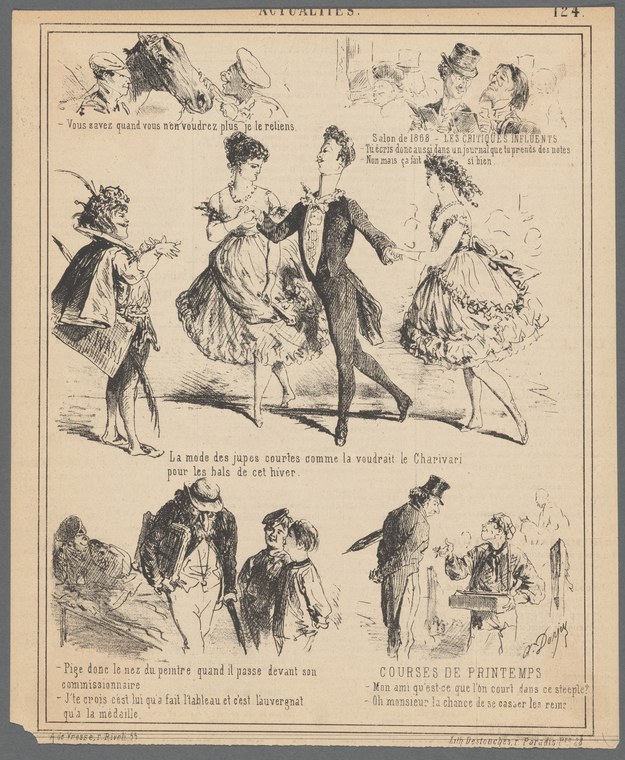
La mode des jupes courtes comme la voudrait le Charivari pour les bals de cet hiver
Unknown artist
- Collection:
- Prints depicting dance
- Source:
- New York Public Library
- Rights:
- Public domain — free to use, share and adapt.
- Recorded as:
- Public Domain
This engraving provides a vivid, historically specific record of how ballroom dancing was actually performed and dressed in mid-19th-century Paris, and equally important, how it was perceived and satirized by contemporary social critics. For scholars of dance history, fashion history, and gender studies, it documents the controversy surrounding women's mobility and exposure in public dance, and the close relationship between ballroom dancing and broader social debates about female freedom and propriety. The work also exemplifies how dance imagery functioned as a tool for social commentary in popular visual culture, reaching audiences far beyond specialized dance contexts.
What you are looking at
This is a satirical French engraving depicting fashionable ball culture of the winter season, organized in two registers. The upper half shows a lively dance scene with five figures in contemporary dress: women in short skirts (the focus of the satire, as indicated by the title) and men in tailcoats and evening wear. The dancers are arranged in a loose group, with animated poses suggesting movement and flirtation—one couple appears to be waltzing or in close proximity, while others gesture expressively toward one another. The lower half contains three separate vignettes of social comedy: a disheveled man approaching a well-dressed couple, a portly gentleman conversing with a younger man, and a woman seated at a dressing table or vanity. The entire composition is rendered in black ink with fine cross-hatching and fluid line work characteristic of mid-19th-century satirical journalism. The French text at top and bottom anchors the work as social commentary on contemporary manners.
The dancing
The dancers in the upper section display the closed and open holds typical of 19th-century ballroom dancing. Several figures stand with arms raised or extended in gestures of invitation or response; one pair appears to be in a waltz hold with the woman's skirt caught mid-swirl. The poses are exaggerated and comedic rather than formally correct, emphasizing the precariousness of the short skirts worn by the female dancers—a novelty and point of scandal at the time. Bodies lean toward one another in postures of social engagement and courtship; the overall impression is of movement frozen mid-gesture, with particular attention to the women's legs and the exposure created by the shortened hemlines.
The dance depicted
This is a social ballroom scene, most likely depicting the waltz or cotillion as danced at fashionable Parisian winter balls. The work is satirical rather than documentary; it uses the figure of the short skirt as a vehicle for commentary on changing fashion and manners among the Paris elite. The title—'The fashion for short skirts as the Charivari would wish it for the winter balls'—references Le Charivari, a prominent French satirical journal, suggesting this engraving may have appeared in that publication or in a similar periodical. The dance itself is recognizable as ballroom dancing of the 1840s-1860s period, but the artist's primary interest is social critique rather than dance instruction.
How it was made
This is a wood engraving or steel engraving, executed in black line with careful cross-hatching to create tone and shadow. The fine precision of the line work and the delicate rendering of fabric and facial features are characteristic of mid-19th-century reproductive engraving techniques. The technique allowed for mass reproduction in illustrated journals and newspapers, making this a work of popular satire intended for wide circulation among the educated middle class. The page number (124) visible at the top and the publication mark at the bottom ('Les Beaux-Arts à l'abrégé') confirm this as a page from a periodical or collected volume, suggesting an audience of art readers and social commentators rather than dance specialists.
About this work
This is a satirical engraving from mid-19th-century France depicting fashionable ballroom dancing as a vehicle for social commentary on changing women's fashion. The short skirts worn by the female dancers—shocking by the standards of the day—are the stated subject of the satire, but the work also captures the postures, dress codes, and social choreography of elite Parisian dance culture. The scene belongs in a gallery of dance imagery because it documents both the actual practice of ballroom dancing in this period and the cultural anxieties surrounding women's visibility and bodily display in public social spaces. The work is neither a dance manual nor a romantic idealization; it is a witty, observational record of a specific historical moment when dance, fashion, and social propriety intersected.
How to look at it
Attend first to the two registers of the composition and how the satire works across them. The upper section depicts the dance itself with vivid, exaggerated gesture; the lower section depicts the social and sartorial anxieties that the dance provokes. Notice how the women's legs are rendered with particular care and emphasis—this is the point of the satire. Look at the postures of the male dancers and observers: their expressions and gestures reveal the social meaning attributed to the exposed legs. The text at top and bottom frames the image as a specific commentary on contemporary fashion, not a timeless representation of dance. Finally, observe the technical skill of the engraving: the fineness of line, the subtle modeling of fabric and shadow, and the clarity of individual faces and expressions—all evidence of a professional hand working within a tradition of social satire.
The artist
The engraver is not recorded. The style and subject matter suggest this was created by a staff artist or freelancer working for a Parisian satirical journal in the mid-19th century. The technical skill and the specific reference to Le Charivari (a journal known for employing accomplished draughtsmen and engravers) suggest a professional illustrator working within the tradition of French social satire established by artists like Honoré Daumier. The anonymity is typical of periodical engraving of this era, where artists often worked without individual attribution.
The period
This engraving dates to a period of significant change in ballroom dance and fashion in France, likely the 1840s-1860s. The waltz had become dominant in Parisian elite society by this time, displacing older forms like the cotillion, and was still the subject of some moral anxiety. More importantly, this is the era when women's fashion began to shift—hemlines began to rise slightly (though still scandalously modest by later standards), and women's social participation in public dance venues expanded. The short skirt depicted here was a novelty that provoked both fascination and moral outrage among conservatives. The engraving's tone reflects the ambivalence of the period: amusement at the new fashion combined with anxiety about its social implications.
Where it lives
The work is held in the New York Public Library's collection of prints depicting dance. The publication information visible on the page ('Les Beaux-Arts à l'abrégé') and the page number suggest this was originally part of a bound periodical or collected volume of satirical engravings, now separated and catalogued as a single print.
Dance in this work
Questions about this work
Why is this a dance image and not just fashion satire?
Because the dance itself is the subject and the occasion for the satire. The short skirts matter precisely because they are worn while dancing in public, in close proximity to men, in postures that involve bodily movement and display. The engraving documents the actual postures and holds of ballroom dancing—waltz hold, open and closed positions—and uses the dance scene as the frame for social commentary. Fashion and dance are inseparable here.
What dance is this showing?
Most likely the waltz or a related ballroom form like the polka or cotillion, as these were the dominant social dances in Parisian elite culture in the 1840s-1860s when this engraving was made. The holds and postures visible in the image are consistent with these dances. The artist does not label the dance specifically; the focus is on the social scene rather than dance technique.
How do we know this was satirical and not a straightforward depiction?
The title itself signals satire: 'The fashion for short skirts as the Charivari would wish it'—meaning, as the satirical journal imagines an exaggerated version of it. The postures are comedic and exaggerated rather than formally correct. The lower register with its vignettes of social awkwardness reinforces the satirical tone. The attribution to Le Charivari, a known satirical publication, confirms the genre.
What was shocking about short skirts in this period?
In mid-19th-century European society, women's legs were essentially invisible in public; ankles were considered immodest to display. Short skirts, which revealed the ankle or lower leg, were provocative and controversial. They became particularly charged when worn while dancing, an activity that already involved physical closeness and movement. This engraving captures both the novelty and the moral anxiety surrounding this shift in fashion and social behavior.
More dance artwork





