49 works in this view — arrow keys or swipe to move between them.
Dance in Art
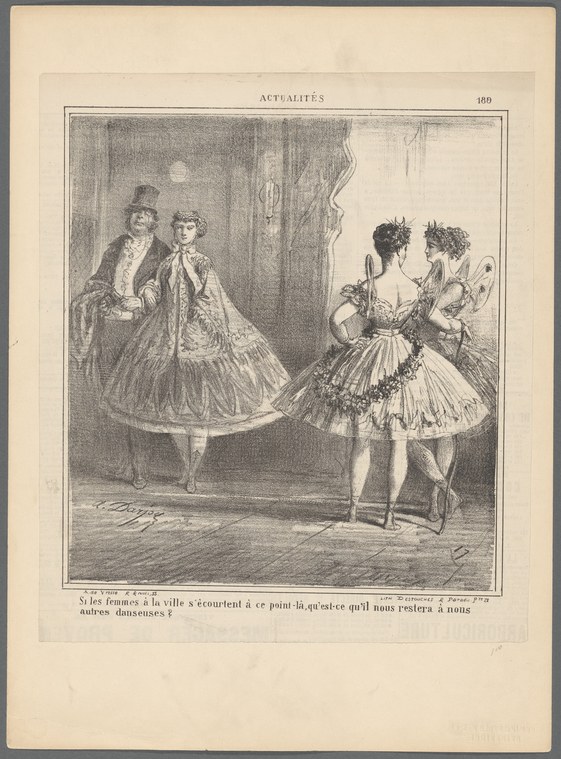
Si les femmes à la ville s'écourtent a ce point-là, qu'est-ce qu'il nous restera à nous autres danseuses?
Unknown artist
- Collection:
- Prints depicting dance
- Source:
- New York Public Library
- Rights:
- Public domain — free to use, share and adapt.
- Recorded as:
- Public Domain
For dance historians, this work is valuable not as documentation of how ballet was performed, but as evidence of how mid-19th-century culture understood the relationship between ballet costume, female respectability, and social class. It shows that ballet dancers and their visual identity were objects of social scrutiny and anxiety; the print's humor depends on an audience that understood ballet dancers as a distinct, potentially transgressive category of woman. It testifies to the cultural weight carried by the tutu and staged femininity in this period.
What you are looking at
A satirical engraving depicting a conversation between fashionable society women and professional ballet dancers. On the left, two elegantly dressed women in voluminous skirts converse in a darkened interior; on the right, two female dancers in classical ballet costume—shorter tutus with decorative trim, hair styled in the fashion of mid-19th-century theatrical ballet—face them with apparent indignation or protest. The composition uses sharp tonal contrasts: the left side is heavily shadowed, the right brightly lit to emphasize the dancers' pale, sculptural bodies and costumes. The floor is sketched with light hatching to suggest a stage or studio floor. The print is executed with fine cross-hatching typical of mid-to-late 19th-century engraving.
The dancing
The two society women on the left wear day dresses with full skirts characteristic of the 1850s–60s; one gestures with a fan or parasol. The two dancers on the right stand in relaxed, nearly parallel positions, both turned toward the women with expressions of concern or complaint. Neither dancer assumes a theatrical pose or demonstrates a specific step; the emphasis is on social confrontation rather than movement technique. The artists' understanding of ballet is evident in the costuming (tutu, pointe-work-era styling) but the scene is designed to show conflict, not technique.
The dance depicted
This is a satirical social commentary print, not a documentation of dance practice. The French caption translates to something like: 'If women in the city shorten their skirts to this point, what will be left for us other dancers?' The print satirizes the fashion for shorter skirts in urban women's dress, positioning professional ballet dancers as protesting the erosion of the distinction between their stage costumes and everyday fashion. It reflects mid-19th-century anxieties about the social boundary between respectable women and theatrical performers, and the threat posed by changing fashion norms. The 'dancers' are not performing but advocating—they represent a professional category defending its visual identity.
How it was made
This is an engraving, likely steel-engraved or etched, printed from a plate and published as a periodical illustration (the header reads 'ACTUALITÉS' and includes a date that appears to be 1869). The fineness of line and subtlety of cross-hatching suggest skilled reproductive engraving, typical of satirical or news-related prints made for magazines and journals of the period. The technique allowed rapid production and wide circulation to an urban, literate audience interested in social satire and fashion commentary. Such prints were affordable and disposable, making them a primary vehicle for contemporary social critique.
About this work
This is a mid-19th-century French satirical engraving addressing the intersection of fashion, professional identity, and gender performance. It uses the visual contrast between society women and ballet dancers to comment on the destabilization of dress codes and the threat this posed to the professional distinctiveness of theatrical dancers—who depended on costume as a marker of their liminal social status. The print is both a joke about fashion and a historical record of anxieties surrounding women's public appearance and the permeable boundary between stage and street.
How to look at it
Attend to the composition's division: shadow and conversation on the left, light and exposure on the right. The dancers are not dancing; they are witnessing and objecting. Their stance is ordinary, not theatrical—this is the point. The women's dress is exaggerated and fashionable; the dancers' dress is presented as professional uniform. The print's humor lies in the inversion of what ought to be transgressive (short skirts, exposed legs) becoming ordinary for 'respectable' women while dancers protest the loss of their exclusive visual identity. The artist has chosen a moment of social confrontation rather than movement, making this about costume and status rather than technique.
The artist
The artist is not recorded in the catalogue. The style and publication context (Actualités, a journal or series of satirical prints) suggest a mid-19th-century French engraver working in the reproductive or journalistic tradition—skilled in line engraving but producing topical, ephemeral commentary rather than fine art. The work belongs to a tradition of French social satire, possibly influenced by or contemporary with Honoré Daumier's caustic lithographs, though executed in a more conventional engraved style.
The period
This print dates to the era of Romantic ballet's decline and the professionalization of dance pedagogy. By the 1860s, classical ballet was established as a theatrical form with codified technique and distinct costume norms, yet the social position of female dancers remained precarious and contested. Simultaneously, fashion was changing rapidly, and the democratization of shorter skirts threatened the visual distinctiveness of stage costume. The print reflects anxieties about modernity, changing women's roles, and the blurring of boundaries between public and private, respectable and theatrical. It appears in the same period that ballet was moving toward the more athletic, less overtly sensual Cecchetti method and toward codification of classical technique.
Where it lives
Held by the New York Public Library in the Prints collection, catalogued as depicting dance. It is a periodical illustration from a French satirical or news-oriented publication (likely Actualités or a similar contemporary journal), suggesting it was produced and circulated for a mass audience of urban, educated readers interested in social commentary.
Dance in this work
Questions about this work
Is this print actually about ballet or just using dancers as a prop?
It is primarily social satire using ballet dancers as representatives of a threatened professional category. The dancers are not shown performing; they are shown as advocates for their own social distinctiveness. However, the print assumes the viewer recognizes ballet costume and understands the dancers' precarious social position, so knowledge of mid-19th-century ballet culture is essential to its meaning. The 'ballet' here is about identity and class, not technique.
What does the caption say and why does it matter?
The caption translates approximately to: 'If women in the city shorten their skirts to this point, what will be left for us other dancers?' It expresses professional anxiety: the dancers fear that if fashionable women adopt shorter skirts, the visual distinction of stage costume disappears and, with it, the dancers' claim to a special status. The caption reveals that costume was the primary marker of a dancer's professional and social identity, and that changes in everyday fashion threatened that boundary.
When was this made and why should I care about a fashion satire?
The print dates to approximately 1869, a period when women's fashion was beginning to change and when ballet was well-established as a professional theatrical form. It matters because it shows how dance and fashion were entangled in 19th-century culture, and how dancers' social status depended on visual distinction from 'respectable' women. For historians of dance, gender, and visual culture, this is primary source evidence of how ballet dancers were perceived and how anxious they were about their place in society.
More dance artwork





