49 works in this view — arrow keys or swipe to move between them.
Dance in Art
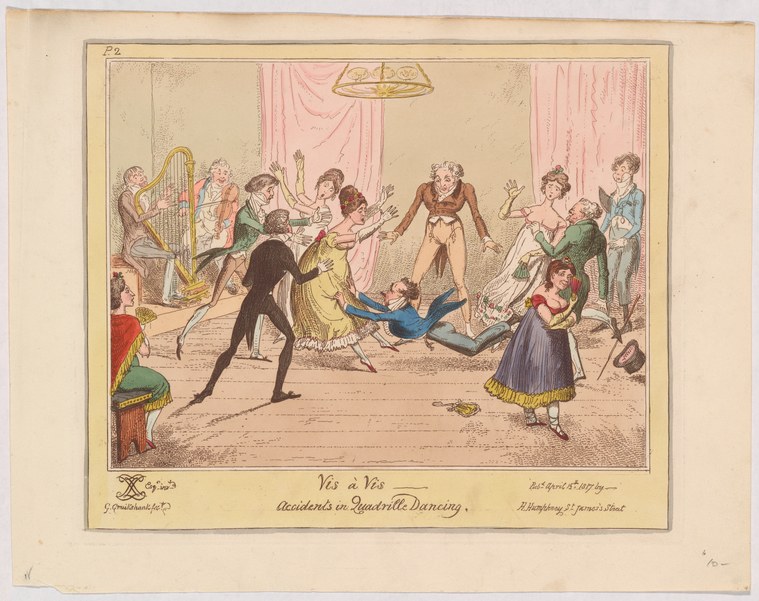
Vis à vis - accidents in quadrille dancing
Unknown artist
- Collection:
- Prints depicting dance
- Source:
- New York Public Library
- Rights:
- Public domain — free to use, share and adapt.
- Recorded as:
- Public Domain
The print offers a rare, detailed view of quadrille dress, posture, and social context from the perspective of someone who observed these dances and understood their conventions well enough to parody them. It captures the dance in actual ballroom conditions—with musicians, onlookers, and the pressure of social judgment—rather than as an abstract choreographic diagram, showing us how the quadrille lived in practice.
What you are looking at
A crowded interior ballroom scene, rendered in hand-colored engraving, shows an accident unfolding during a quadrille. The setting is a grand salon with tall pink curtains, a chandelier, and architectural details suggesting an aristocratic or upper-middle-class home. At least twenty figures occupy the space: some dancing in formation, others watching, and several reacting to a central mishap. A woman in a yellow dress has fallen or is falling backward, her leg raised, while a man in dark coat bends toward her in alarm. Other dancers nearby—in pale silks and jewel tones—have frozen or turned to observe the disruption. Musicians sit at left with a harp. The composition captures the moment of social chaos: the orderly geometry of the quadrille shattered, decorum breached, the watching crowd divided between continued dancing and concerned attention to the accident.
The dancing
The dancers hold the closed and open positions typical of quadrille formation—couples facing and angled toward each other, arms extended in holds or gestures of balance. The fallen woman's raised leg and backward lean suggest a loss of footing or a partner's misstep; the man attending her extends an arm in an instinctive catch or support. Other figures freeze mid-step or mid-turn, their bodies arrested in the suspended attitudes of social dance interrupted. The contrast between the relaxed, attentive postures of onlookers and the strained geometry of those still dancing marks the exact moment the order breaks.
The dance depicted
This is a quadrille, the fashionable figure dance of the mid-nineteenth century, shown in a moment of comedic rupture. The quadrille was a strictly choreographed dance for four couples in a square formation, performed in ballrooms across Europe and America to orchestral music. The print's title announces the subject as 'accidents in quadrille dancing'—a genre of humorous social commentary that found the tension between the dance's rigid steps and the unpredictability of human bodies, balance, and flirtation irresistible. The accident depicted here—a woman's fall or stumble—was the very sort of small catastrophe that threatened the dancer's self-possession and the ballroom's social order, making it a natural subject for satire.
How it was made
This is a hand-colored engraving or etching, established from the black line-work visible beneath the watercolor washes and the small printed text along the lower margin. The technique allowed for mass circulation of such satirical prints; multiple impressions could be hand-colored by workshop assistants, making the image affordable to middle-class households and print collectors. The coloring—bright pinks, yellows, and flesh tones applied with loose, summary brushwork—was economical and rapid, prioritizing legibility and charm over refinement. This is vernacular print culture, designed to amuse parlor collections and dance enthusiasts alike.
About this work
This is a hand-colored satirical engraving of a quadrille accident, likely from the 1830s–1850s, when such comedic prints about ballroom mishaps were popular across Europe. The work belongs to a substantial print tradition that found humor in the collision between the quadrille's strict geometry and the fallible human bodies attempting to execute it. Aristocratic and bourgeois audiences alike enjoyed seeing the pretensions of polite dancing undermined by a misstep, a turned ankle, or a momentary loss of composure. The print documents not only the quadrille itself—its formation, dress, and setting—but also the anxieties and pleasures that attended it: the importance of grace, the horror of a public stumble, and the pleasure of watching elegance disrupted.
How to look at it
Watch the arrested moment: the instant when the woman's foot leaves the floor and the orderly line of dancers fractures. The artist has chosen a split second of maximum chaos and maximum visibility—the accident is central, the ballroom still legible, and enough dancers remain upright that the context is clear. Notice the diagonal lines of energy: the woman's fall opposes the orderly rows and geometric holds of the dance itself, and the eyes of the watching crowd create secondary lines of attention that pull the viewer's gaze through the room. The hand-coloring emphasizes the woman's bright yellow dress and the dark coat of the man attending her, making them the visual anchor in a busy scene.
The period
The quadrille emerged in Paris in the 1770s and dominated fashionable ballrooms throughout the nineteenth century. By the 1830s–1850s, it had become so ubiquitous and codified that it was ripe for satire; prints mocking quadrille accidents, romance, and mishaps circulated widely as popular entertainment. This print sits at the intersection of dance instruction (the quadrille required teaching and discipline) and social satire (the ballroom was a theater of class display and romantic comedy). Contemporary dance manuals were producing the first written codes for quadrille steps; simultaneously, satirists were showing the gap between the ideal and the actual.
Where it lives
The work is held in the Prints depicting dance collection of the New York Public Library. It is catalogued under the title 'Vis à vis - accidents in quadrille dancing' with the notation that it was engraved and colored in the period indicated (likely early-to-mid nineteenth century, though the exact date and publisher remain unconfirmed). Such prints were common commercial products, issued by printsellers and publishers in London, Paris, and other major cities.
Dance in this work
Questions about this work
What is a quadrille?
A quadrille is a four-couple square dance, popular in ballrooms from the 1770s onward. Dancers took positions at the four sides of a square and executed a series of choreographed figures—changes, tours, and promenades—in strict coordination. It required instruction and practice, and became a marker of genteel social standing.
Why would someone make a print about quadrille accidents?
The contrast between the dance's rigid rules and the messy reality of human bodies in motion made for natural comedy. A fall, a lost shoe, or a fumbled step exposed the social pretension that surrounded ballroom dancing, and audiences found this funny. Satirical prints about ballroom mishaps were a whole genre.
How do we know this is a quadrille and not some other dance?
The title plainly states it. The composition also shows the hallmarks: four couples positioned in or near a square formation, the formal dress and ballroom setting, and the orderly spacing typical of quadrille choreography. The moment of disruption reads as the rupture of a rigid pattern.
More dance artwork





