49 works in this view — arrow keys or swipe to move between them.
Dance in Art
Bal Mabile
Unknown artist
- Collection:
- Prints depicting dance
- Source:
- New York Public Library
- Rights:
- Public domain — free to use, share and adapt.
- Recorded as:
- Public Domain
Bal Mabile represents a pivotal moment when ballroom dancing moved from private aristocratic and bourgeois interiors to public, commercially operated, mixed-gender venues accessible to ordinary urban dwellers. The Jardin Mabille and its depictions in popular prints like this one shaped how nineteenth-century society imagined itself dancing and how dance itself became a commodity and a form of public spectacle. For dance historians and social historians alike, the image documents the relationship between urban leisure, fashion, gender mixing, and the technologies of illumination and public space that defined modern urban life.
What you are looking at
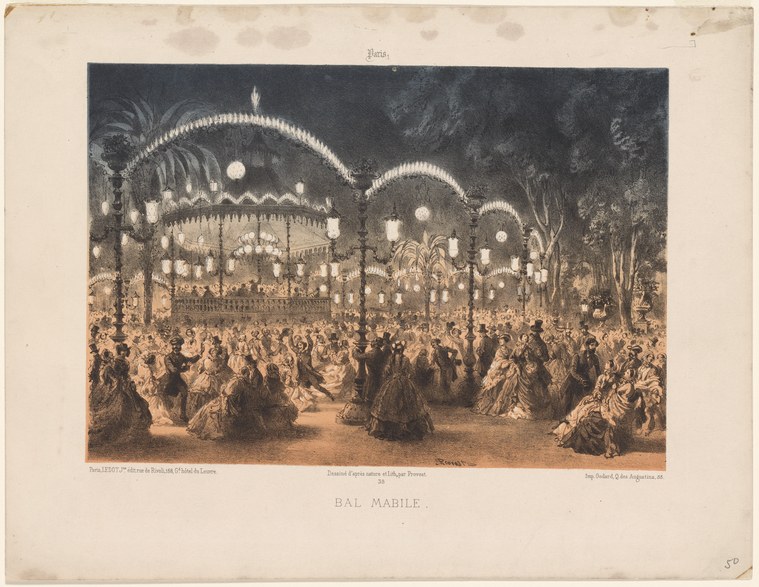
A grand outdoor ball at night, illuminated by hanging lanterns that create an ethereal glow across a vast crowd. The scene is set in what appears to be a public garden or promenade, with tall trees flanking the space and architectural structures—possibly pavilions or galleries—visible in the background with ornamental detailing. Hundreds of figures in formal dress fill the composition: men in dark coats and women in full-skirted gowns with fitted bodices, the silhouettes characteristic of mid-nineteenth-century fashion. The crowd is in motion and interaction—some couples dancing, others promenading, standing in conversation, or seated on benches. The lighting is soft and theatrical, with the lanterns creating pools of brightness that emphasize the festive, almost dreamlike quality of the nocturnal gathering. The perspective draws the eye deep into the space, suggesting a fashionable public entertainment of considerable scale and social importance.
The dancing
The dancers visible across the composition appear to be engaged in couple dances typical of ballroom socializing—men and women facing one another or in proximity suggesting a closed or semi-closed position. The women's enormous skirts dominate the silhouettes, with the dancers' upper bodies upright and formal. Some figures stand with weight settled, others are mid-stride or mid-turn. The overall posture is restrained and vertical, characteristic of ballroom decorum; there is no suggestion of vigorous footwork or acrobatic movement. The crowd includes both active dancers and numerous stationary onlookers, indicating a mixed social venue where dancing was one activity among promenading and socializing.
The dance depicted
This depicts a Bal Mabile, the famous public ball held at the Jardin Mabille (later called Jardin d'Été) on the Champs-Élysées in Paris. The venue operated from the 1840s onward and became iconic for mixed-gender, outdoor, evening social dancing open to the paying public—a democratization of ballroom culture. The dances performed would have been the popular couple dances of the era: waltzes, quadrilles, polkas, and galops. The image captures the social function rather than technical detail; what matters is the spectacle of public, illuminated, mixed-gender dancing in a garden setting, a novelty of nineteenth-century urban leisure. The title and the scene confirm this is social ballroom dancing in a specific, famous Parisian venue.
How it was made
This is a hand-colored engraving or lithograph, likely produced commercially for popular circulation in the 1840s–1860s. The technique allows fine detail in the architecture and clothing, and the addition of color—warm amber from the lanterns, flesh tones, and the blues and whites of gowns—enhances the nocturnal theater. The medium suggests this was a widely distributed print, part of a market for images of fashionable Parisian leisure and urban modernity. Such prints functioned as souvenirs and status markers, circulating among bourgeois audiences interested in witnessing (if only pictorially) this celebrated public venue.
About this work
Bal Mabile is a commercial print documenting one of nineteenth-century Paris's most famous public entertainment venues—a garden ballroom where the middle and working classes could pay to dance outdoors at night under electric lanterns. The image is more sociological than technical: it records a moment in the history of public leisure, the opening of ballroom dancing to a broader urban public, and the spectacle of modernity. The composition emphasizes scale and illumination rather than individual dancers' form, celebrating the crowd and the setting as much as the dance itself. For dance history, it is valuable as evidence of how social dancing was practiced and publicized in the mid-nineteenth century, and of the social meanings attached to the waltz, quadrille, and polka as markers of bourgeois respectability and urban modernity.
How to look at it
Attend to the composition's depth and scale: the artist has used perspective and lighting to convey the vastness of the crowd and the architectural grandeur of the garden, not to isolate or analyze individual dancers. Look at the silhouettes: the women's enormous skirts and the men's formal coats tell you about fashion, gender, and class. Notice the lanterns, which are the work's visual anchor and symbol of the venue's modernity and theatrical appeal. The moment chosen is not a single dance step but a sustained social spectacle—this is how the Bal Mabile wanted to be seen and how the public consumed it: as a crowd, an event, a place to go, not as a site of technical dance display.
The artist
The artist is not recorded. The print's style, composition, and technique are consistent with commercial lithographic or engraved production by Parisian print houses of the 1840s–1860s, a period of high demand for views of fashionable Parisian life. Such prints were often anonymous or bore only a publisher's mark, circulating as consumer goods rather than authored artworks. The sophistication of the composition and the hand-coloring suggest professional commercial production aimed at a bourgeois market.
The period
The Bal Mabile operated from 1840 onward and was at the height of its fame in the 1850s and 1860s, a period of rapid urban development and the expansion of commercial leisure in Paris under the Second Empire. The waltz, quadrille, and polka had become the dominant social dances of the European bourgeoisie, shedding their earlier associations with scandal or lower-class roughness. The Bal Mabile's innovation was to democratize access to these dances by opening them to paying publics in a garden setting, using new gas and electrical lighting to create a theatrical nocturnal environment. Dance itself was becoming modernized, publicized, and commercialized; the ballroom was shifting from a private domestic or aristocratic space to an urban, public, gendered, and ticketed spectacle. Prints like this one were part of how the bourgeoisie consumed and celebrated this new urban modernity.
Where it lives
The print is held in the New York Public Library's collection of prints depicting dance. The cataloguing record does not specify the publisher, printer, date, or artist; such information is common to be lost or unknown for nineteenth-century commercial prints, which often circulated without clear attribution.
Dance in this work
Questions about this work
What was the Bal Mabile?
The Bal Mabile, or Jardin Mabille, was a public garden and ballroom on the Champs-Élysées in Paris, famous from the 1840s onward for evening social dancing open to paying customers. It pioneered the idea of commercial, mixed-gender, public ballroom dancing under electric light—a new form of urban leisure. The venue became legendary and was the subject of popular prints, literature, and song.
What dances were performed at the Bal Mabile?
The popular couple dances of the mid-nineteenth century: the waltz, quadrille, polka, and galop. These were the standard social dances of the European bourgeoisie. The Bal Mabile's orchestra would have performed these in rapid succession, allowing dancers to move from one form to another across an evening.
Who went to the Bal Mabile?
The Bal Mabile was explicitly marketed to the urban middle and working classes—people who could afford a ticket but were not members of aristocratic society. This was revolutionary: it opened ballroom dancing to a broader public and was both celebrated as democratic and condemned as disreputable by conservative critics. The mixed-gender, outdoor, evening setting gave it an edge of transgression and modernity.
How was this image made?
This is a hand-colored engraving or lithograph, a commercial print process that allowed for mass production and wide circulation. The hand-coloring was done by specialists, often by workers in the publisher's workshop. Such prints were sold in Paris and abroad as souvenirs and pictures of fashionable life, serving a popular market for images of urban modernity.
More dance artwork





