49 works in this view — arrow keys or swipe to move between them.
Dance in Art
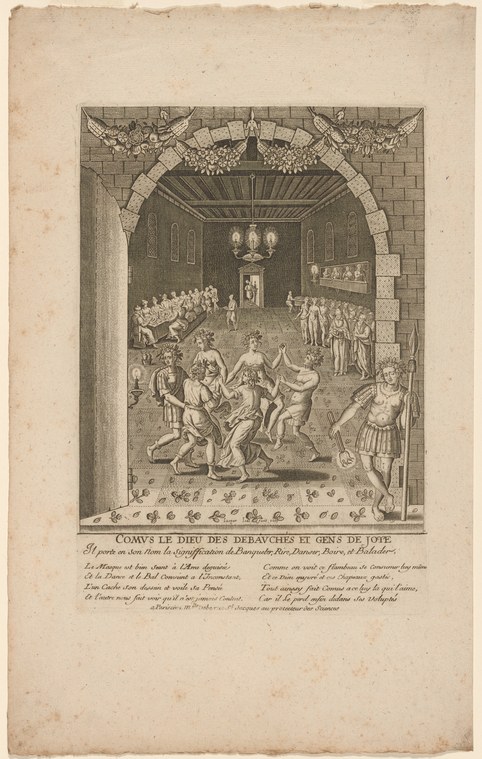
Comus le dieu des debauches et gens de joye: Il porte en son nom la signiffication de banqueter, rire, danser, boire, et balader
Unknown artist
- Collection:
- Prints depicting dance
- Source:
- New York Public Library
- Rights:
- Public domain — free to use, share and adapt.
- Recorded as:
- Public Domain
This print is essential evidence for understanding how Renaissance and early modern artists visualized the social meaning of dance: not as a technique or art form in its own right, but as a manifestation of broader moral and social states. It shows that 'dancing' could be a metaphor for disorder, excess, and the release of social constraint—a perception that shaped how dance was depicted in art and how it was understood by educated observers. The loose, ungoverned movement of the figures contrasts sharply with the formalized court dances of the same period, revealing the period's complex ambivalence about dance as both social accomplishment and moral danger.
What you are looking at
A crowded interior hall or gallery with vaulted ceiling and stone archway dominates the composition. Figures in early modern dress—long gowns and doublets—fill the space in an atmosphere of festive revelry. In the foreground, multiple dancers move in various attitudes: some with arms raised, others in conversation or embrace, creating a sense of animated social disorder. The scene is lit from above through what appears to be a coffered ceiling with hanging lamps. Along the back wall, spectators stand watching from a raised platform, while the foreground is scattered with scattered objects on the floor—possibly discarded items suggesting the raucous nature of the gathering. The overall composition conveys a moment of uninhibited merrymaking: the god Comus presiding over revelry, drinking, dancing, and unbridled pleasure.
The dancing
Dancers are distributed loosely across the floor rather than arranged in couples or formal sets. Bodies are in varied positions—some upright with raised arms, others leaning into companions, some figures in bent or twisted postures suggesting vigorous movement or inebriation. The dress suggests Renaissance or early modern period: women in long gowns with full skirts, men in hose and doublets. No consistent hold is visible; the choreography appears improvisational and unstructured, with individuals responding to music and impulse rather than executing a codified pattern. The distribution suggests multiple simultaneous actions rather than a unified dance formation.
The dance depicted
This is a personification print rather than a documentation of an actual dance practice. Comus was the classical Roman god of festivity, and the French title ('Comus the god of debauchery and joyful people') frames the image as an allegorical tableau representing the social condition of revelry itself—'banqueting, laughing, dancing, drinking, and wandering' as the inscription specifies. The image does not depict a recognizable dance form but rather the anarchic, pleasure-seeking movement and posture associated with carnival license and uninhibited celebration. The loose, asymmetrical arrangement suggests the kind of social dance—possibly country dances or bransles—that might accompany such occasions, but the artist's primary concern is allegorical rather than documentary.
How it was made
This is an engraving or possibly etching (the record does not specify; the technique is established from the image). The fine hatching and controlled line-work characteristic of Renaissance or early modern printmaking suggest engraving. The work was produced for circulation as a print, likely intended for a educated audience familiar with classical references and allegorical imagery. The level of detail—facial expressions, fabric textures, architectural elements—indicates a skilled hand and suggests this was meant for examination and study in a collector's cabinet rather than rapid consumption. The print format allowed wide distribution of what was essentially a moral or philosophical commentary on human nature dressed in classical costume.
About this work
This is an allegorical engraving personifying Comus, the god of festive pleasure, as a crowded, animated scene of social dancing and merrymaking in an early modern interior. The work is not a record of an actual dance but a visual representation of a concept—the state of uninhibited revelry—expressed through the posture and arrangement of figures in a moment of collective pleasure. The print belongs in a gallery about dance because it uses dancing bodies and the social occasion of dance to explore a philosophical or moral category; it shows us not how people danced at a particular moment but how artists of the period visualized the idea of 'dancing' itself as a sign of chaos, pleasure, and the abandonment of restraint. The composition and subject matter reflect early modern interests in classical allegory and in the relationship between dance, music, and social order.
How to look at it
The viewer should notice the contrast between the formal architecture of the hall—the ruled, geometric archway and ceiling—and the chaotic, disordered bodies moving within it. The artist has captured not a moment of synchronized movement but a simultaneity of different actions and postures: some figures dance, others embrace, others stand watching or appear to stumble. Look at the scatter of objects on the floor and the variety of arm positions and body angles; these convey the anarchic nature of the scene. The raised platform of spectators at the back suggests the distance between observer and participant, between restraint and abandon. The print invites us to read 'dancing' not as a codified sequence but as a visible sign of disorder and pleasure.
The period
This print dates from the Renaissance or early modern period (likely 16th–17th century, though the record provides no firm date). It reflects the period's deep investment in classical allegory and the personification of abstract concepts through mythological figures. In the same era, court dances were becoming increasingly formalized and codified—the branle, pavane, and galliard were subjects of detailed instruction—yet popular and carnival dances remained improvised and anarchic. The print captures this tension: Comus as a classical reference point but surrounded by the rough, unschooled movement of common festivity. The image also engages with the period's moral anxiety about dance: Protestant reformers condemned dancing as sinful excess, while courtly elites refined it into an art of governance and display. This print sits somewhere between those poles, using classical mythology to explore the dangerous attractions of uninhibited pleasure.
Where it lives
The print is held in the New York Public Library's collection of prints depicting dance. It is a work created for circulation in printed form, indicating it was made for distribution to a educated, literate audience familiar with classical references and allegorical conventions.
Dance in this work
Questions about this work
What is Comus?
Comus is a figure from classical Roman mythology and later Renaissance literature, representing festivity, pleasure, wine, and revelry. In early modern art, Comus became a popular allegorical character used to explore themes of excess and uninhibited pleasure. John Milton's masque 'Comus' (1634) is perhaps the most famous literary treatment.
Is this depicting an actual dance that people performed?
No. This is an allegorical image using dance and the social occasion of dancing to represent the abstract concept of revelry and pleasure. While the figures are certainly moving to music and displaying the kinds of social dances that would have been recognizable in the early modern period, the artist's purpose is not documentary but conceptual.
Why are the dancers so disorderly compared to court dances of the same period?
The contrast is intentional. Court dances like the pavane and galliard were formalized, rule-governed, and performed by trained dancers. Comus presides over the opposite: the wild, improvised, carnivalesque dancing of common people and carnival occasions. The image reflects the period's moral and social distinction between 'refined' and 'vulgar' dance.
More dance artwork





