49 works in this view — arrow keys or swipe to move between them.
Dance in Art
Pastoral dance scenes of the eighteenth century
Unknown artist
- Collection:
- Prints depicting dance
- Source:
- New York Public Library
- Rights:
- Public domain — free to use, share and adapt.
- Recorded as:
- Public Domain
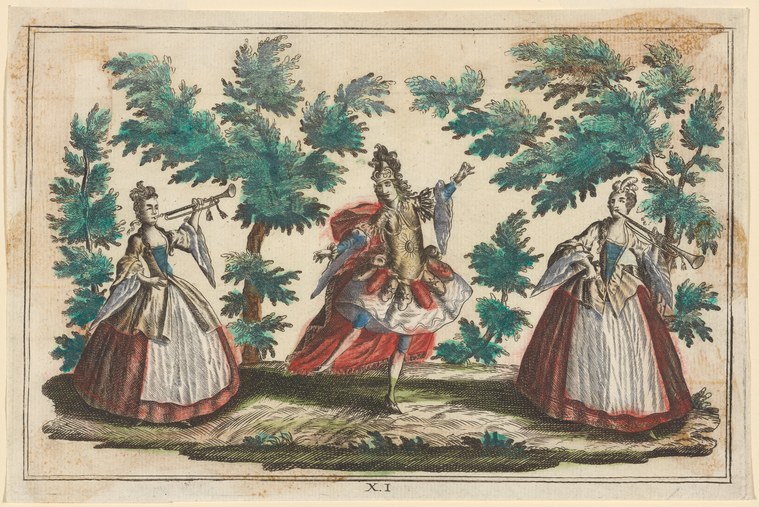
This image preserves visual evidence of how early eighteenth-century European nobility moved, held their bodies, and understood grace—knowledge otherwise available only through written dance notation and literary description. For a historian or performer working to reconstruct Baroque social dance, the print records arm carriage, posture, and the sculptural relationship between the dancer's body and her costume, which shaped movement as much as training did. As an artifact of print culture, it also reveals how dance was commodified, circulated, and learned in an era before photography.
What you are looking at
Three elegantly dressed women occupy a pastoral landscape dotted with stylized trees rendered in green and brown washes. The woman at left holds a long telescope or spyglass to her eye, her gaze directed upward; she wears a full skirt in white linen with a deep red or burgundy outer skirt or overskirt, and holds her free arm in an extended, graceful pose. The central figure—the focal point—is caught in an active dancing posture: she wears a brilliant red coat or jacket over white undergarments, her body twisted in an exuberant contrapposto, one arm raised high and the other gesturing outward, her head tilted back in evident pleasure or abandon. Her pose suggests rapid turning or spinning. The woman at right mirrors the pose and dress of the left figure: white underskirt, burgundy overskirt, and an extended arm gesture, though she faces forward and stands more stationary. The ground is suggested by brown wash and minimal linear detail; the trees form a loose arcade above, framing the figures without confining them. The entire composition is hand-colored engraving or etching, with delicate line work and selective color application that emphasizes the dancers' costumes and the separation of the figures from a neutral ground.
The dancing
The three dancers employ a vocabulary of arm extension and rotational weight shift characteristic of early eighteenth-century European social dance. The central figure's twist, with one arm elevated and the torso rotating away from the legs, suggests a turning movement under control—a hallmark of the period's courtly style. The flanking figures' extended arms and upright carriage, with one hand placed at or near the hip and the other extended in space, follow the same vocabulary of graceful elongation and open positions. Their feet are not clearly rendered, but the upright spine and lifted chest of all three suggest the pulled-up posture required of period social dance. The spacing—three separate female figures rather than coupled pairs—and the isolated stance of each suggest these are individual character studies or a dance performed without male partners, or moments extracted from a narrative scene.
The dance depicted
This appears to be a study of early eighteenth-century French or Italian pastoral dance, most likely a theatrical or courtly social dance from the 1730s–1750s. The subject matter—rural setting, female dancers, theatrical costume with exaggerated skirts and red silk—and the engraving's didactic arrangement suggest it may document or illustrate fashionable dances of the moment, possibly from a dance manual or print series meant to instruct or entertain. The central figure's apparent spinning motion and the others' posed stasis could represent successive moments in a single dance, or three variations on a theme. The refined posture, arm carriage, and open body alignment indicate a trained European court or theater tradition, not folk or vernacular practice. Without inscription or clear attribution, the specific dance form—minuet, gavotte, or other Baroque courtly dance—cannot be definitively named, but the vocabulary and setting point firmly to the European nobility's leisure culture.
How it was made
This is a hand-colored engraving or etching, identifiable by the fine parallel lines and crosshatching visible in the background and the delicate outline work defining the figures. The color has been applied selectively and somewhat loosely after printing, a common practice for circulating instructional or entertainment prints of the period. The soft edges where pigment meets paper and the unevenness of the wash over the trees suggest watercolor or gouache laid by hand. The technique allowed rapid reproduction and relatively inexpensive distribution—thousands of copies could be printed from one plate and colored by hand in ateliers—making this a medium well suited to the fashion for dance prints and instructional imagery in early eighteenth-century Europe. The finesse of the line work and the care taken in color application suggest a print intended for a literate, educated audience, likely amateur dancers themselves or people of fashion.
About this work
This is a hand-colored engraving documenting or illustrating European court dance of the early eighteenth century, likely French or Italian in origin. It presents three women in a pastoral setting, engaged in or posing moments from a dance characterized by extended arm gestures, upright carriage, and the swirling skirts of period court dress. The print's purpose was almost certainly pedagogical or fashionable—to instruct dancers, to amuse the court, or to circulate knowledge of dances in vogue among the European nobility. The composition isolates each figure while binding them thematically, suggesting the print may be one plate in a series illustrating variants or figures of a single dance or style. Its survival in the New York Public Library's dance print collection confirms its recognition, then and now, as a document of dance practice.
How to look at it
Observe the central figure's spine and the rotation of her torso relative to her legs—this twist, with the raised arm, captures a moment of rotational momentum or balance that would have required trained coordination. Notice how the flanking figures' stillness and formal arm extension contrast with the central dancer's apparent motion; the print may be showing the same dance performed at different tempi, or extracting a moment of climax. The exaggerated width and volume of the skirts are not merely costume detail: they move as part of the dancer's body, swinging and settling with rotational and lateral motion, and the artist has rendered them with enough specificity to suggest how they draped and responded to movement. The upright carriage of all three—the lift of the chest, the extension of the limbs—is not natural but trained; it is the silhouette of courtly education, and the print preserves it as a ideal worth studying.
The period
The early eighteenth century saw an explosion in European court dance prints and instructional imagery, driven by rising literacy, the fashion for social dancing among the nobility, and improvements in printing technology that made hand-colored engravings affordable for a broad audience. Dances such as the minuet, gavotte, and courante dominated court life in France, Italy, and England, and prints documenting or illustrating them were part of the apparatus of fashion and taste. The pastoral setting—rustic trees, open ground, idealized figures—reflects a broader European aesthetic celebrating shepherds, shepherdesses, and rural simplicity as fashionable retreat from courtly rigidity, even as the dancers' refined posture and expensive silks signal their belonging to the elite. By mid-century, such prints had become collectible curiosities and instructional tools, and their circulation helped standardize dance vocabulary across European courts.
Where it lives
The print is held in the New York Public Library's collection of prints depicting dance, catalogued as a document of eighteenth-century dance practice. The sparse bibliographic record reflects the historical anonymity of many such prints—products of commercial workshops rather than named artists, and often bound into collections or sold as individual sheets, making their original publication details hard to recover.
Dance in this work
Questions about this work
How do I know this is from the eighteenth century and not earlier or later?
The style of the engraving—the fine parallel lines and the hand-coloring technique—is consistent with prints from the 1730s–1760s. The costume, particularly the full-width skirt and the cut of the jacket, is typical of that period. The aesthetic vocabulary—pastoral setting, refined poses, theatrical costume—and the print's apparent purpose as instructional or fashionable imagery also point to the early eighteenth century, when such prints were widely circulated in Europe.
What dance is this showing?
Without an inscription or title, the specific dance cannot be named with certainty. The vocabulary—open positions, extended arms, upright carriage, and what appears to be rotational movement—is consistent with the Baroque court dances popular in the early eighteenth century, such as the minuet, gavotte, or courante. The pastoral costume and setting suggest it may be a theatrical or fashionable variant of one of these dances, or a character dance within a larger work.
Why are there three women and no men?
Female dancers were sometimes depicted alone in prints meant to illustrate fashion, courtesy, or dance steps aimed at female learners. Alternatively, the print may extract a moment from a larger theatrical or courtly scene, or show three variations or positions within a single dance rather than a simultaneous ensemble. Without further context, it is unclear whether the three are meant to represent a single dance moment or successive stages.
What does the telescope mean?
The telescope or spyglass held by the left figure is likely a fashionable prop or attribute rather than a functional element of the dance. It may signal the pastoral or theatrical character of the scene, or reference a specific narrative or character type (such as a shepherdess or a character from commedia dell'arte). Its presence is another indicator that this is a theatrical or courtly entertainment rather than a documentary record of everyday social dance.
More dance artwork





