49 works in this view — arrow keys or swipe to move between them.
Dance in Art
Catharine-Walzer: für das Piano-Forte
Unknown artist
- Collection:
- Prints depicting dance
- Source:
- New York Public Library
- Rights:
- Public domain — free to use, share and adapt.
- Recorded as:
- Public Domain
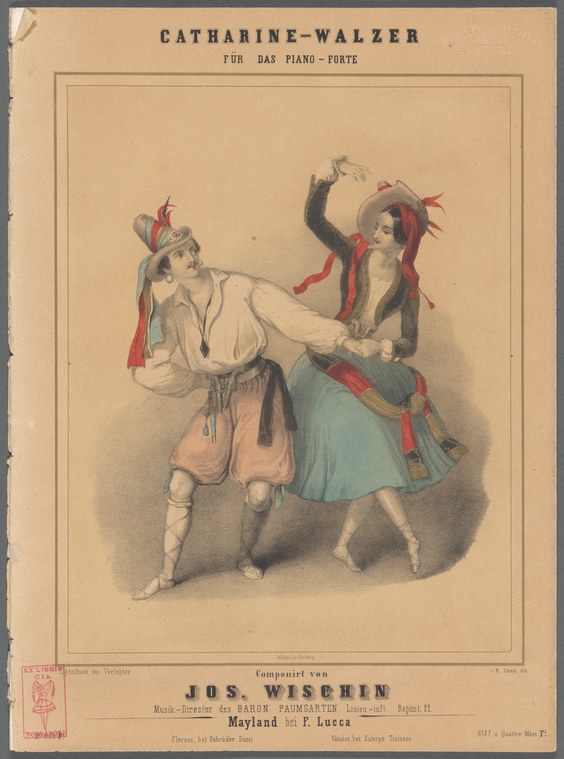
This work demonstrates how ballroom dance was disseminated and visualized in the 19th-century domestic and commercial sphere—not through performance alone but through affordable, reproducible imagery attached to published music. For historians and dancers, it provides a reliable visual record of how the Waltz was actually held, positioned, and performed, showing the specific aesthetic of speed, rotation, and exuberance that defined the form at its cultural peak.
What you are looking at
This is a hand-colored lithograph depicting a couple in a lively waltz, likely from sheet music cover art or a dance instruction publication. The composition shows two figures in an outdoor or neutral setting against a warm beige background. The man, on the left, wears a richly colored costume in earth tones with what appears to be a Romantic-era or folk-inspired jacket, light breeches, and decorative elements at the neck. The woman, on the right, is dressed in a pale blue-green skirt with red ribbon trim and a fitted upper garment; her dark hair is adorned with red ribbon as well. Both figures are captured mid-turn in an energetic moment, their bodies angled dynamically. The woman's skirt is caught mid-swirl, extending outward in a way that conveys rapid rotational movement. The man's arm is raised expressively, and their relative positioning suggests the close partnering and forward-moving momentum characteristic of Romantic-era ballroom dance.
The dancing
The two dancers are in a close waltz hold, though the artist has captured them at a moment of pronounced rotation and lift. The man leads with his right arm elevated and extended, while the woman is depicted leaning back slightly into the turn, her torso engaged and her left arm raised. Their proximity is intimate but proper, consistent with 19th-century ballroom protocol. The artist has rendered their bodies with clear understanding of how waltzing couples move through space: the woman's skirt billows from centrifugal force, and both figures show the controlled weight shift necessary for the triple-time pattern. The poses suggest energetic, showy dancing rather than demure restraint.
The dance depicted
This is almost certainly a Viennese Waltz or Waltz in the 19th-century European tradition. The title—'Catharine-Walzer'—directly names the form. The costume, the close hold, the evident rotational movement, and the date of publication (suggested by the lithographic style and dress) all point to the Waltz's peak popularity in the Romantic era, roughly 1830s–1880s. The Catherine or Katharina Waltz may have been a named variation or a waltz associated with a particular dancer or occasion; such named dances were common merchandise in the 19th-century music market. The image captures the Waltz in its most recognizable pose: rapid, joyful turning with full-bodied commitment.
How it was made
This is a hand-colored lithograph, identifiable by the characteristic soft grain, the layered color application, and the printing evidence visible in the composition. The credits at the bottom—'Componiert von Jos. Wiesner' and printing information—are typical of 19th-century sheet music covers and dance instruction publications. Lithography was the dominant technology for affordable color reproduction in the 1830s–1880s; it allowed for rapid, economical circulation of music and dance imagery to a broad domestic market. The hand coloring (visible in the subtle gradations and the slight imprecision of the color registration) suggests a work designed for middle-class consumption, neither luxury art nor mass-market newsprint but the practical, decorative middle ground of household music.
About this work
This is the illustrated cover or accompanying art for a published waltz composition, likely mid-19th-century, created to market a named dance work to amateur musicians and dancers in the European ballroom market. The waltz was by far the most popular couple dance of the Romantic era, and sheet music with printed choreographic or theatrical imagery was a standard commercial product. The lithograph serves two functions simultaneously: it advertises the music and demonstrates the dance, showing prospective buyers what 'the Catharine Waltz' looked like in motion. As a historical document, it captures both the physical vocabulary of Romantic-era ballroom dance and the visual culture through which dance was commodified and taught to the rising middle class.
How to look at it
Observe the moment the artist chose to freeze: the couple mid-turn, with the woman's skirt in full swirl and the man's arm raised in the upbeat, rising moment of the waltz's three-beat cycle. This is not the static pose of a formal portrait but a snapshot of kinetic energy. Notice the lithographer's use of line and soft color to suggest speed and rotation; the curved contours of the skirt and the off-vertical axis of the bodies convey momentum. The hand-coloring technique, with its slight color bleeding and warmth, creates intimacy and movement in a way a pure line engraving could not. This is a work designed to be studied by dancers learning the form and by musicians visualizing the mood of the composition.
The artist
The composition is credited to 'Jos. Wiesner' (Josef or Joseph Wiesner), a composer active in the mid-19th century. Wiesner was among many prolific composers of dance music for the European ballroom and drawing room market; such music was often ephemeral, published in large quantities and rapidly superseded. The lithographic printing credits suggest a professional publishing operation, likely in an Austrian or German city (Vienna, Prague, or Leipzig). Wiesner's name, appearing on the composition credit alongside the printer's marks, indicates a composer of modest but commercial significance—successful enough to warrant colored lithographic covers but not canonized as a major symphonic or operatic figure.
The period
The Waltz reached its cultural zenith in the mid-19th century, particularly in Vienna and the German-speaking territories. It had evolved from a folk and peasant dance of the late 18th century into the dominant form of fashionable ballroom dancing by the 1820s–1840s, despite initial moral objections to its close hold and rapid rotations. By the mid-century, when this image was likely produced, the Waltz was completely respectable and ubiquitous: published waltz compositions numbered in the thousands, and the dance appeared in every ballroom from imperial courts to provincial towns. Artistically, the Romantic era was intensely invested in both preserving and commercializing folk and regional dances; the lithographic medium was at its peak as a technology for color reproduction, making illustrated sheet music a major vector for visual culture.
Where it lives
This work is held in the New York Public Library's collection of prints depicting dance. It is catalogued as a sheet music cover or dance instruction illustration, a common category within 19th-century printed ephemera. The source designation and medium confirm its function as a commercial music publication.
Dance in this work
Questions about this work
What is a Catherine Waltz?
Named waltzes were common in 19th-century dance music; the specific title often referred to a particular composer's variation, a named dancer, or a regional tradition. Without further documentation, 'Catharine Waltz' likely indicated a published piece by Wiesner that was either regionally popular or marketed under that title for commercial appeal. Many such waltzes are now lost to history or exist only in sheet music collections like this one.
Why are they dressed in folk or historical costume?
This may be authentic folk or regional dress (suggesting a regional waltz variation) or theatrical styling intended to evoke peasant origins and charm. The Romantic era was fascinated by folk traditions, and dance music often borrowed from or was marketed as deriving from regional styles. The costume choices would have signaled authenticity and cultural specificity to contemporary buyers.
How do I know this is actually depicting a waltz correctly?
The close hold, the body angle and weight shift, and the evident rotational movement all match contemporary descriptions and images of Waltz dancing. The raised arm and lifted torso of the man, the woman's back angle and participation in the turn, and the billowing skirt all show understanding of the mechanical and aesthetic reality of the dance. A historically informed viewer or dancer would recognize this as competent choreographic illustration.
What was lithography used for in 19th-century dance culture?
Lithography was the dominant technology for producing affordable, colorful printed images for a mass or middle-class market. Dance music, theatrical programs, and instruction manuals were all illustrated with lithographs because the medium was fast, reproducible, and could incorporate hand-coloring for appeal. Sheet music covers in particular were often beautifully illustrated as a marketing tool and an aid to performers and learners.
More dance artwork





