49 works in this view — arrow keys or swipe to move between them.
Dance in Art
Le Basque
Unknown artist
- Collection:
- Prints depicting dance
- Source:
- New York Public Library
- Rights:
- Public domain — free to use, share and adapt.
- Recorded as:
- Public Domain
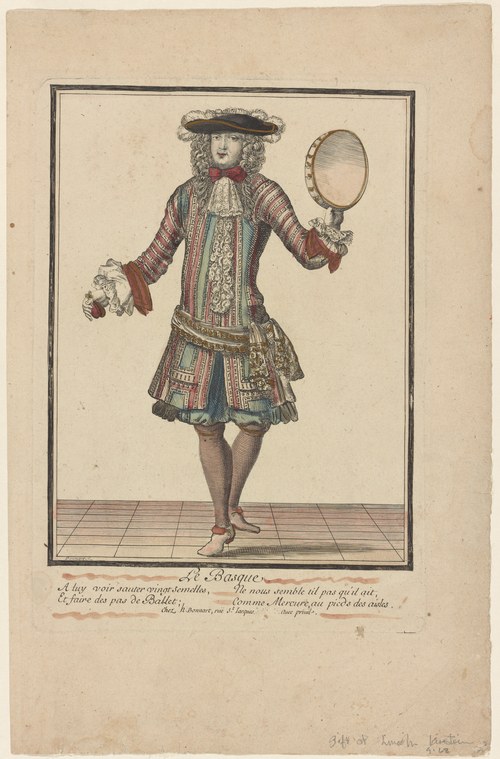
This print preserves a specific type of danced character that was popular in early modern French entertainment but is now little known outside specialist literature. The pose, costume, and prop (the mirror) encode a complete satirical idea about vanity and self-regard that was meant to be read and performed, making this image a rare window into how early 18th-century choreography used gesture, dress, and character to communicate meaning. For historians of dance and theater, such prints are among the primary documents we have for understanding what was actually danced and how it looked.
What you are looking at
A single figure stands on a tiled floor against a plain background, facing forward and slightly angled toward the viewer's right. The dancer wears an elaborate early 18th-century coat in deep burgundy or plum, densely patterned with ornamental embroidery in gold and white in vertical stripes and repeated motifs. The coat is cut away at the front with a short skirt that falls to mid-thigh, revealing legs in pale stockings and shoes with small heels. A matching waistcoat or vest layer is visible beneath. The dancer wears a dark hat with an upturned brim and what appears to be a white plume or feather. Most distinctively, the figure holds a hand mirror in the raised right hand at shoulder height, angled toward the face, while the left hand extends outward with palm open—a pose that suggests both display and the self-regard implied by the mirror. The French caption below reads "Le Basque" and includes verse that speaks to vanity and self-admiration. The print is hand-colored in red, yellow, and brown tones over a line engraving, and the entire scene is framed by a simple black border.
The dancing
The single figure is posed in a three-quarter stance with weight even on both feet, creating a stable, presentational posture rather than one caught mid-movement. The raised right arm holds the mirror at a height that allows the face to be visible to both the figure itself and the viewer—a deliberate compositional choice that makes the act of self-inspection part of the dance's meaning. The left arm extends in an open gesture that is neither a formal dance position nor a relaxed hang; it reads as part of the affectation the pose is meant to convey. The body is straight rather than bent, and the legs are extended rather than articulated—there is no visible step, leap, or dynamic weight shift. The overall carriage suggests a theatrical strut or parade of dress rather than balletic technique.
The dance depicted
This is most likely a representation of a *character dance* or *danse de caractère* from the early 18th-century court or stage, a type of entertainment that was distinct from formal court dances like the minuet. The caption "Le Basque" suggests a character from the Basque region—one of the stock ethnic or regional types that appeared in French theatrical and court dances of the period as comic or exoticized figures. The mirror is a prop that encodes the dance's meaning: the figure is meant to be vain, self-absorbed, and more concerned with appearance and self-display than with refined movement. The verse confirms this reading, addressing themes of vanity and mirrors. This was a genre that allowed considerable freedom from the geometric precision and restrained deportment required in formal court dances, and the painting captures that freedom through exaggeration and theatrical pose. The dance is a *danse comique* or character turn, not a ballroom or processional form.
How it was made
This is a hand-colored engraving—the outlines and details are cut in copper and printed in black, then selectively colored by hand in red, yellow, brown, and touches of gold. The technique allowed for precise linear definition of the clothing ornament and architectural setting, while the hand coloring provides warmth and richness that would have made these prints desirable as souvenirs or teaching materials. The quality of the line work and the regularity of the tiling suggest a professional print shop, likely Paris or another major theatrical center. This type of image—a single figure in full costume against a neutral background—was a standard format for documenting theater costumes, dances, and character types for circulation to a literate public that either attended performances or purchased prints as a form of entertainment documentation.
About this work
This hand-colored engraving documents a character dance or danse de caractère titled *Le Basque*, likely from the French court or stage in the early 18th century. It shows a single figure in ornate coat and hat, posed with a hand mirror, in a theatrical strut that emphasizes display and vanity rather than balletic technique. The work belongs to a significant body of prints that captured the costume, character, and movement conventions of early modern European dance, preserving choreographic types that would otherwise be lost to history.
The image is valuable because it shows us how dance was understood and marketed as spectacle in the age of Louis XIV and Louis XV—not as abstract movement, but as character, costume, and narrative pose. The print format made dance accessible to readers who could not attend court or theater, and these images were collected, studied, and circulated among the educated elite and aspiring dancers themselves.
How to look at it
Notice the stillness of the figure: this is not a moment of movement but a pose held for display. The artist has frozen the figure at the point of maximum self-regard—the mirror is held where both the figure and the viewer can see the face simultaneously. Look at the ornamentation of the coat: the density and precision of the embroidery is part of the character's vanity and a display of the costume maker's skill. The gesture of the left hand—open, extended, not resting—is artificial and performative, not natural. The tiled floor grounds the figure in space and gives the pose weight and presence. All of these elements work together to communicate that this is a character of exaggerated self-absorption, and that exaggeration is the point of the dance.
The period
This print dates to the early 18th century, a period when French court and stage dance was undergoing significant change. The reign of Louis XIV (d. 1715) had established France as the arbiter of taste in dance, and the codification of ballet technique was well advanced; however, outside the formal ballet and court dances (minuet, courante, etc.), there was a robust tradition of character dances, comic turns, and theatrical entertainment that drew on regional stereotypes, pastoral fantasy, and commedia dell'arte. These character dances were performed at court during divertissements, in public theaters, and as interludes in opera. The tradition of documenting dances in prints was well established by this period—it served both as a record of performance and as a form of publicity. Prints of dancers and dances were collected, traded, and used as teaching or reference materials.
Where it lives
This work is held in the New York Public Library's collection of prints depicting dance. It is part of a larger body of early modern dance prints, many of which document costume, character, and choreographic types from the French court and stage.
Dance in this work
Questions about this work
What does 'Le Basque' mean, and why is the figure holding a mirror?
Basque refers to a person from the Basque region (in what is now Spain and France), and in early 18th-century French entertainment, regional or ethnic types were common stock characters, often portrayed as comic or exotic. The mirror is a prop that encodes the character's main trait: vanity and self-admiration. The French verse below the image reinforces this theme, making fun of the figure's self-regard. The dance is a character turn, not a formal court dance.
Is this a ballet?
Not in the sense of classical ballet technique. This is a character dance or danse de caractère—a theatrical entertainment that used exaggerated gesture, costume, and prop to create a comic or exotic type. While such dances might have been performed on the same stage as ballet, they operated under different rules: they allowed for more pronounced acting and character work, and less emphasis on technical precision and symmetry. They were popular in French court and public theater in the early 18th century.
How do we know what pose or gesture this shows?
We don't have a video or written choreography, so we rely on the print itself. The artist chose to freeze the figure in this particular pose, which suggests it was the most characteristic or recognizable moment of the dance—the point where the vanity and self-regard that define the character are most visible. The mirror, the extended gesture, and the theatrical strut all reinforce this reading.
Who made this print, and when?
The artist is not recorded in the catalogue. The style and format suggest a professional Parisian print shop from the early 18th century, but without more information, a precise date and maker cannot be established. The NYPL holds it as part of its collection of dance-related prints from this period.
More dance artwork





