49 works in this view — arrow keys or swipe to move between them.
Dance in Art
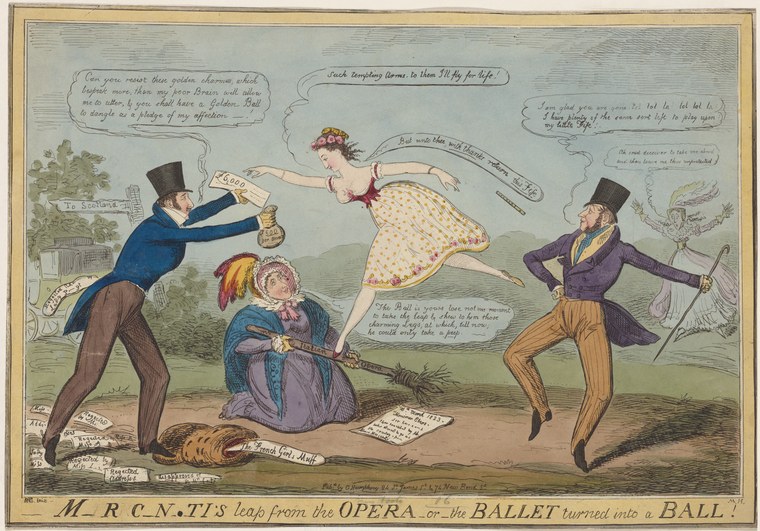
M-rc-n.ti's leap from the opera, or the ballet turned into a ball
Unknown artist
- Collection:
- Prints depicting dance
- Source:
- New York Public Library
- Rights:
- Public domain — free to use, share and adapt.
- Recorded as:
- Public Domain
This print is evidence that dance—particularly the boundary between theatrical and social dance—was a matter of public satire and concern in the early 19th century. It reveals that spectators understood the difference between performed ballet and ballroom propriety well enough to mock their collision, and that a woman's uncontrolled movement in social space was recognized as comic and transgressive.
What you are looking at
A satirical colored engraving depicting a chaotic ballroom scene with three principal figures and at least one additional character. A woman in a yellow patterned dress dominates the center, captured mid-leap or violent motion with arms and legs splayed dramatically. She appears to be literally flying or being propelled upward. To the left, a man in a dark blue coat and top hat reaches toward her with one arm raised, holding what appears to be a whip or stick in the other hand. To the right, a second man in a purple coat and tan breeches also reaches toward the airborne woman with extended arms. Between them, seated on the ground in purple drapery, is an elderly woman or attendant looking at scattered papers or documents. The setting is a landscape background with trees and open ground, not an interior ballroom. Multiple speech bubbles contain text in period script, indicating this is a narrative or satirical print. The composition is theatrical and exaggerated, emphasizing absurdity and physical chaos rather than ordered dance.
The dancing
The woman's body position—legs extended, torso twisted, arms spread—shows violent, uncontrolled movement rather than any recognizable dance hold or frame. The two men adopt hunting or catching postures, their bodies angled toward her as if pursuing rather than partnering. The seated figure provides static contrast and suggests distress or documentation of the chaos. The total absence of closed positions, symmetry, or the upper-body control expected of ballroom dance confirms this is a satirical distortion of dance, not an accurate depiction of technique.
The dance depicted
The print satirizes the transformation of opera-ballet into a ball—likely the social dance that followed a formal theatrical performance. The exaggeration suggests ridicule of fashionable ballroom behavior, with the woman's uncontrolled flight implying either loss of decorum, physical comedy, or the chaos that ensues when theatrical performance spills into social space. This is not a representation of actual dance practice but a caricature intended to mock contemporary manners and the relationship between performance and society dance.
How it was made
This is a hand-colored engraving or etching, as indicated by the linear hatching visible in the background, the precise line work defining figures, and the selective application of watercolor or hand-applied pigment. The medium permitted wide circulation as a satirical print, allowing the commentary to reach a broad public audience beyond the original performance or event being mocked. The technique's relative affordability meant such prints were produced quickly to capitalize on topical scandals or fashionable absurdities.
About this work
This is a narrative satirical print dating from the early 19th century (most likely Regency or Gilded Age era based on costume and engraving style), documenting the social disruption or physical comedy that occurred when the formal ballet of an opera performance transformed into social ballroom dancing. The print belongs in a dance collection not because it depicts skilled dance, but because it captures a moment of social friction between theatrical and ballroom worlds—and because it shows how the public understood and mocked the dance of the period. The exaggerated female figure, the pursuing male gestures, and the chaos of the scene reveal contemporary anxieties about female bodily autonomy, social propriety, and the intoxicating power of performance.
How to look at it
Attend to the suspended, weightless quality of the woman's body—she is not dancing, but flying or being hurled. Notice the men's predatory postures and the hunting language of their gestures, which transform a social encounter into a pursuit. Look at the seated figure's calm documentary posture as she records or witnesses the chaos, suggesting this is a known or recurring phenomenon. The speech bubbles, though difficult to read in reproduction, would have carried the satirical argument that a contemporary viewer could have followed immediately.
The period
In the Regency and early Gilded Age, the social evening often concluded with dancing, and the transition from formal spectacle (opera, ballet) to informal social dance created moments of social instability. Women's mobility in ballroom dance was constrained by tight corsetry and formal holds, making exaggerated movement a visual joke. The print also captures the period's ambivalence about female bodily display and the power of theatrical performance to unsettle ordinary social order. Satirical prints were the dominant form of public commentary on fashion, manners, and celebrity.
Where it lives
The work is held in the New York Public Library's collection of prints depicting dance, indicating it was preserved as documentation of social and theatrical practice despite (or because of) its satirical intent.
Dance in this work
Questions about this work
What actually happened at this event?
The print is satirical commentary on a specific or typical incident, not a straightforward documentary record. Without the text in the speech bubbles being fully legible, we cannot determine whether a particular notorious incident is being mocked or whether the print is a generic commentary on the chaos that could ensue when ballroom dancing followed opera performance. The title suggests a known event.
Why is the woman flying?
The exaggerated upward motion is the artist's satire: either she has leaped or been propelled so vigorously that decorum is destroyed, or the print is mocking women's loss of control in social situations. The violence of the gesture—arms and legs splayed—suggests either comedy (slapstick failure of a dance step) or critique (inappropriate bodily display).
Is this about a real person or event?
The title references 'M-rc-n.ti' and an incident in which an opera or ballet 'turned into a ball.' The letters are abbreviated, possibly to avoid libel, but the print was clearly meant to be read as commentary on a recognizable recent occurrence. The New York Public Library cataloging suggests it documents actual social history, even if exaggerated for effect.
More dance artwork





