49 works in this view — arrow keys or swipe to move between them.
Dance in Art
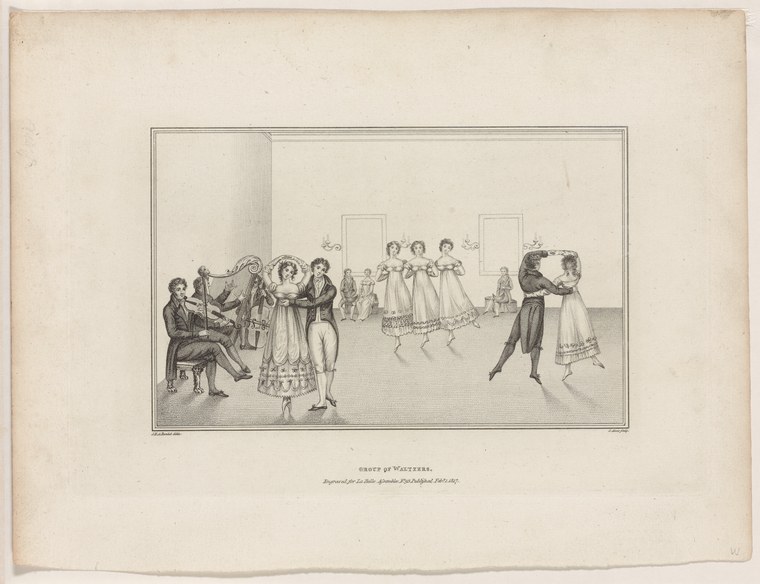
Group of waltzers
Unknown artist
- Collection:
- Prints depicting dance
- Source:
- New York Public Library
- Rights:
- Public domain — free to use, share and adapt.
- Recorded as:
- Public Domain
This is primary source material for understanding how the waltz was danced in English ballrooms during the Regency era—the hold, the frame, the speed of rotation, and the social scale on which it was performed. The work documents a crucial moment in dance history when the waltz shifted from aristocratic novelty to widespread fashionable practice, and shows the aesthetic and social context in which that shift occurred.
What you are looking at
A ballroom or assembly room scene depicting couples and groups engaged in the waltz. The setting is a spacious interior with plain walls and two doorways visible in the background. In the foreground, a musician sits playing a harp or similar stringed instrument. The dancers are arranged across the floor in various groupings: several couples in the middle distance perform the characteristic waltz hold and turning motion, while additional figures populate the background. The women wear high-waisted Empire-line gowns with long skirts and short puffed sleeves, their hair arranged in Regency-era styles with decorative combs or feathers. The men are dressed in tight-fitting breeches, tailcoats, and formal waistcoats. The composition captures a moment of social dance with figures at different points in the rotation, creating a sense of continuous movement around the room.
The dancing
The waltz couples display the characteristic closed ballroom hold with the man's right hand on the woman's back and left hand extended to meet hers, their bodies held at a formal distance and angled to facilitate the turning motion. The dancers' postures are upright and controlled, with visible weight shifts as they execute the three-step rotational figure. The artist has captured dancers mid-turn, with some couples shown profile and others nearly frontal, emphasizing the rotational geometry of the dance. The harpist in the foreground sits slightly apart, visually anchoring the musical accompaniment.
The dance depicted
This is unambiguously a waltz scene, almost certainly Viennese or English Regency-era waltz, danced in the closed position with the turning figure that defines the form. The waltz was the dominant fashionable ballroom dance of the Regency period (roughly 1811–1820) and the decades immediately following. The image shows the dance in its social context—not theatrical performance but the actual ballroom practice of the era. The costume, setting, musical accompaniment, and dance hold all point to this specific historical moment when the waltz was transitioning from controversial novelty to established social convention in English and Continental ballrooms.
How it was made
This is an engraving, executed with fine parallel hatching and cross-hatching to build form and suggest the movement of fabric. The technique allowed for precise rendering of costume detail and the architectural setting, and the clear line work makes the dance positions legible at distance. The engraving process suggests this was a commercial print, likely published for a middle-class audience interested in ballroom fashion and dance instruction. The composition and execution imply professional production for distribution rather than a unique work.
About this work
A Regency-era engraving documenting the social waltz in its moment of fashionable ascendancy. The work captures not theatrical spectacle but the actual practice of polite society dancing, showing the characteristic closed hold, turning motion, and formal dress of English ballroom waltz in the early nineteenth century. The inclusion of the harpist and the careful attention to the multiple couples in various phases of rotation suggests this may serve a documentary or instructional purpose—recording how the dance was actually performed in fashionable assemblies.
The engraving belongs to a substantial body of Regency-era dance prints that served as both fashion records and practical guides. Such works circulated among the genteel classes and were often bound into drawing room collections. The image is valuable not as an isolated artwork but as a historical record of ballroom practice, costume, and social choreography at a specific moment.
How to look at it
Observe the repeated rotation of the couples—how the artist has staggered them around the room to suggest the continuous circular motion of the dance. Notice the closed hold and the slight forward lean and turned frame necessary to execute the waltz's characteristic turn. The positioning of the harpist is key: this tells us what instrument accompanied the waltz in Regency ballrooms (not the piano, as later became standard). Look at the women's skirts to see how the artist suggests movement—the fabric is rendered with directional line work that implies the outward swing created by the spinning motion.
The period
The waltz emerged from Viennese and German sources in the 1780s and 1790s, reaching England and France in the early 1800s where it provoked moral outrage from conservative commentators alarmed by the close body contact of the closed position. By the Regency period (1811–1820), it had become fashionable in London ballrooms despite ongoing social controversy. This engraving dates to that moment of transition and acceptance. The rise of the waltz coincided with the decline of the quadrille and cotillion as the primary social dances, though both continued to be performed. Dance prints flourished during this period as both fashion documentation and instruction, serving a growing middle-class market for guidance on genteel behavior.
Where it lives
The work is held in the New York Public Library's collection of prints depicting dance. It is listed as an engraving with catalogue information indicating 'Group of Waltzers' as its subject. No artist attribution or publication information is recorded in the catalogue.
Dance in this work
Questions about this work
What instrument accompanied the waltz in Regency ballrooms?
This engraving shows a harp, which was indeed used for waltz accompaniment in early nineteenth-century English ballrooms. Later the piano became the standard ballroom instrument, but the harp remained fashionable into the 1820s and 1830s. The choice of instrument would have affected the tempo and style of the dance.
Is this a theatrical performance or social dancing?
This is social ballroom dancing in a private or semi-public assembly room. There is no theatrical staging, no audience visible, no raised platform. The dancers are genteel amateurs in a social context, not professional performers. This was how the waltz was actually danced by the classes who could afford to learn it and attend balls.
Why is the artist's name not recorded?
Many commercial prints from this period circulated without clear attribution, either because they were produced by publishing houses that employed multiple engravers, or because the engraver's name was considered less important than the subject matter. The focus was on the dance and the fashion rather than the artistic reputation of the maker.
More dance artwork





