49 works in this view — arrow keys or swipe to move between them.
Dance in Art
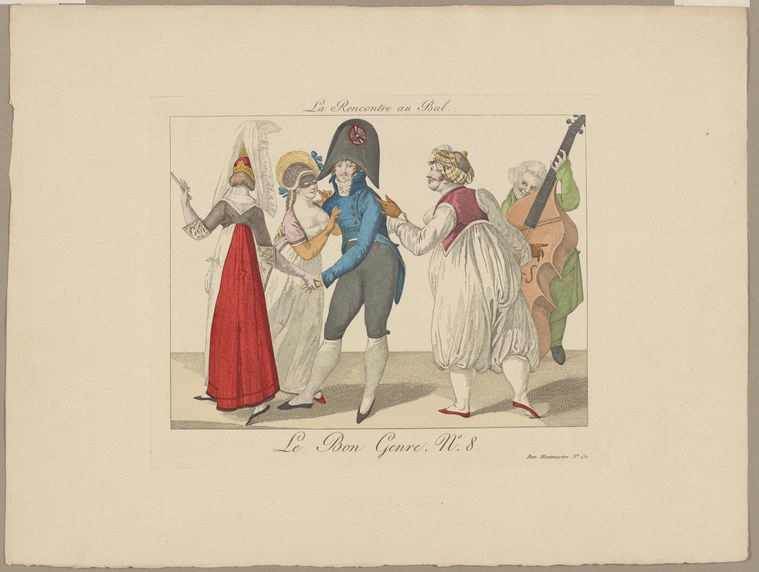
La Rencontre au bal
Unknown artist
- Collection:
- Prints depicting dance
- Source:
- New York Public Library
- Rights:
- Public domain — free to use, share and adapt.
- Recorded as:
- Public Domain
This print preserves a vanished social world: the rigid codes of Regency ballroom dance, where a single gesture or glance carried meaning in the machinery of courtship and class performance. For anyone studying the social history of dance, it is a primary document showing how dance and costume, posture and music worked together to enforce social hierarchy and decorum. The careful hand-coloring and circulation as a popular print also reveal that this dance world was valued enough to be visualized and shared—dance was a subject of popular interest, not merely elite practice.
What you are looking at
A ballroom encounter in the early 19th century. Five figures occupy the scene in a moment of social interaction: a military officer in dark blue uniform with bicorne hat stands at the center, flanked by two women in high-waisted white gowns typical of the Regency period. The woman on the left wears a red cloak and feathered headdress; the woman on the right holds a fan. To the left stands a woman in white with a tall headdress and decorative plume, one arm raised in gesture. On the right, a portly man in brown coat plays a stringed instrument—likely a cello or bass violin. The background is neutral, keeping focus on the figures. The hand-colored engraving captures a specific social moment: the formal introduction or opening of a dance between the officer and one of the women, with musicians and attendants present. The title *La Rencontre au bal* (The Meeting at the Ball) anchors this as a scene of courtship ritual and ballroom etiquette.
The dancing
The central figures adopt the formal posture expected of Regency ballroom society. The officer stands upright, his arms extended in a courtly gesture of invitation or address toward the nearest woman, whose body language suggests receptiveness—she faces him directly, one arm raised. The women wear the high-waisted, columnar silhouettes of circa 1800–1815 fashion, with long skirts that would restrict movement to small, controlled steps. The musician on the right bends slightly toward his instrument in the attitude of active performance. The composition emphasizes vertical lines and bilateral symmetry typical of neoclassical taste. The gestures are restrained and ceremonial rather than athletic—this is social dance conducted within strict rules of decorum.
The dance depicted
This depicts a Regency-era ballroom scene, almost certainly showing the quadrille, cotillion, or related court dances that dominated elite social dancing of the period circa 1800–1820. The evidence is the formal dress (high-waisted Regency gowns, military uniform, formal coat), the presence of live musicians, and the rigid, upright posture and controlled gesture. The officer's presentation and the woman's reception suggest the ritualized opening or invitation phase of a partner dance. No pointe work, no theatrical artifice, and no folk idiom: this is social ballroom dancing of the upper classes, where the dance functioned primarily as a vehicle for courtship and the display of rank and manners. The small, measured steps required by the clothing would have been the norm.
How it was made
A hand-colored engraving, likely French, circa 1800–1820. The crisp linear composition and careful stippling characteristic of engraving are visible in the shading of the clothing and skin, while the primary colors—the woman's red cloak, the officer's blue coat, the pale gowns—have been added by hand in watercolor or gouache. This technique allowed for mass reproduction: multiple impressions could be hand-colored by assistants, making it an affordable popular print. The inscription in cursive script at top and bottom, together with the formal composition, suggests this was part of a dance instruction series or social satire—likely French, given the French title and the Regency context.
About this work
A French hand-colored engraving documenting an encounter at a Regency-era ballroom, probably dating to the early 19th century. The work captures the formal conventions of upper-class social dancing of the period: the military and civilian dress codes, the presence of musicians, and the ritualized posture and gesture that governed partner selection and the opening of dances such as the quadrille. This is not theatrical ballet or folk dance, but the social ballroom practice that structured courtship and rank display among the European elite. The work belongs in a gallery of dance art because it documents how dance functioned as social ritual, and because the engraver has observed and fixed the specific bodily discipline that such dancing required.
How to look at it
Attend first to the posture and the clothing: the stiffness and verticality of the bodies, the way the women's skirts restrict movement to small, neat steps, the formal geometry of the scene. The officer's gesture and the woman's response are the drama here—social negotiation conducted through movement and bodily positioning. Look at the musician on the right, whose presence is essential: ballroom dance required live music, and the musician was part of the social apparatus. The artist has chosen the moment of invitation and acceptance, not the dance itself—the opening gambit of a ritual that would unfold in measured, predetermined patterns.
The period
The Regency era (roughly 1811–1820 in Britain, or more broadly the Napoleonic period across Europe, circa 1800–1820) saw a rigid standardization of ballroom dancing and ballroom etiquette. The quadrille and cotillion, imported from France and formalized into strict patterns, dominated fashionable dance. Women's dress—the high waist, the column silhouette, the full skirt falling from beneath the bust—had been revolutionary a decade earlier but by 1810 was established convention. This engraving sits at the intersection of Regency fashion, social taste, and visual satire: prints documenting ballroom behavior, courtship rituals, and the comic hypocrisies of social climbing were enormously popular in London and Paris. Dance manuals and satirical prints about dance were both common, and this image may belong to either tradition—or both.
Where it lives
A hand-colored engraving from the New York Public Library's collection of prints depicting dance. The work is catalogued only as *La Rencontre au bal* (The Meeting at the Ball), with the artist unrecorded. The style and inscription suggest a French or Franco-British print of the early 19th century.
Dance in this work
Questions about this work
What dance is being shown?
The specific dance cannot be determined from the image alone, but the formal dress, posture, and setting indicate a Regency-era ballroom dance—most likely a quadrille or cotillion. These were the dominant partner dances of the European upper classes circa 1800–1820. The image shows the moment of invitation and acceptance rather than the dance itself.
Why is the woman wearing a red cloak?
The red cloak and feathered headdress mark her as a woman of rank or fashion. The contrast with the pale gown beneath suggests both wealth and fashionable taste. In a formal ballroom context, such a cloak might be worn as a decorative outer layer or might indicate a specific role or status within the social hierarchy of the ball.
What was the purpose of ballroom dance in this period?
Ballroom dance was a primary vehicle for courtship, for the display of rank and education, and for the enforcement of social hierarchy and decorum. To dance well—to move with control and grace, to know the patterns, to follow the rules of precedence and etiquette—was to demonstrate fitness for marriage and for social standing. The dance itself was often less important than what it communicated about the dancer.
How do I know this is a Regency-era print?
The dress provides the strongest evidence: the women's high-waisted gowns with full skirts, the military uniform, the formal coat and breeches. These are characteristic of circa 1800–1815. The hand-colored engraving technique, the cursive inscription, and the style of the musical instrument all support a dating to the early 19th century, probably French or British.
More dance artwork





