49 works in this view — arrow keys or swipe to move between them.
Dance in Art
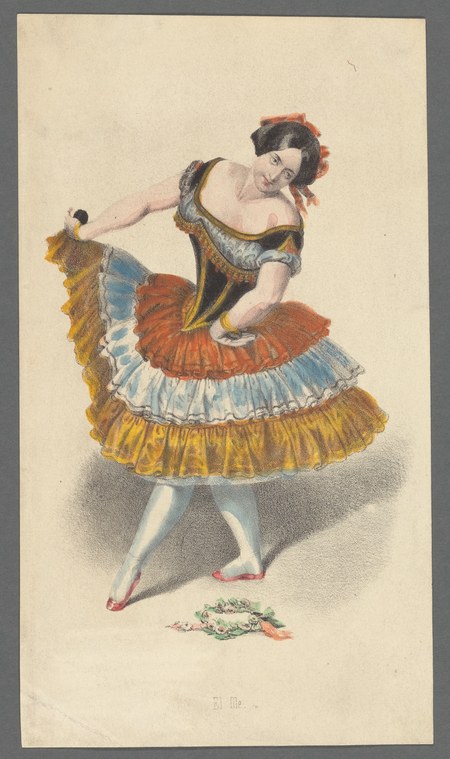
Donna Josefa Vargas in El Ole: [caption title]
Unknown artist
- Collection:
- Prints depicting dance
- Source:
- New York Public Library
- Rights:
- Public domain — free to use, share and adapt.
- Recorded as:
- Public Domain
Named performer prints are rare primary documents for dance history before photography became standard. This image connects a specific person—Donna Josefa Vargas—to a specific theatrical practice, providing visual evidence of how Spanish dance was costumed, presented, and marketed to nineteenth-century audiences. For historians of theatrical dance, Spanish dance, or women performers of the period, the conjunction of name, image, and dance style makes this a rare documentary artifact.
What you are looking at
A solo female dancer in theatrical costume stands in a three-quarter pose against a plain background, her body angled to the right. She wears a black off-shoulder bodice with elaborate gold trim and a tiered skirt composed of three deep ruffles in red, pale blue, and gold, each heavily flounced. Her dark hair is pulled up and adorned with a red ornament. She holds a large gold or cream-colored fan in her extended right arm, angled upward, while her left arm rests across her torso. Her legs are bare except for red heeled slippers, and her weight is shifted onto her right foot in a graceful contrapposto stance. A small wreath of flowers rests on the ground beneath her. The hand-colored print employs soft shading to suggest volume and form, with particular attention to the texture and fall of the layered skirt.
The dancing
The dancer's pose is fundamentally frontal despite the three-quarter turn of the torso, displaying an open, presentational stance characteristic of theatrical performance. The extended arm holding the fan creates a strong diagonal line; the other arm is held low and relaxed. The weight-shift creates elegant counterbalance, with one leg supporting while the other is slightly released. The posture is upright and poised rather than in any dynamic mid-movement position—this is a portrait attitude, not a frozen moment of choreography.
The dance depicted
The costume, pose, and handling suggest Spanish or Spanish-influenced theatrical dance of the nineteenth century. The tiered flounced skirt, the fan, the bare legs, and the theatrical presentation all point toward stage versions of Spanish dance as performed in European and American theaters during the Romantic era and after. The title references 'El Olé', suggesting connection to Spanish dance tradition, though the stylized theatrical costume and posed presentation indicate this is stage performance rather than vernacular practice. The image likely documents a performer (Donna Josefa Vargas) known for Spanish dance specialties rather than an actual choreographic moment.
How it was made
This is a hand-colored engraving or lithograph, identifiable by the linear work beneath the applied color and the technique of tonal shading through parallel lines. The hand-coloring is precise but not uniform—consistent enough to suggest commercial production of a theatrical portrait print. The medium allowed for multiple impressions, making the performer's image portable and collectible. Such prints were common merchandise associated with theater, sold in print shops and by street vendors, and could reach audiences beyond those attending performances.
About this work
This is a theatrical portrait print documenting a named performer, Donna Josefa Vargas, in character costume for a Spanish-themed stage dance. The image belongs to a substantial body of nineteenth-century prints depicting dancers and theatrical performers, often derived from or commemorating specific performances or roles. It captures the aesthetic of Romantic-era theatrical exoticism, when European and American stages sought to represent distant or 'exotic' cultures through stylized costume and performance. The work is valuable precisely because it names both the dancer and the dance, providing concrete documentation of what professional Spanish dance performance looked like on the commercial stage.
How to look at it
The viewer should note that this is a posed portrait, not a captured moment of choreography. The dancer's stillness, frontality, and presentation to the viewer are deliberate. The composition emphasizes costume—the three-tier skirt is the dominant visual element, arranged to display all three colors and layers—over any actual movement. The pose is elegant and balanced, designed to be flattering rather than dynamic. The viewer should read this as how a performer wished to be remembered and marketed, not how the dance was actually executed.
The period
This print dates to the height of Romantic theatrical culture, when European and American stages were fascinated by 'local color' and ethnic or national dance specialties. Spanish dance held particular appeal: it was physically distinctive, visually striking, and fit within frameworks of European orientalism and exoticism that dominated mid-to-late-nineteenth-century entertainment. The theatrical costume shown here—particularly the elaborate fan and tiered skirt—represents a stylized, Europeanized version of Spanish dance aesthetics, designed for sightlines in large theaters and for pictorial effect. Prints like this one were part of the machinery by which theatrical performance was commodified and circulated beyond the theater itself.
Where it lives
The print is part of the New York Public Library's collection of prints depicting dance, held as part of its broader holdings in theatrical and performance documentation. Such collections preserve visual records of performance practice, costume, and the commercial circulation of theatrical images.
Dance in this work
Questions about this work
Who was Donna Josefa Vargas?
The catalogue record does not provide biographical information beyond this print. She was a named theatrical performer known for Spanish dance specialties, circulating in professional theatrical circles during the nineteenth century. The print suggests she was notable enough to merit commercial reproduction and sale, but further details about her life, career, or specific performances are not available from this source alone.
What is 'El Olé'?
The title refers to the Spanish exclamation 'olé' and likely indicates either a specific theatrical piece or a generic reference to Spanish-themed performance. 'Olé' became a stock marker of 'Spanishness' in nineteenth-century theatrical marketing. Without additional documentation, it is not possible to identify whether this refers to a titled composition, a role within a larger work, or a generic performance designation.
Is this what Spanish dance actually looked like?
This is theatrical performance dress and presentation, not vernacular practice. The costume is highly stylized for stage effect: the tiered skirt, bare legs, heeled slippers, and theatrical bodice were designed to be visually striking in a theater and to appeal to European and American audiences' preconceptions about 'Spain.' Actual Spanish dance of the period would have looked and moved differently.
How were these prints made and used?
The print was made by hand-coloring an engraved or lithographic base, allowing multiple copies to be produced. These prints were sold in theatrical contexts and through print shops, serving as souvenirs, promotional material, and collectible records of popular performers. They circulated widely and were affordable enough for working-class theater-goers to purchase.
More dance artwork





