49 works in this view — arrow keys or swipe to move between them.
Dance in Art
Polkamania
Unknown artist
- Collection:
- Prints depicting dance
- Source:
- New York Public Library
- Rights:
- Public domain — free to use, share and adapt.
- Recorded as:
- Public Domain
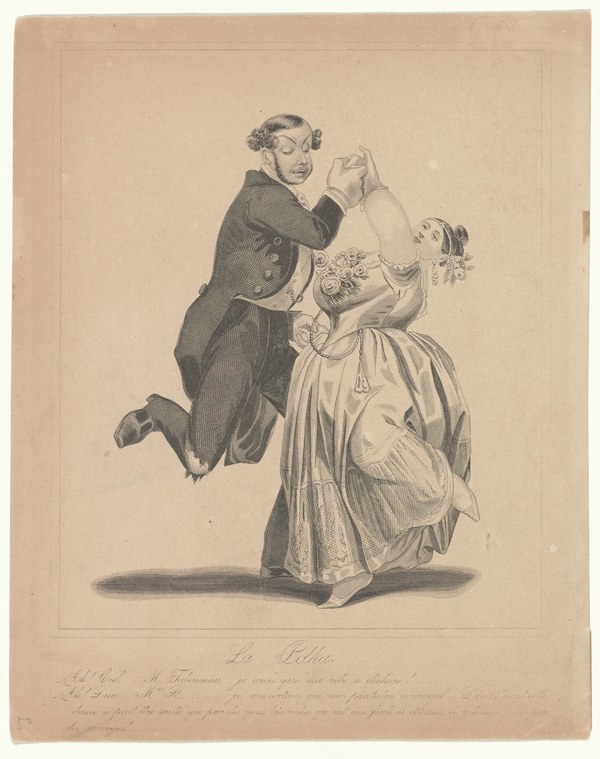
The print offers a rare satirical window into the social anxieties and erotic charge that accompanied the polka's arrival in Europe. For historians of nineteenth-century dance and gender, it documents how the dance became a vehicle for male courtship and how artists weaponized comedy to comment on changing ballroom conventions. The exaggerated postures and mock-theatrical tone reveal that the polka was not simply a technical achievement but a social provocation worthy of mockery.
What you are looking at
A man in dark formal dress—coat, waistcoat, and breeches—kneels on one leg in a posture of ardent supplication toward a standing woman. She wears a high-waisted white or pale dress with puffed sleeves and holds a posy of flowers; her head is turned away in a gesture of coy refusal or affected indifference. The man's posture is exaggerated and theatrical: his torso leans forward, one leg extended behind, his face turned upward toward hers with an expression of pleading intensity. The woman's pose mirrors the affected rejection common to comedic courtship scenes—her body angled away, her free hand raised in a dismissive gesture. The setting is plain, with only a shadow cast beneath them suggesting a stage or studio floor. The print's inscription below reads "La Polka" and includes a dedication in French, establishing this as a satirical or comic commentary on the polka craze.
The dancing
Two figures in a highly stylized, asymmetrical composition. The man is in a deep kneel with extended leg, his upper body twisted toward the woman in a posture of exaggerated supplication. The woman stands upright, her weight settled, her body angled away in studied indifference. The spatial relationship between them—close but refusing contact—is the visual fulcrum of the scene. Neither figure demonstrates the physical frame or hold of actual polka dancing; instead, this is a pantomimic or comedic tableau about courtship and the social dynamics surrounding the dance.
The dance depicted
The title "La Polka" and the French inscription suggest this is satirical commentary on the polka mania that swept Europe in the 1840s–1850s. The work does not depict actual polka movement or hold; rather, it stages a comic courtship scene in which a man implores a woman to dance with him. The exaggerated, kneeling posture and her affected rejection parody the social rituals and gender dynamics that surrounded the polka's introduction to ballrooms. This is a print about the *social life* of the polka—the courtship, flirtation, and masculine pursuit it enabled or symbolized—rather than a representation of the dance technique itself.
How it was made
This is a hand-colored or tinted lithograph or engraving, likely mid-nineteenth century, executed with fine line work and tonal shading to model the figures' forms and fabrics. The technique allows for both the graphic precision required to render facial expression and costume detail, and the broad washes of tone that give the figures weight and presence. The print's inscription in script, its formal framing lines, and its circulation as a popular satirical image suggest it was designed for mass reproduction and consumption—a commercial print for a broad urban audience rather than a fine-art original.
About this work
This print stages a comic scene of courtship dressed as the social drama of the polka. A man in formal dress kneels in supplication before a woman in an elegant pale gown who turns away in studied indifference. The title and French caption identify this as satire on the "polka mania" that gripped Europe in the mid-nineteenth century, when the Bohemian dance became a flashpoint for anxieties about courtship, gender, and social propriety. Rather than depicting polka technique, the print mines comedy from the social negotiations and masculine pursuit that surrounded the dance's adoption into ballroom society. It belongs in a gallery of dance art as evidence of how deeply the polka penetrated European culture—not as a technical manual but as a mirror of the social and erotic energies the dance unleashed.
How to look at it
The viewer should attend to the exaggeration and asymmetry of the pose. The man's deep kneel and pleading expression are far removed from the actual mechanics of polka dancing; they reference instead the melodramatic conventions of stage comedy and the stock figure of the lovesick suitor. The woman's turned-away posture and dismissive hand gesture parody coquetry and feminine refusal. Together, these poses compress the social negotiation surrounding the polka into a single frozen moment of courtship theater. The print's power lies not in accuracy to the dance but in its satirical distillation of the gender dynamics and social comedy that the polka made visible.
The period
The polka emerged in Bohemia around 1830 and became an international craze by the 1840s, when it spread rapidly through Vienna, Paris, and London. Its tempo, its bouncing step, and its requirement that couples maintain close contact made it radically modern and scandalous by contemporary standards. Conservative critics attacked it as vulgar and sexually suggestive; it became associated with youth rebellion and lower-class entertainment before being absorbed into respectable ballroom practice. The 1840s–1850s saw a flood of polka-themed prints, songs, and satirical commentary as artists and writers grappled with the dance's social meaning. This print sits squarely in that moment of cultural anxiety and satire.
Where it lives
The work is held in the New York Public Library's collection of prints depicting dance. The inscription and style suggest it is a European satirical print from the mid-nineteenth-century period of polka mania; its exact date, artist, and place of publication are not recorded in the catalogue.
Dance in this work
Questions about this work
Is this a realistic depiction of polka dancing?
No. The kneeling posture and supplicatory gesture have nothing to do with polka technique. This is satire: the artist has staged a comedic courtship scene that comments on the social rituals and gender dynamics surrounding the polka, not the dance itself. The exaggeration is intentional and the point.
Why is the man on his knee?
The kneel references stock theatrical poses of male supplication and lovesickness common to nineteenth-century comic theater and popular prints. It signals that this is courtship drama, not dance instruction. The pose mocks masculine pleading and female coquettry—the social performance that the polka enabled and exposed.
What does 'polka mania' mean?
Between the 1840s and 1860s, the polka became a craze across Europe, adopted rapidly by urban ballrooms despite initial criticism as vulgar and morally suspect. The dance's speed, proximity, and energy generated intense social commentary. This print is one of hundreds of cultural artifacts—songs, cartoons, novels—that documented and satirized the polka's power over European society.
More dance artwork





