49 works in this view — arrow keys or swipe to move between them.
Dance in Art
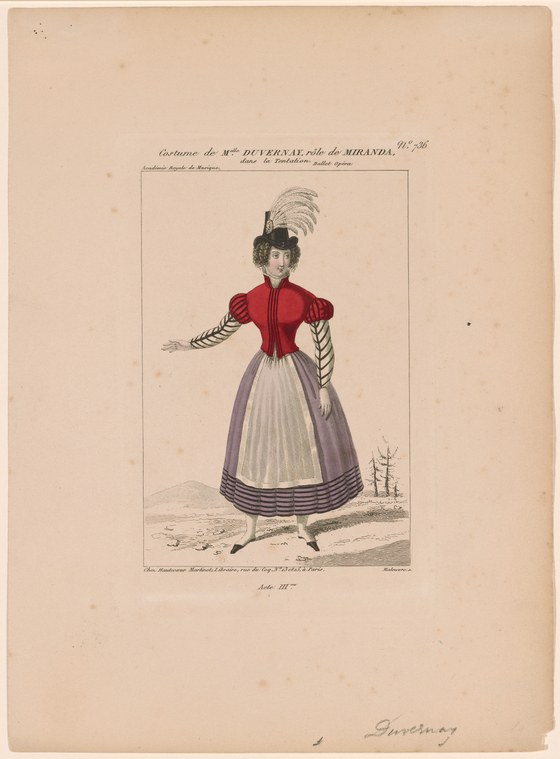
Costume de Melle. Duvernay, rôle de Miranda, dans La tentation
Unknown artist
- Collection:
- Prints depicting dance
- Source:
- New York Public Library
- Rights:
- Public domain — free to use, share and adapt.
- Recorded as:
- Public Domain
Costume plates like this are essential evidence for how performers of the Romantic era were visually presented to audiences. The image preserves not only the cut and detail of a specific costume but also the name of the performer who wore it, anchoring the history of dance to individual artists whose performances are otherwise lost to time. For historians of theatrical dress, female performance, and the material culture of dance, such prints form a primary archive.
What you are looking at
A woman stands alone against a plain background, posed as if mid-performance or final tableau. She wears a striking red bodice with pronounced puffed sleeves laced with decorative braiding, paired with a full skirt in pale lavender-gray gathered into horizontal pleats at the hem. A tall white feathered headdress rises from her dark hair. Her posture is upright and formal, with one arm extended and the other at her side, suggesting a balletic port de bras. The ground line is indicated by sparse detail—a few grasses and a small ship visible in the distance on the right, situating this as a theatrical costume plate rather than a naturalistic scene. The paper is hand-colored, with delicate watercolor washes defining the fabric textures and the crisp outline of the figure.
The dancing
A single female dancer is shown in a formal standing pose with her weight evenly distributed. Her arm carriage is balletic: one arm extends outward at shoulder height while the other hangs naturally, suggesting either a held position or the completion of a movement phrase. Her posture is upright and dignified. The silhouette shows a dancer in costume rather than a captured action moment, which is typical of theatrical costume documentation.
The dance depicted
This is a costume plate for a theatrical production, specifically documenting the costume worn by Mlle Duvernay in the role of Miranda in *La Tentation* (presumably a dramatic or operatic work). The inscription identifies this as a design record rather than a depiction of dance itself. The formal balletic port de bras and the theatrical costume—ornate and clearly designed for visibility from a distance—suggest classical or romantic theatrical dance of the early 19th century, but the image serves a documentary rather than narrative function. The plate records how the role was dressed for performance, not how the dance was executed.
How it was made
This is a hand-colored engraving or aquatint, a reproductive technique that allowed theatrical costume designs to be circulated as prints for posterity and reference. The fine line work establishes the figure's outline and anatomical structure, while transparent watercolor washes (applied after printing) add the colors: red, lavender, flesh tones, and subtle modeling of fabric volume. The technique is characteristic of early 19th-century theatrical documentation, where such plates served both as costume records for theater archives and as souvenirs for audiences and collectors interested in celebrated performers.
About this work
This is a theatrical costume plate documenting the dress of a named performer, Mlle Duvernay, in a specific role in what appears to be a dramatic or musical work. The image belongs to a tradition of printed costume records that flourished in European theaters from the late 18th century onward, serving as both practical documentation and objects of circulation among theater enthusiasts. The inscription in French, the hand-coloring technique, and the formal presentation all indicate a work aimed at a cultivated European audience with interest in theatrical fashion and celebrity performers. Though it does not depict dance in action, it documents how dance was dressed—a crucial archive for understanding the visual presentation of theatrical movement in its period.
How to look at it
Look first at the precision of the costume detail: the lacing of the sleeves, the pleating of the skirt, the construction of the headdress. These are rendered with documentary specificity, showing what an audience member would have seen from a distance. Notice the formal, frontal pose: the figure is presented for viewing as a costume object, not caught in a moment of narrative action. The subtle hand-coloring over the printed line shows how theatrical color would have appeared under stage lighting—not naturalistic but deliberately vivid and contrasting. The inscription at the top anchors the image to a specific performance moment, reminding us that this is not a generic type but a record of a particular evening on stage.
The period
This work dates to the early 19th century, an era when theatrical costume documentation flourished as a commercial and archival practice across Europe. The hand-colored engraving was a standard medium for circulating images of celebrated performers and their costumes to a broad audience. The Romantic period (roughly 1820–1850) saw an intense interest in picturesque and exotic costume as part of the expansion of balletic narrative and the rise of the ballerina as a celebrity figure. The role of Miranda—likely derived from Shakespeare's *The Tempest*—suggests a dramatic rather than purely balletic work, possibly a melodrama or opéra comique, which would have featured dance as one element within a larger theatrical spectacle rather than the sole focus.
Where it lives
The work is held in the New York Public Library's Prints collection, part of a broader archival holding of theatrical and dance imagery. The item is catalogued as a costume plate—a genre of theatrical documentation that forms a continuous series across European institutions from the 18th century forward.
Dance in this work
Questions about this work
Who was Mlle Duvernay?
The inscription identifies her by name and role but provides no biographical detail. She was a performer in early 19th-century French theater, named in this costume plate as the originator of the role of Miranda in *La Tentation*. Without additional archival research, we cannot determine her prominence or later career, though the fact that her costume was documented and circulated as a print suggests she was at least a notable performer of her moment.
Was this role danced or spoken?
The title *La Tentation* (The Temptation) suggests a dramatic work—possibly a melodrama or opéra comique—rather than a pure ballet. While the costume shows balletic elements in its design and the performer's posture suggests balletic training, the role likely involved spoken drama, pantomime, and dance in combination, as was typical of theatrical spectacle in the period.
How were these prints made and used?
The image is an engraving (or possibly aquatint) that was printed in black ink and then hand-colored with watercolor. Such prints were sold to audiences, collected by theater enthusiasts, preserved in archives, and used by costume designers and historians as reference documents. They were mass-produced but individually finished, making each print slightly unique.
Why is there a ship in the background?
The tiny ship visible on the horizon is part of the costume plate convention: it indicates setting or place without occupying the composition. It may refer to a maritime element in the plot or simply establish atmosphere. Such small landscape elements were standard in costume plates of the period, anchoring the figure in a theatrical world.
More dance artwork





