49 works in this view — arrow keys or swipe to move between them.
Dance in Art
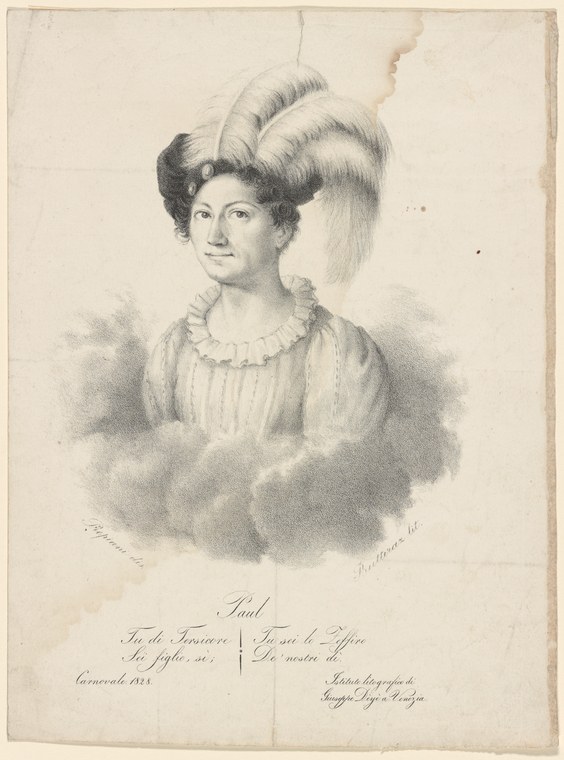
Paul, tu di Tersicore sei figlio, sì; tu sei lo Zeffiro de' nostri dì
Unknown artist
- Collection:
- Prints depicting dance
- Source:
- New York Public Library
- Rights:
- Public domain — free to use, share and adapt.
- Recorded as:
- Public Domain
The work documents the visual culture of Regency ballroom society at a moment when dance was at the center of fashionable life, and shows how dancers and dance patrons were commemorated and celebrated. It illustrates the conventions of Regency portraiture and the idealized image of feminine grace and elegance that ballroom culture both required and produced.
What you are looking at
A young woman in early 19th-century dress is shown in three-quarter view against a soft, clouded background typical of Regency-era portraiture. She wears a high-waisted, Empire-silhouette white muslin gown with a gathered neckline and short puffed sleeves—the fashionable dress of the Napoleonic period. Her hair is styled in the era's characteristic fashion: dark, voluminous, and crowned with an ornamental headdress or comb with tall, elegant plumes rising above her head. The portrait is rendered in fine pencil or chalk, with delicate cross-hatching in the background to create atmospheric depth. The composition is intimate and celebratory, presenting her as a figure of grace and refinement associated with the ballroom culture of the Regency.
The dancing
The woman's posture is upright and composed, her shoulders relaxed and squared. Her gaze is level and direct, meeting the viewer with a serene, confident expression. The tilt of her head is slight and elegant. There is no representation of active dance movement—the figure is still, posed for presentation rather than caught mid-step. Her arms are not visible in the composition; the image frames her from approximately mid-torso upward.
The dance depicted
The image does not depict active dancing. Instead, it is a portrait of a woman identified by the Italian inscription as a figure associated with Terpsichore (the Muse of dance), positioned within ballroom culture. The inscription suggests allegorical or honorific purpose rather than documentary record of a specific dance. The dress, hair, and styling conventions place her squarely in the Regency ballroom world of ca. 1810–1820, when minuets, cotillions, quadrilles, and country dances were the standard social forms. The portrait may commemorate a celebrated dancer or a patron of dance, or it may be a romantic invocation of the muse herself in contemporary dress.
How it was made
This is a lithograph or engraving rendered in black chalk or pencil on paper, with stumped shading to create soft tonal transitions. The technique produces a refined, genteel effect suited to fashionable portraiture of the period. The delicate handling of the hair plumes and the atmospheric cloud effects suggest skilled draftsmanship. The medium—a printed or hand-drawn portrait on paper—points to a work intended for circulation among educated, middle-to-upper-class audiences, whether as a formal commission, a fashion plate, or a commemorative portrait.
About this work
This is a Regency-era portrait of a woman celebrated in connection with dance and the ballroom, executed in the refined graphic style of early 19th-century portraiture. The Italian inscription invokes Terpsichore, the muse of dance, and identifies the sitter as a figure of distinction in that realm. The work belongs to a rich tradition of imaging the ballroom culture and the elegant femininity associated with Regency social dance—a moment when dance portraiture shifted from narrative and allegorical scenes toward intimate celebration of individual dancers and patrons. The portrait captures not a dance in progress, but the aesthetic ideal behind Regency ballroom culture: refined deportment, fashionable dress, and an assured presence in the social sphere where dance was central.
How to look at it
Note the precision of the Regency fashion details: the high waistline, the simplicity of the white muslin, the careful rendering of the hair and ornamental plumes. These were markers of elegance and refinement in the period. The soft, clouded background and the gentle modeling of the face create an air of romantic idealization typical of Regency portraiture. The inscription, in Italian, invokes a classical tradition (Terpsichore) while the image is entirely contemporary, suggesting a deliberate conflation of the sitter's modern identity with classical allusion—a common rhetorical move in ballroom culture.
The artist
The artist is not recorded. The signature or mark on the print is not legible in the image. The work belongs to the tradition of Regency-era portrait lithography and engraving, a popular and economical medium for circulating fashionable portraits among the gentry and upper-middle classes. Many such works were produced by professional print makers and circulating libraries; attribution often lost over time.
The period
This portrait dates to the Regency period (approximately 1811–1820) in Britain, an era of intense social dancing and the professionalization of theatrical dance. Regency ballrooms were sites of ritual and courtship, where minuets, cotillions, quadrilles, and country dances structured social interaction. Simultaneously, theatrical ballet was rising in prestige, with dancers like Maria Taglioni beginning their careers in the 1820s. Portraiture of dancers and dance patrons flourished in this period, reflecting both the social importance of ballroom culture and the growing celebrity of stage performers. The fashion in dress—the Empire waist, puffed sleeves, and plume headdress—dates the work precisely to this era and marks it as a document of Regency taste and aesthetics.
Where it lives
The work is held in the Prints collection of the New York Public Library. It is a print or engraving on paper, likely from a series of Regency portraits or a commemorative issue. The inscription and the professional quality of execution suggest it was produced for circulation among the educated classes, either as a standalone portrait or as part of a larger publication.
Dance in this work
Questions about this work
Is this a portrait of a real dancer?
The inscription suggests the sitter was a celebrated figure in ballroom or theatrical dance, but without more information on the artist and print history, the specific identity cannot be established from the image alone. The work may commemorate a professional dancer, a patron, or a society woman celebrated for her grace. The allegorical reference to Terpsichore suggests honorific intent.
What kind of dance would she have done?
In the Regency ballroom (ca. 1810–1820), a woman of this social position would have danced minuets, cotillions, quadrilles, and country dances in structured social settings. These were partnered or group dances governed by strict conventions of deportment and frame. If she was a theatrical dancer, she may have performed in ballet or in pantomime-ballet hybrids.
What is the headdress?
This appears to be a fashionable ornamental comb or tiara with tall plumes—a standard accessory in Regency ball dress. Such plumes were expensive and a mark of social status. They were meant to frame the face and add height and drama to the silhouette.
Why is this a print rather than a painting?
Prints were far cheaper and faster to produce than paintings, making them the standard medium for commemorative and fashionable portraiture in the Regency era. They could be circulated widely among the middle and upper-middle classes, reproduced in quantity, and displayed in homes. This democratized portraiture and made images of celebrated dancers accessible to a much broader audience.
More dance artwork





