49 works in this view — arrow keys or swipe to move between them.
Dance in Art
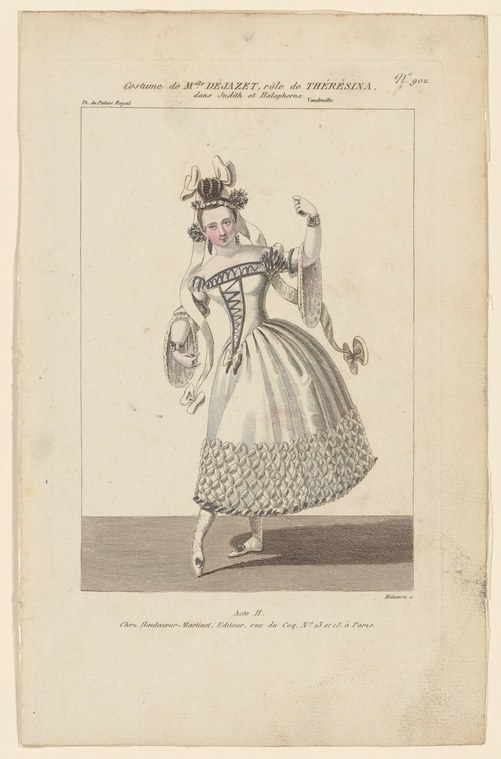
Costume de Melle Dejazet, rôle de Thérésina, dans Judith et Holopherne.: Vaudeville. Th. du Palais Royal. Acte II
Unknown artist
- Collection:
- Prints depicting dance
- Source:
- New York Public Library
- Rights:
- Public domain — free to use, share and adapt.
- Recorded as:
- Public Domain
Vaudeville and the work of female stars like Déjazet are often invisible in dance history, which privileges the École de Danse and ballet. This print documents a tradition of physical comedy, character work, and female professional autonomy that was central to 19th-century popular theatre. The specificity of the costume and pose tells us how women moved in comedic roles, what audiences expected to see, and how theatrical costume itself was a medium of character and spectacle.
What you are looking at
A single female dancer is shown in a theatrical pose against a plain background, wearing an elaborate early 19th-century costume. She stands with weight on her left leg, her right leg extended forward in a graceful attitude, and both arms raised—the right arm bent and lifted to shoulder height, the left arm extended outward. Her costume consists of a corseted bodice with a wide neckline and short puffed sleeves, paired with a full skirt of striking design: the upper portion is plain white or pale fabric, while the lower half features a dense pattern of diamond or scale-like shapes creating a textured, sculptural hem. Her headdress is elaborate—a tall construction with feathers or plumes rising above, and the styling suggests fashionable Restoration-era hair and millinery. She wears soft ballet slippers. The figure is rendered in black ink with fine cross-hatching for shadow and volume, against a plain stage floor suggested by a thin dark line. The composition is a costume study in isolation, characteristic of theatrical documentation from the 1820s–1840s.
The dancing
A single dancer is positioned in three-quarter profile, her weight clearly on her supporting leg while the other extends forward with pointed toe. Her upper body is lifted and engaged, with arms arranged expressively rather than in a formal ballroom hold—the raised arms and extended leg suggest narrative mime or expressive movement rather than the geometric patterns of ballroom or court dance. Her posture and the turn of her head suggest character portrayal rather than pure dance technique. The silhouette emphasizes the costume as much as the body, and the pose is one of alert, forward-facing engagement typical of theatrical acting as much as dancing.
The dance depicted
This is a costume study for a vaudeville production—specifically, a character role in a play with dance rather than a ballet per se. The inscription identifies this as the costume of Mlle. Déjazet in the role of Thérésina from 'Judith et Holopherne' (Judith and Holofernes), a vaudeville spectacle performed at the Palais Royal theatre in Paris. Mademoiselle Déjazet (1797–1868) was a celebrated actress-dancer and singer who specialized in comedic and trouser roles in the Parisian vaudeville tradition. The pose is theatrical rather than balletic: it captures a moment of dramatic character presence rather than formal choreography. The costume—particularly the distinctive patterned skirt—suggests a fantastical or comedic interpretation of the biblical heroine, likely involving transformations or comic business typical of vaudeville.
How it was made
This is an engraving or possibly a hand-colored lithograph printed from an etched plate, from the catalogue of theatrical costume studies that were widely distributed in Paris during the Restoration and July Monarchy periods. The technique allowed for precise definition of costume detail—the patterned skirt and elaborate headdress are rendered with fine line work and cross-hatching to suggest texture and volume. Such prints were sold individually and in collected volumes to document famous roles, serving as souvenirs for theatre-goers, records for costume makers, and repertory documentation for touring companies. The notation at the foot (naming the performer, venue, act, and playwright) is characteristic of published theatrical prints from the 1820s–1840s.
About this work
This is a documented costume study of a professional theatre role from early 19th-century Paris—not a depiction of virtuoso ballet, but a record of performance in the vaudeville tradition, which blended dance, mime, music, and comedy. Mademoiselle Déjazet was a star of the Opéra-Comique and Palais Royal, known for energetic comic performance and female impersonation roles. The image captures the intersection of theatre costume design, female professional performance, and the vaudeville aesthetic—a form that, though less canonized than ballet, was the dominant form of theatrical dance entertainment for ordinary Parisians of the era. The costume itself, particularly the fantastical patterned skirt, suggests a burlesque or comic interpretation of classical subject matter, a hallmark of the vaudeville stage.
How to look at it
The pose is a theatrical moment of alert readiness or forward momentum, frozen mid-action—the extended leg and lifted torso suggest imminent movement or response. The costume itself, particularly the distinctive scale-patterned hem, is as much a subject as the body. Notice the careful articulation of the head and neck (theatrical presence) and the way the arms are arranged expressively rather than in any formal ballroom configuration. The print's isolation of the figure against empty stage space is characteristic of costume documentation: the figure is shown without scenery or other performers to allow the costume and character to read clearly. The engraver has emphasized line and pattern over anatomical naturalism—the patterned skirt is almost abstract, suggesting ornament and spectacle over realistic fabric.
The artist
The artist is not recorded. The engraving belongs to a substantial market of Parisian theatrical print publishers (firms such as Martinet, Janet-Lange, and others) who produced costume studies, portrait engravings of famous performers, and architectural views of theatres. These prints were often hand-colored by women workers and sold at the theatre doors and through print sellers. The style and conventions are consistent with the output of Paris's theatrical engraving studios in the 1820s–1840s.
The period
The 1820s–1840s were a period of theatrical expansion and celebrity culture in Paris. The Restoration and July Monarchy saw the flourishing of the Opéra-Comique, the Palais Royal, and the Vaudeville theatre itself as major cultural institutions. Ballet was ascending in prestige (Romantic ballet with figures like Marie Taglioni emerged in this period), but vaudeville and opéra-comique remained the dominant live entertainments for broad audiences. Female performers like Déjazet were stars comparable in fame to ballerinas, and the rise of lithography and industrial engraving made theatrical imagery widely available. This print reflects a moment when theatre was becoming a mass entertainment, documented and circulated through cheap prints.
Where it lives
From the New York Public Library's prints collection 'Prints depicting dance.' The New York Public Library holds a substantial collection of French theatrical prints from the 19th century, many of which document performers and roles from the Paris stage.
Dance in this work
Questions about this work
Who was Mademoiselle Déjazet?
Virginie Déjazet (1797–1868) was a French actress, singer, and dancer celebrated in Parisian vaudeville and opéra-comique. She was known for comic and cross-dressing roles and was a major star of the Palais Royal and Vaudeville theatres. She performed regularly from the Restoration period into the mid-19th century and was renowned for her energy, wit, and physical skill.
What is vaudeville?
Vaudeville was a form of theatrical entertainment combining spoken comedy, song, and dance in short, often satirical sketches or adaptations of classical subjects. It was distinct from both serious opera and pantomime, and was the dominant popular theatre form in Paris from the 1790s onward. Performers like Déjazet were skilled in all three disciplines.
Why is the costume so unusual?
The patterned skirt and fantastical headdress suggest a burlesque or comic treatment of the biblical Judith story—vaudeville routinely adapted classical and biblical subjects for comedy. The costume is designed for visibility and spectacle in a large theatre, and the pattern may have created movement and visual interest as the performer danced and moved.
Is this ballet?
No. While this depicts a dancer and involves music and movement, it documents a theatrical role in vaudeville—a form that blended comedy, mime, song, and dance. Vaudeville performers were skilled in dance but were not trained in ballet technique or bound by its conventions. The pose and costume are theatrical and comedic, not balletic.
More dance artwork





