49 works in this view — arrow keys or swipe to move between them.
Dance in Art
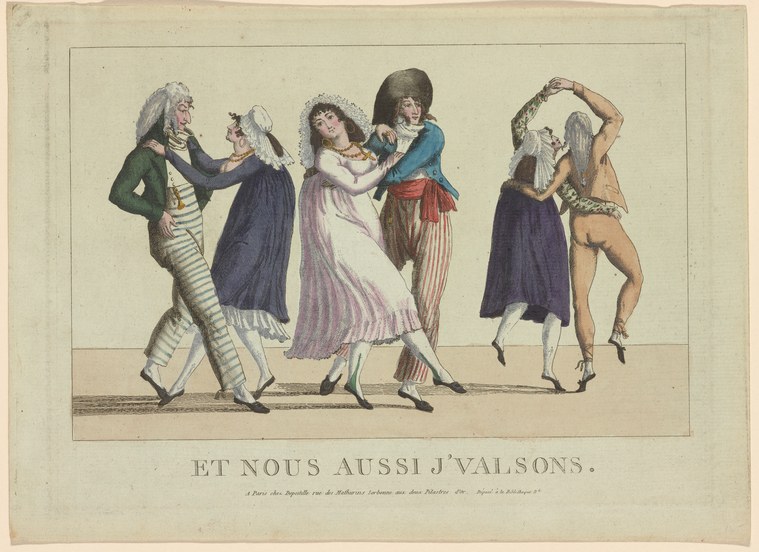
Et nous aussi j'valsons
Unknown artist
- Collection:
- Prints depicting dance
- Source:
- New York Public Library
- Rights:
- Public domain — free to use, share and adapt.
- Recorded as:
- Public Domain
The waltz was the most contested dance of its era, and this print offers direct evidence of how it was perceived—not merely as a dance, but as a social crisis requiring commentary and satire. The image also demonstrates that ballroom dance was central to Regency-era visual culture and public discourse, important enough to warrant publication and circulation as a satirical print.
What you are looking at
Five figures in Regency-era dress occupy a shallow stage or platform against a plain background. The composition reads left to right as a narrative sequence of the waltz. At far left, a grey-haired man in green coat and striped breeches gestures expressively, one hand raised; a woman in dark cloak reaches toward him. Center-left, a couple in closed position—he in blue coat and red breeches, she in a high-waisted white muslin gown with dark hair and headdress—execute the turning motion characteristic of the waltz. At center-right, another woman in dark dress with raised arms mirrors or precedes the turn. At far right, a lightly clad male figure (possibly a servant or allegorical attendant) in semi-nude classical drapery strikes an exaggerated pose with one arm overhead, weight on one leg. The hand-coloring suggests watercolor over engraving; the palette is muted—greens, blues, pinks, flesh tones—against cream paper. The title in French below reads 'Et nous aussi j'valsons' ('And we too are waltzing').
The dancing
The central dancing pair shows the characteristic closed frame of the waltz: the man's right hand at the woman's waist, her left hand on his shoulder, their right and left hands clasped at shoulder height. Both bodies incline slightly inward in the contrapostal lean essential to the waltz turn. The woman's weight appears shifted onto her right side as the couple pivots; her skirt flares outward with the centrifugal force of rotation. The surrounding figures gesture and pose rather than dance—the man at left gestures dramatically, the women at either side raise their arms in attitudes or emphatic poses. The rightmost figure adopts an exaggerated classical contrapposto utterly disconnected from social dance.
The dance depicted
This is a waltz, almost certainly Viennese Waltz, depicted in a satirical or commentary mode. The title—'And we too are waltzing'—suggests this is a response to the waltz craze that seized European society in the early 19th century, a dance that scandalized conservatives for its close hold and apparent impropriety. The central pair executes a proper waltz turn; the surrounding figures suggest the fashionable excess, the pretension, and the social chaos the waltz seemed to invite. The classical male figure at right may be satirizing the deployment of Greco-Roman reference in fashionable discourse, or commenting on the loss of classical restraint. This is not instruction or celebration but social satire: a dance scene made to be amusing rather than exemplary.
How it was made
This is a hand-colored engraving or aquatint, as evidenced by the fine line work, the shallow pictorial space, and the watercolor tinting applied selectively to enhance the composition. The technique allowed rapid reproduction and distribution to a broad audience—essential for a satirical print designed to comment on fashionable behavior. The hand-coloring was likely applied after printing, suggesting either a luxury version or a secondary commercial process. The medium belongs to the tradition of satirical social prints that flourished in London and Paris in the Regency period, works that were bought, pinned to walls, and passed among friends to be read as visual jokes about contemporary manners.
About this work
This is a hand-colored satirical print on the subject of the waltz, the most controversial ballroom dance of the Regency era. It depicts a couple waltzing in proper form at center while surrounding figures strike exaggerated poses and gestures, suggesting social excess and pretension. The title announces the print's commentary: the waltz was not merely danced, but obsessed over, imitated, and debated across European society. The work belongs to the genre of social satire that flourished in the early 19th century, using the ballroom as a stage for observations on fashion, manners, and social change.
For dance historians, the image is valuable precisely because it captures the waltz at a moment of intense social friction—before it became routine, when the close hold between man and woman and the rapid turning motion were genuinely shocking to conservative observers. The artist did not need to clarify the dance was a waltz; the form of the central couple was instantly recognizable, and the surrounding hysteria confirms the subject. This is how people experienced the waltz: not as a neutral social practice, but as a symptom and a scandal.
How to look at it
Attend first to the central pair: the man and woman are in the moment of a waltz turn, inclined inward, their hands in position, her skirt displaced by rotation. This is the scandalous close hold that provoked moral outrage. Then observe how the surrounding figures break the conventions of the waltz entirely—they pose, gesture, and perform attitudes rather than dancing. The classical male figure at right, rendered almost nude and striking a theatrical pose, stands outside any recognizable social dance tradition. The print's satire works by contrast: the central couple shows what waltzing actually looked like, while the periphery shows how fashionable society responded to it—with excess, pretension, and loss of composure.
The period
The waltz arrived in Vienna in the late 18th century and spread to Paris and London in the early 19th, coinciding with the Napoleonic Wars and the political upheaval that defined the Regency period (in Britain, 1811–1820). The dance scandalized moral conservatives: the close hold between partners, the rapid turning, and the apparent absence of the formal, restrained deportment expected of genteel dancers all marked it as foreign, excessive, and vaguely dangerous. A wave of satirical prints, poems, and caricatures denounced the waltz while simultaneously confirming its fashionable appeal. This print participates in that conversation, using satire to acknowledge the waltz's grip on fashionable society while mocking its practitioners. The hand-colored engraving was the dominant medium for such commentary and ensured wide circulation among the literate and leisured classes.
Where it lives
The work is held in the New York Public Library's collection of prints depicting dance. It is typical of early 19th-century satirical social prints, works produced for middle-class consumption and circulation, meant to be purchased, viewed, and discussed in private settings.
Dance in this work
Questions about this work
Was the waltz really considered scandalous?
Yes. The waltz's close hold between partners—where a man's hand rested at a woman's waist and they turned together in rapid motion—violated Regency codes of propriety and restraint. Conservative observers condemned it as improper, even immoral. This print is one of dozens of satirical responses to the waltz craze, using humor to both mock and acknowledge the dance's fashionable appeal.
What is the figure on the right supposed to represent?
The classical semi-nude male figure at right appears to be either a satirical invocation of high artistic tradition (to mock the pretensions of fashionable society) or an allegorical attendant. He strikes a pose utterly unrelated to ballroom dance, emphasizing through contrast the excessive theatricality of the waltzing figures.
Is this an instruction manual or a social commentary?
It is social commentary in the form of satire. While the central couple demonstrates the waltz correctly, the surrounding figures and the overall composition mock rather than endorse the dance. The print was designed to amuse viewers by exaggerating the social excess and moral panic the waltz inspired.
More dance artwork





