49 works in this view — arrow keys or swipe to move between them.
Dance in Art
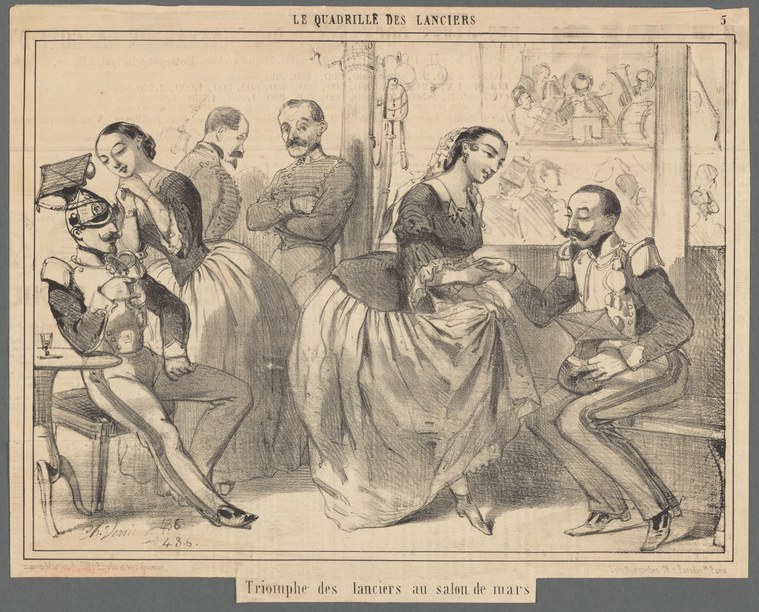
Le quadrille des lanciers: triomphe des lanciers au salon de mars
Unknown artist
- Collection:
- Prints depicting dance
- Source:
- New York Public Library
- Rights:
- Public domain — free to use, share and adapt.
- Recorded as:
- Public Domain
The Lancers was one of the most widely danced quadrilles of the mid-19th century, and this print is rare evidence of how it was staged and what it meant to its participants—not primarily as athletic movement but as a structured social performance in which rank, dress, and attentiveness mattered as much as the footwork. For dance historians, the work reveals the intimate connection between ballroom dance, military identity, and heterosexual display in this period, showing how a 'triumph' of a dance was measured in admiration and social success rather than technical virtuosity.
What you are looking at
A crowded salon scene rendered in fine-line engraving, showing military officers in dress uniforms and women in Empire-waist gowns arranged in a lively interior space. At the center, a woman in a flowing white gown is positioned between two seated officers who gaze toward her, their bodies angled in attitudes of attention and admiration. Behind them, other figures cluster—some standing, some seated—creating depth and the sense of an event in progress. The setting appears to be an elegant 19th-century drawing room or ballroom, with architectural details visible in the background. The composition captures a moment of social interaction and dancing activity, with the gathered crowd suggesting an audience or assembly participating in or observing the central action. The engraving technique allows precise rendering of fabric textures, military insignia, and the gestural animation of multiple figures.
The dancing
The central woman stands in an upright, poised position with her weight distributed evenly, her body angled to engage with the two officers seated before her. Her arms are held in a graceful, restrained manner characteristic of formal 19th-century dance. The officers' seated postures show them leaning slightly forward, their gaze directed upward toward the dancer, suggesting admiration or observation. The surrounding figures are loosely arranged without formal holds or strict positioning, indicating a social gathering rather than a closely choreographed formation, though some pairs appear to be engaged in paired movement or observation. The overall frame conveys elegance and decorum rather than vigorous physical exertion.
The dance depicted
The title *Triomphe des lanciers au salon de mars* identifies this as a depiction of the Lancers quadrille, a French country dance in square formation that was extremely popular in fashionable 19th-century ballrooms. The Lancers was a figure dance performed by four couples in a square, made up of five distinct figures, and was a staple of ballroom dancing in the 1840s–1860s. This print documents the dance as a social event among the military and aristocratic classes, showing the setting, dress, and social context in which it was performed rather than the geometric precision of the figures themselves. The emphasis on the woman at the center and the attentive officers around her suggests an interest in the courtship and social performance aspects of ballroom dancing rather than technical detail.
How it was made
This is a finely executed engraving, recognizable by its precise parallel hatching, fine line weight, and monochromatic rendering. Engraving allowed for detailed social observation and was the standard medium for reproductive prints and satirical commentary in 19th-century France. The technique's precision enabled the artist to render military dress uniforms with accuracy—the epaulettes, buttons, and insignia are clearly defined—and to differentiate social rank and status through costume. This print was likely produced for popular circulation, either as a standalone satire or as part of a series documenting fashionable life, making it accessible to a broad urban audience interested in commentary on contemporary social manners and dancing customs.
About this work
This engraving documents the Lancers quadrille, one of the most celebrated dances of the 19th-century European ballroom, as it was actually performed in fashionable military and aristocratic circles. Rather than attempting to show the geometric patterns of the dance itself, the artist chose to capture the social scene—the gathering, the dress, the moment of performance—emphasizing the cultural significance of the dance as an event of courtship, status display, and social assembly. The work belongs to a rich tradition of prints that recorded and sometimes gently satirized the manners and fashions of contemporary ballroom society, serving both as documentation and as commentary on the rituals of courtship and social climbing that ballroom dancing facilitated.
How to look at it
Note the woman's centered position and the officers' seated attitudes of admiration around her—this captures the essential social structure of the Lancers and of 19th-century ballroom dancing more broadly, in which the woman's performance was framed for observation and evaluation. The artist has chosen not to freeze a moment of intricate footwork but rather a moment of social presentation and attention, suggesting that the 'triumph' of the Lancers lay as much in the social experience of the event as in the execution of the steps. Observe the precision of the uniform details and the careful rendering of fabric and posture: this level of specificity indicates a serious documentary interest in how fashionable military society actually danced and dressed, not merely a generic ballroom scene.
The period
The Lancers quadrille emerged in the 1830s and dominated European ballrooms through the 1870s, reaching peak popularity in the 1840s–1860s when this print was likely made. It succeeded the Plain Quadrille and competed with other square dances and cotillions for space in the ballroom. The dance's appeal lay in its structured elegance, its combination of established figures and room for individual interpretation, and its suitability for officers and aristocrats who valued both decorum and display. In the visual arts, prints documenting ballroom fashion and manners were extremely popular in France during this period, often with satirical or gently mocking intent toward the pretensions and courtship rituals of fashionable society. The emphasis on military dress in this particular print reflects the intersection of military identity and social climbing in the post-Napoleonic ballroom.
Where it lives
This engraving is held in the New York Public Library's collection of prints depicting dance. It belongs to the tradition of 19th-century Parisian social satirical and documentary prints that were produced for popular circulation and collection.
Dance in this work
Questions about this work
What was the Lancers quadrille?
The Lancers was a square dance for four couples, consisting of five distinct figures, that became the dominant quadrille in European ballrooms from the 1840s through the 1870s. It combined elements of earlier quadrilles with new figures and required coordination between couples but allowed for variations and individual style. The dance was associated with elegance and was favored by officers and the aristocracy.
Why are the officers seated if this is a dance?
The print captures a moment of social observation rather than the actual execution of steps. In ballroom culture, dancing was as much about being watched—about displaying dress, deportment, and status—as about movement. The seated officers' attentive gaze suggests the courtship and display function of the dance.
Is this a satire or a serious document?
The print likely functions as both. Prints of this kind often gently mocked fashionable society's pretensions while also providing a serious record of how people actually dressed and behaved. The careful rendering of military details and the emphasis on the 'triumph' suggest documentary intent, but the composition and arrangement may contain satirical commentary on the rituals of ballroom courtship.
When was the Lancers danced?
The Lancers reached peak popularity in the 1840s–1860s and remained fashionable in ballrooms into the 1870s and beyond. It was danced across Europe and in North America, and was considered one of the essential ballroom dances of the Victorian era.
More dance artwork





