49 works in this view — arrow keys or swipe to move between them.
Dance in Art
Folk and ethnic costumes
Unknown artist
- Collection:
- Prints depicting dance
- Source:
- New York Public Library
- Rights:
- Public domain — free to use, share and adapt.
- Recorded as:
- Public Domain
This print documents the social choreography of Regency-era ballrooms, where structured dances like the quadrille and cotillion provided the only respectable context for young unmarried people to interact. The image shows how dance was inseparable from courtship, and how the formality of both military dress and fashionable feminine display were central to that ritual. For dance historians, it is evidence of what contemporaries valued in dance: elegance, propriety, and the successful orchestration of social encounter.
What you are looking at
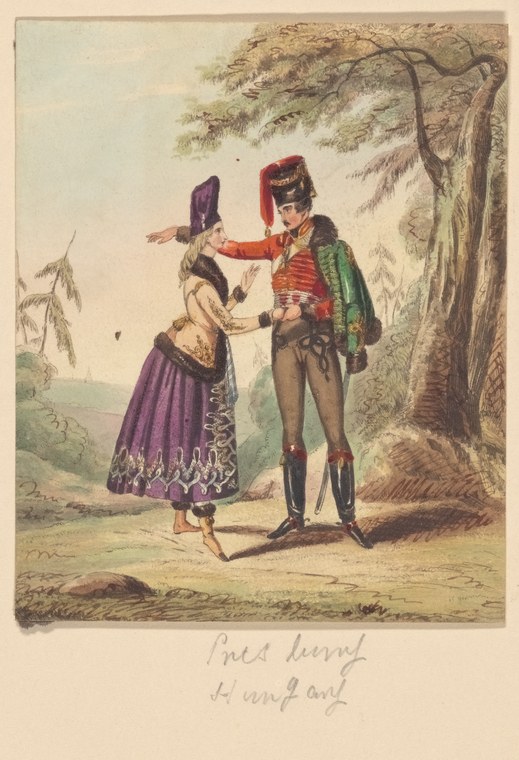
A young military officer in a bright red coat with gold braiding and green facings encounters a woman in a purple dress beneath tall trees on a wooded path. The woman, wearing a fashionable purple gown with ornate white trim at the hem and a distinctive purple plumed headdress, gestures expressively toward the officer with her right arm extended. The officer, in full dress uniform with white breeches and tall boots, faces her with one hand raised in a gesture of greeting or engagement. The setting is Romantic and picturesque—dappled light filters through the canopy of a large tree on the right, and the path stretches into middle distance with rolling hills visible. The composition captures a moment of courtship or flirtation, with the figures arranged in an elegant diagonal that emphasizes the formality of their interaction. A small handwritten inscription appears below the image but is difficult to read clearly.
The dancing
The two figures are positioned in a loose open stance, facing each other at an angle. The woman's weight appears to shift toward her right leg as her arm extends upward and outward in an animated, inviting gesture. The officer stands relatively still, his posture formal and upright as befits military dress. Neither figure is executing formal dance steps or holds; rather, they are engaged in the gestural language of aristocratic courtship and social interaction. The distance between them and their open, lateral positioning suggest a promenade or social greeting rather than a closed partnership.
The dance depicted
This appears to depict a moment from a social dance or courtship ritual of the early 19th century, most likely a Regency-era ballroom encounter. The elegant dress, military uniform, and woodland setting suggest the world of Regency romance literature and visual culture. The woman's animated gesture and the officer's responsive stance suggest the playful formality of a cotillion, quadrille, or similar structured social dance of the period, where such choreographed moments of approach and greeting were central to the dance form. The image captures not the execution of specific steps but the social theater of ballroom dancing—the moment of introduction and flirtation within a formal structure.
How it was made
This is a hand-colored engraving or aquatint, typical of early 19th-century popular prints. The delicate line work and careful modeling of the figures suggest copper-plate engraving, with watercolor or gouache applied by hand to create the vivid purples, reds, and greens. This technique was ideal for mass-produced social scenes intended for a middle-class market—images that captured the aspirations and romantic fantasies of the era. The labor-intensive hand-coloring indicates circulation among an educated audience who could afford such prints.
About this work
This hand-colored engraving captures a moment of Regency-era courtship set within the context of fashionable social dancing. The scene depicts a military officer and an elegantly dressed woman in a woodland setting, their poses and gestures suggesting the choreographed flirtation of early 19th-century ballroom dances. The print is a document of social convention: it shows not the technical execution of dance but the courtship ritual that dancing enabled. The precision of the figures' dress and the romantic setting place this squarely within the visual culture of Regency romance, where dance was the primary social arena for the interaction of unmarried men and women.
The work belongs in a dance history collection as evidence of what dancing meant in this period: not primarily a display of skill or athleticism, but a framework for courtship and social negotiation. The engraving illustrates the moment of encounter within that framework, the gesture and stance that gave form to social ambition and romantic aspiration.
How to look at it
The viewer should attend to the moment chosen: not the execution of steps, but the instant of greeting and acknowledgment. The woman's extended arm and the officer's raised hand are the focal point—this is the language of courtship translated into gesture. The careful attention to costume and setting—the fashionable purple dress, the military distinction of his coat, the picturesque woodland—indicates that the artist understood this as a scene of social aspiration, not merely of dancing. The composition, with the figures set against the tree line, creates a sense of intimacy and private encounter even as the precision of their dress speaks of public presentation.
The artist
The artist is not recorded in the collection, though the style and execution are consistent with early 19th-century popular printmaking produced in London or Paris. The handwritten inscription below the image may be a title or artist attribution, but it is not legible in reproduction. The quality of draftsmanship and the care in rendering costume detail suggest a professional engraver working within the commercial market for fashionable social prints.
The period
This print belongs to the Regency era (c. 1811–1820) or the decades immediately following, when the rigid formality of 18th-century court dances was yielding to new social dances of the ballroom. The quadrille, which arrived from France in the 1810s, and the cotillion represented a middle ground between the highly choreographed dances of the court and the emerging informal dances of the 19th century. These dances were structured and rule-bound, yet they allowed for improvisation and personal expression within those rules. The print captures the romantic ideology of the period: the belief that dance was the natural and proper context for courtship, and that elegance and propriety in dress and bearing were the measures of social worth.
Where it lives
The work is catalogued in the New York Public Library's collection of prints depicting dance. It is one of a large number of early 19th-century popular prints documenting social customs, dance, and courtship rituals. These prints were produced for a commercial market and widely distributed.
Dance in this work
Questions about this work
What dance is this showing?
The image does not show the execution of specific dance steps, but rather depicts the social context and courtship ritual of Regency-era ballroom dancing. The elegant dress and formal stances suggest dances like the cotillion or quadrille, where such moments of approach and greeting were choreographed. The print captures the theater of the ballroom rather than the technique of the dance.
Why is the woman wearing that unusual headdress?
The plumed headdress was fashionable female evening wear in the Regency period and appears in fashion plates and portraits of the era. It was designed to display wealth and status while adding height and visual drama to the silhouette. For a woman attending a ballroom, such an ornament was as much a part of the costume of dancing as her dress.
What does the military uniform tell us?
The officer's dress uniform indicates his rank and status. Military officers were prominent figures in Regency ballrooms, and their uniforms were markers of eligibility and prestige in the marriage market. The contrast between his formal military dress and her fashionable civilian gown suggests the complementary roles of male protection and female display that were central to Regency courtship ideology.
Is this based on a specific painting or literary scene?
The catalogue record does not identify a specific source, and the inscription is illegible. However, the scene is entirely consistent with the conventions of Regency romance literature and visual culture. It may be an original composition or an interpretation of a well-known narrative moment.
More dance artwork





