49 works in this view — arrow keys or swipe to move between them.
Dance in Art
Folk and ethnic costumes
Unknown artist
- Collection:
- Prints depicting dance
- Source:
- New York Public Library
- Rights:
- Public domain — free to use, share and adapt.
- Recorded as:
- Public Domain
For dance historians, the image preserves the bodily carriage, arm positions, and spatial relationships of early 19th-century quadrille or cotillion technique, before photographic documentation became possible. For students of fashion and material culture, it demonstrates how dance and dress were inseparable elements of genteel female performance, and how prints like this circulated idealized images of courtly femininity and grace. The combination of technical accuracy in the choreography and allegorical or satirical intent in the title raises questions about how dance was imagined as a vehicle for social commentary and national character in the Romantic period.
What you are looking at
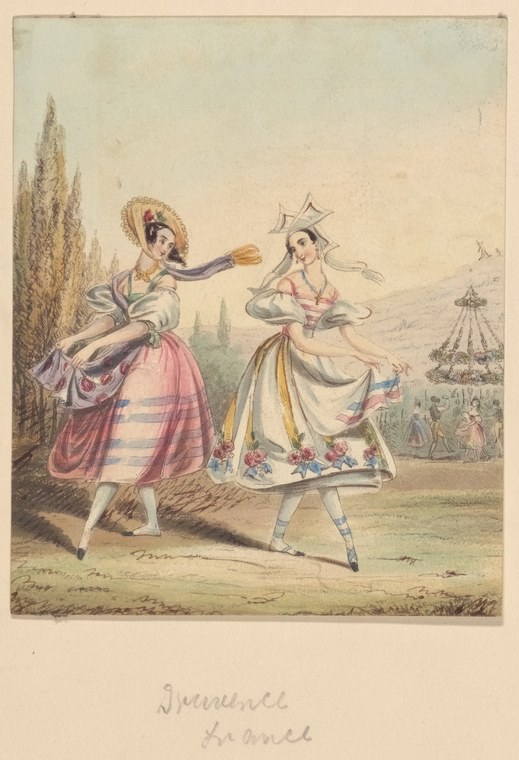
Two young women in elaborate early 19th-century dress dance outdoors in a formal garden setting. The woman on the left wears a pale dress with a deep pink or crimson overdress or shawl swept dramatically across her body, topped with a tall feathered headdress; she extends her arm toward her partner in a beckoning gesture. The woman on the right, in a white muslin dress with a yellow or gold sash and a simpler headdress, mirrors her companion's posture with arms raised. Behind them rises a tall cypress tree, and in the far background a pavilion or garden structure with crowds of spectators can be seen. The setting suggests an aristocratic garden party or fête champêtre. The composition captures the dancers mid-movement, their bodies angled toward each other in what appears to be a moment of coquettish greeting or invitation rather than a technical dance step. The hand-colored print renders the scene with delicate washes and careful attention to textile detail—the sheen of the fabrics, the texture of feathers, the drape of overdresses.
The dancing
Both dancers stand with knees slightly bent and weight forward on the balls of the feet, suggesting lightness and readiness to move. The woman on the left reaches one arm across her body toward her partner, while holding the other at her side; the woman on the right reciprocates with both arms raised in an open, welcoming frame. Neither dancer is in a closed ballroom hold; instead, the connection is gestural and flirtatious. The spacing between them—roughly two feet—and the turned-out positions of their legs suggest training in courtly dance, though the informality of the pose and the garden setting place this outside the ballroom. The posture and arm carriage read as purposefully elegant rather than athletic.
The dance depicted
This appears to depict a Regency-era social dance, most likely a quadrille or cotillion, executed in a garden setting as part of fashionable outdoor entertainment. The women's dress, the formal yet playful gesture, and the pavilion full of spectators all point to the early 19th century, when country dances and French quadrilles dominated the social calendar of the British gentry and aristocracy. The print is titled "Innocence & France," which may suggest a narrative or allegorical reading rather than documentary accuracy, but the choreographic elements—the open frame, the arm positions, the slight plié—are consistent with the quadrille technique of the period. The garden setting reflects the Romantic taste for blending dance, nature, and social ritual.
How it was made
This is a hand-colored engraving or aquatint, executed with fine linework and finished with watercolor or gouache washes. The technique allowed for precise rendering of fabric texture and the architecture of elaborate dress while maintaining the delicate tonal gradations necessary to suggest depth and light in the garden. The presence of color and the evident hand-finishing suggest this was a luxury object, likely sold to middle and upper-class print collectors who wished to own images of fashionable entertainment and dress. The print's small to modest size and the care lavished on detail indicate it was intended for a portfolio or collection rather than public display.
About this work
This hand-colored engraving captures an early 19th-century moment of courtly flirtation in a garden setting, showing two women in high fashion engaging in what appears to be a quadrille or social dance of the Regency era. The work documents both the choreographic conventions of the period—the open frame, the arm carriage, the slight flexion of the knees—and the material culture of dance: the elaborate muslin and silk dress, the headdresses, the garden pavilion designed for public performance. The inscription 'Innocence & France' hints at a satirical or allegorical intent, suggesting the print may be commenting on French taste and manners in Britain. As a record of how social dance was practiced, imagined, and marketed to a fashionable audience in the Regency period, it is a valuable index to both dance history and the visual culture of the era.
How to look at it
Notice the precision with which the artist has rendered the dancers' posture: the slight bending of the knees, the turned-out legs, the carriage of the head and shoulders. These are not exaggerated or idealized but appear to be faithful observations of how the body moved in early 19th-century courtly dance. The informality of the gesture—the reach across the body, the open arms—suggests a moment of greeting or invitation rather than a formal figure, and the garden setting allows for a more relaxed and playful rendering than a ballroom scene would permit. The title 'Innocence & France' should prompt the viewer to ask what critique or commentary the print may be making: does the composition celebrate or mock the dancers and their setting? The presence of the pavilion and spectators in the background suggests that dance was a public performance, observed and judged by society.
The period
The early 19th century saw an explosion in the production and consumption of hand-colored prints depicting fashionable life, particularly scenes of dance, dress, and courtship. The quadrille, imported from France and adopted enthusiastically by British society, became a symbol of refined taste and cosmopolitan manners. At the same time, print culture allowed satirists and social commentators to critique French influences on British fashion and behavior—a tension evident in the title 'Innocence & France,' which suggests a playful suspicion of French morals and aesthetic values. The garden setting reflects the Romantic period's investment in nature as the setting for refined emotion and social encounter. Regency-era dance prints were produced for a broad middle-class audience and often combined documentary detail about dress and deportment with wit and social observation.
Where it lives
The work is held in the New York Public Library's collection of prints depicting dance. It is catalogued as an example of folk and ethnic costume imagery, though the subject is in fact a scene of fashionable Regency social dance rather than vernacular or ethnic practice. The collection suggests that the print was valued as a record of dress and social life rather than as a work of fine art.
Dance in this work
Questions about this work
What dance are they doing?
Most likely a quadrille or cotillion, the fashionable French social dances that dominated British ballrooms in the early 19th century. The open frame, the arm positions, and the setting all support this identification. However, the garden setting and the informal, flirtatious gesture suggest this is a stylized or imaginative rendering rather than a strict documentation of technique.
Why is it called 'Innocence & France'?
The title is likely satirical, playing on anxieties about French cultural influence in Regency Britain. 'Innocence' may be ironic, suggesting that the elegant, fashionable women in the print are anything but innocent, and that French taste and manners were viewed with suspicion by British society. The print may be inviting viewers to enjoy both the beauty of the scene and a mild critique of its fashionability.
What technique was used to make this?
This is a hand-colored engraving or aquatint, finished with watercolor or gouache. The technique allowed for fine detail in the rendering of fabric and dress while maintaining soft tonal gradations in the garden background. Hand-coloring made such prints luxury objects, affordable mainly to middle and upper-class collectors.
How does this compare to other dance prints of the period?
Regency-era dance prints typically combine documentary interest in fashion and deportment with wit and social commentary. This print is notable for its garden setting, which was less common than ballroom scenes, and for the apparent allegorical or satirical intent suggested by the title. The precision of the dancers' posture is consistent with prints aimed at a fashionable, educated audience.
More dance artwork





