49 works in this view — arrow keys or swipe to move between them.
Dance in Art
Folk and ethnic costumes
Unknown artist
- Collection:
- Prints depicting dance
- Source:
- New York Public Library
- Rights:
- Public domain — free to use, share and adapt.
- Recorded as:
- Public Domain
For historians of dance and social custom, this print documents the visual codes of early 19th-century military and folk dress at the precise historical moment when Napoleon's armies were reshaping European society. The encounter between military uniform and folk costume is itself a historical record: it shows which regional traditions were still visible and valued in the early 19th century, and how they were staged for consumption by urban, middle-class audiences. The stiffness and formality of both figures—the absence of active movement—reveals the highly controlled, rule-bound nature of social dance in this period.
What you are looking at
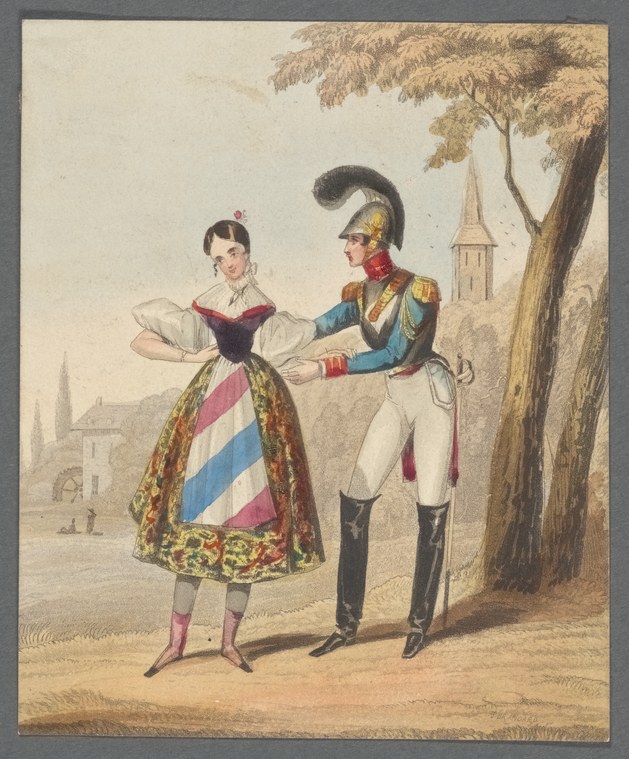
A military officer in early 19th-century dress encounters a woman in regional folk costume in a park-like setting. The officer wears a high-crested helmet, blue coat with gold epaulettes and trim, white breeches, and black boots—the uniform of a Napoleonic-era cavalry or dragoon officer. The woman wears a dark velvet bodice with white chemise sleeves, a full skirt decorated with bold diagonal stripes in blue, pink, and gold brocade, and a decorative shawl or overdress. Both figures stand on a sandy path beneath tall trees; church spires are visible in the misty distance, suggesting a European town square or public garden. The officer gestures toward the woman with his right hand in a posture of courtship or invitation, while she faces him with an alert, interested expression. The scene captures a moment of social encounter—neither clearly a dance, though the formal postures and careful placement suggest choreographed social interaction or the prelude to one.
The dancing
Both figures stand in an upright, formal posture typical of early 19th-century deportment. The officer's weight is evenly distributed; his right arm extends in a gesture of address or invitation, while his left hand rests near his sword hilt. The woman stands facing him, her posture open and receptive. Neither figure displays the flexed knees, weight shift, or arm frame characteristic of active dancing; instead, they embody the stiff vertical alignment of social presentation and court etiquette. The spatial relationship is intimate but correct—close enough for conversation, far enough for propriety.
The dance depicted
This image most likely depicts a moment of courtship or social encounter in early 19th-century military society rather than an active dance. The title 'Folk and ethnic costumes' suggests the work is documenting regional dress traditions, and the woman's costume is unmistakably folk—possibly Central European, Hungarian, or Alpine in origin, based on the bold striped overdress and embroidered detail. The officer's uniform and the woman's folk dress underscore a social hierarchy and cultural encounter. If a dance is implied, it would be a formal court dance of the Regency or early Napoleonic period—a minuet, contredanse, or quadrille—but the image shows only the social preliminaries, not the dance itself. The rigid postures preclude identifying a specific dance style with confidence.
How it was made
This is a hand-colored lithograph or engraving, executed with fine detail characteristic of early 19th-century European popular prints. The coloring is applied selectively and with restraint—the military uniform and folk costume receive vivid color (gold, red, blue), while the background is left largely monochromatic (sepia wash and gray tones). The technique allows both precision in costume detail and a picturesque, theatrical composition. The style and quality suggest this was a commercial print—possibly French or Austrian—produced for a middle-class audience interested in military fashion and regional ethnography. The hand-coloring indicates this was an expensive, finished object rather than a mass-produced illustration.
About this work
This is an early 19th-century hand-colored print depicting a moment of social encounter between a military officer and a woman in folk costume. The work sits at the intersection of military portraiture, ethnographic documentation, and romantic courtship imagery—genres that were all popular in the years following the Napoleonic Wars. It belongs in a gallery of dance imagery because it captures the social world in which formal and courtship dances took place: the dress codes, the gender dynamics, the public spaces where social dancing occurred, and the moment immediately before movement began. The image is more about the culture of dance than the dance itself.
How to look at it
Attend first to the costumes: the officer's uniform is specific and authoritative, while the woman's dress is clearly marked as 'other'—regional, folk, picturesque. Notice the spatial gap between them and the careful posture of both figures—this is not spontaneous movement but choreographed social interaction. The formal gestures and upright alignment show how constrained early 19th-century social movement was, even in moments of courtship. The background landscape—the church, the trees, the public setting—shows that this encounter is framed as a theatrical scene, not a documentary one. The hand-coloring directs the eye: the bright colors on costume, the neutral wash on setting.
The period
This print dates from the early 19th century, a period when military uniforms became objects of intense visual interest and popular fascination across Europe. The Napoleonic Wars had made soldiers visible in every town and village; military dress became a symbol of national identity and masculine power. Simultaneously, the early Romantic movement was generating intense interest in folk traditions, regional costumes, and 'authentic' national character—a fascination that drove ethnographic prints, costume books, and theatrical spectacle. Dance was central to both worlds: military officers danced cotillion and contredanse at formal balls; folk traditions were being collected, performed in theaters, and depicted in prints for urban audiences. This image sits at the convergence of these trends.
Where it lives
This print is held in the New York Public Library's collection of prints depicting dance. It is catalogued with minimal metadata; the artist is not recorded, nor is the date or medium. Based on style and technique, it is a European hand-colored engraving or lithograph from the early 19th century.
Dance in this work
Questions about this work
Is this a dance or just a costume study?
The image shows a moment before or between dance, not an active dance. The rigid postures, formal gestures, and upright alignment reflect the deportment codes of early 19th-century social dance—the precision and restraint required of dancers in that period—but no one is dancing here. The work is primarily a costume and social history document, though it illuminates the world in which formal dances took place.
What does the woman's costume tell us?
The bold striped overdress, embroidered decoration, dark velvet bodice, and white chemise are characteristic of Central European or Alpine folk dress, possibly Hungarian or South German. The fact that it is depicted alongside a military officer suggests this was a fashionable or picturesque regional tradition that urban audiences wanted to see and collect. Folk costume was being documented, theatricalized, and commodified for middle-class consumption in this period.
Why would a military officer meet a woman in folk dress?
This is likely a staged scene rather than a documentary one—a theatrical arrangement designed to show the contrast between military uniform and folk tradition. It may have been intended as a souvenir print of military fashion, or as part of a larger series on European regional costumes. Alternatively, it could illustrate a romantic or comic encounter—military officers were stock characters in popular plays and prints of the period.
More dance artwork





