49 works in this view — arrow keys or swipe to move between them.
Dance in Art
Le théâtre des Funambules
Unknown artist
- Collection:
- Prints depicting dance
- Source:
- New York Public Library
- Rights:
- Public domain — free to use, share and adapt.
- Recorded as:
- Public Domain
The Théâtre des Funambules represents a tradition of theatrical entertainment—sometimes called popular theater or boulevard theater—that was as influential on the development of modern performance as academic ballet was, yet is far less documented in art historical scholarship. Dancers, choreographers, and historians studying 19th-century theatrical practice need to understand the full spectrum of performance venues and styles, not only the opera house. This print is direct evidence of that world.
What you are looking at
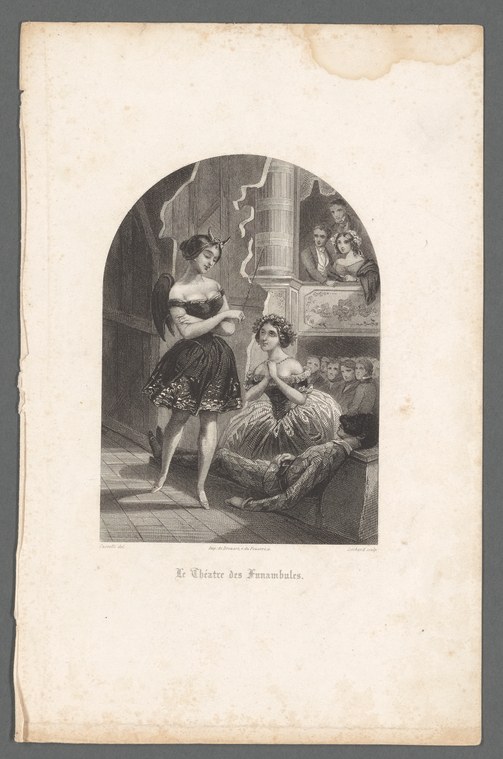
A woman in theatrical dress stands at center-left, her body angled toward a seated figure who gestures expressively from the right side of the composition. The standing woman wears a dark, elaborately patterned skirt with ornamental detail and a fitted bodice; her upper body is bare-shouldered or in a sheer material. She regards the seated figure with apparent interest or concern. Behind them, through an arched architectural frame, a second scene unfolds in softer focus: additional figures observe from what appears to be a booth or gallery space. The setting is decidedly theatrical—classical in its proportions, with draped fabric visible at the upper left. The entire scene is rendered in a dense tonal technique that creates a sense of controlled drama, with strong contrasts between lit and shadowed areas. The composition is vertical and intimate, framed within an arch that emphasizes the stage-like quality of the moment.
The dancing
The standing woman's posture is upright and posed, with weight balanced evenly; her gaze is directed downward toward the seated figure. Her arms are not in a closed dance hold; instead, one arm hangs naturally while the other is positioned near her body. The seated figure (possibly male, possibly a character figure) leans forward with animated arm gestures that suggest speaking or emphatic expression rather than dance movement. Both figures occupy a shallow stage space perpendicular to the picture plane, suggesting a theatrical rather than social dance context. The architectural frame and the presence of spectators indicate this is a staged entertainment rather than participatory dancing.
The dance depicted
This image depicts theatrical entertainment at the Théâtre des Funambules (Theatre of the Tightrope Walkers), a famous Parisian venue known in the 19th century for pantomime, acrobatics, and spectacular staging rather than classical dance. The scene appears to show a dramatic or comedic moment from a pantomime performance—the expressive gesture and posed relationship between the figures suggest narrative action rather than dance steps. The standing woman may be a dancer-performer in the tradition of theatrical dance, but the emphasis here is on theatrical gesture and character interaction, not choreography. The work documents a mode of theatrical performance in which dance, acrobatics, and pantomime were integrated into popular entertainment.
How it was made
This is an engraving, rendered in a tonal technique with careful use of parallel lines and cross-hatching to build form and shadow. The fine detail and tonal control are characteristic of 19th-century reproductive engraving, likely made as a print for circulation in books, periodicals, or as a standalone theatrical souvenir. The arched framing device—common in theatrical illustration of the period—directs attention to the performance and emphasizes the architectural theater space. This technique and format suggest the work was intended for a broad educated audience interested in Parisian entertainment and theatrical culture.
About this work
Le théâtre des Funambules is an engraved theatrical scene documenting performance at one of 19th-century Paris's most celebrated popular theaters. The print captures a moment of dramatic interaction between two performers, rendered with the refined tonal technique characteristic of mid-19th-century reproductive engraving. The work belongs in a gallery of dance imagery not because classical dance is the primary focus, but because it documents the theatrical ecosystem in which dance, pantomime, and acrobatics were performed and celebrated—a crucial context for understanding theatrical dance outside the academy and the ballet stage.
The Funambules was legendary for spectacle: it presented pantomimes, tumbling, elaborate staging, and popular entertainment that delighted working-class and educated audiences alike. This image preserves a moment from that world, showing not a formal choreography but the narrative and gestural language of theatrical performance.
How to look at it
The viewer should attend to the exact moment chosen: not a step or leap, but a moment of dramatic interaction—the woman's attentive stance, the seated figure's emphatic gesture. This is typical of theatrical illustration of the period, which prioritized narrative and character over the formal beauty of the body in motion. Note how the arched frame creates a picture-within-a-picture, emphasizing the artifice and stagecraft; note also the spectators glimpsed in the background, reminding us that this is a public performance for an audience, not a private or social dance. The engraver has chosen to capture a climactic or comedic moment rather than a moment of pure physical virtuosity.
The period
The Théâtre des Funambules operated from 1816 to 1862 on the Boulevard du Temple in Paris and became legendary under the direction of Anselme Mathieu (1825–1862). The theater was celebrated for pantomime—especially the character Pierrot, performed by the great Jean-Gaspard Deburau—and for spectacular acrobatic and visual effects. In the same era, Romantic ballet (with its emphasis on ethereal, otherworldly figures and narrative spectacle) was at its height at the Opéra; the Funambules offered a parallel theatrical culture rooted in physical comedy, improvisation, and popular appeal. The popularity of prints documenting Funambules performances indicates strong public appetite for theatrical imagery and record-keeping in the mid-19th century.
This image dates to that period of the theater's fame, likely between the 1830s and 1850s. It reflects the mid-century print culture in which theatrical scenes were widely reproduced and circulated, allowing audiences to relive performances and non-attendees to experience them vicariously. The refinement of the engraving technique suggests it was made for an educated audience willing to pay for high-quality theatrical documentation.
Where it lives
This engraving is held at the New York Public Library in its collection of prints depicting dance. The provenance and date are not recorded in the catalogue, but the style and subject matter place it as a 19th-century Parisian theatrical print, likely produced for circulation as a souvenir or illustration in theatrical publications.
Dance in this work
Questions about this work
Was the Théâtre des Funambules a dance theater?
Not primarily. It was known for pantomime, acrobatics, and spectacular visual effects. However, dancers and acrobats were integral to its performances, and the boundary between dance, acrobatics, and theatrical movement was not sharply drawn in popular theater. Understanding the Funambules is essential for understanding the full ecology of theatrical performance in the 19th century.
What is a funambule?
A funambule is a tightrope walker. The theater took its name from its origins as a venue for acrobatic and rope-dancing spectacles. By the time this print was made, the theater had become famous for pantomime and elaborate theatrical productions, though acrobatics remained part of the repertoire.
Who was Jean-Gaspard Deburau?
Deburau was the greatest Pierrot of the 19th century, famous for his silent pantomimic performances at the Funambules from 1825 until his death in 1846. His refined, expressive style brought respectability and artistic prestige to popular theater and influenced both theater and ballet of the Romantic era. This print may document a performance by or in the style of Deburau's theater company, though we cannot identify the specific performer.
Why is this print worth looking at if it is not 'pure' dance?
Because dance does not exist in isolation. The Funambules represents a parallel theatrical tradition in which movement, spectacle, and character were integrated. For historians and artists studying 19th-century theatrical practice, this image documents an influential mode of performance that shaped modern theater and influenced how ballet itself incorporated narrative, comedy, and physical virtuosity.
More dance artwork





