49 works in this view — arrow keys or swipe to move between them.
Dance in Art
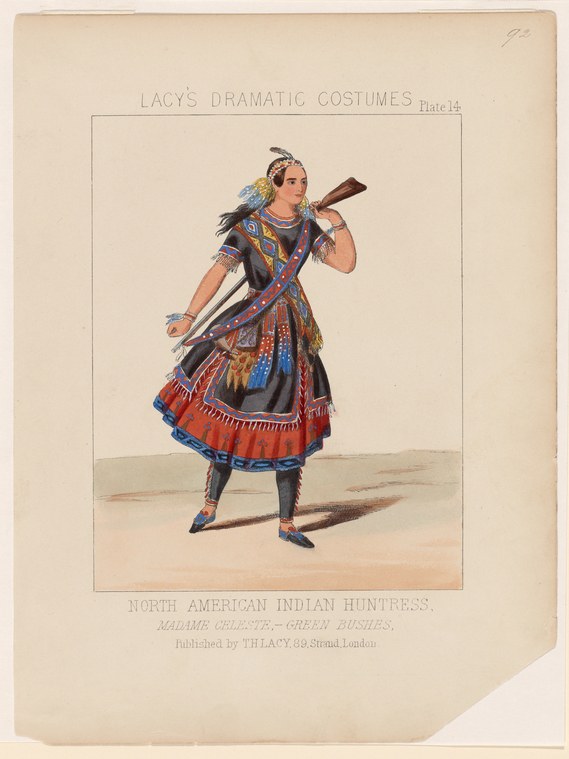
North American Indian huntress, Madame Celeste, Green bushes
Unknown artist
- Collection:
- Prints depicting dance
- Source:
- New York Public Library
- Rights:
- Public domain — free to use, share and adapt.
- Recorded as:
- Public Domain
Madame Celeste was one of the most celebrated performers of her era, and this image documents both her star power and the kinds of roles—physically demanding, dramatically charged, centred on the performer's charisma and costume—that defined her career. The work also reveals the 19th-century theatre's appetite for exotic and orientalist spectacle, and how dance was deployed within that framework as a vehicle for character and narrative rather than as an autonomous art form.
What you are looking at
A single figure stands against a pale ground in theatrical costume, posed in a dynamic hunting stance. The performer wears a richly decorated tunic in deep blue and gold brocade with geometric patterning, a short skirt with a bright red pleated ruffle at the hem, and dark stockings with blue shoes. A feathered headdress sits atop the head—the feathers are vivid blue, suggesting either dyed ostrich plume or an exotic bird. The figure holds a rifle across the body at an angle, one arm extended upward in a confident gesture. The pose suggests motion: the body twists, one leg planted firmly while the weight shifts, the free arm raised. The theatrical lighting creates a sharp shadow beneath the figure against the neutral stage floor, emphasizing the three-dimensionality of the pose and the formal presentation typical of theatrical documentation.
The dancing
The single dancer is captured mid-turn or mid-stride, weight balanced on one leg with the torso rotated and the upper body opened toward the viewer. The raised arm and the angle of the rifle create a diagonal line of force across the frame. The posture is upright and commanding rather than graceful in the classical sense—it reads as bold, martial, and active. The costume is fitted but allows full range of motion in the hips and legs, and the visible footwork (dark shoes, blue stockings) suggests the dancer is en demi-pointe or in a wide, grounded stance.
The dance depicted
This image documents a theatrical character dance of a type popular in the 19th-century stage: the representation of an indigenous figure within a European dramatic or spectacular context. The title identifies the wearer as Madame Celeste, a celebrated French-English dancer-actress, in the role of a 'North American Indian huntress' from a work titled or featuring 'Green Bushes.' The pose, costume, and prop are choreographic—this is not documentary of actual indigenous dance practice but rather a stylised theatrical interpretation designed for European audiences. The dance itself appears to emphasise dramatic posture and character portrayal over technical virtuosity; the energy is narrative and gestural rather than balletic.
How it was made
This is a hand-coloured lithograph or engraving, identifiable by the fine linear detail, the tonal gradation, and the precise registration of the figure against the pale ground. The watercolour or gouache hand-colouring is even and controlled, particularly in the deep blues and reds of the costume. The technique allowed for mass reproduction of costume designs and cast documentation, circulating theatrical images to audiences and archives far beyond the theatre itself. As a plate from Lacy's Dramatic Costumes (a publisher's series of theatrical prints), this object served both as a record of performance and as a model or reference for other theatres, costumers, and performers.
About this work
This is a theatrical costume print documenting Madame Celeste in a character role from the mid-19th-century stage. It belongs to Lacy's Dramatic Costumes, a publisher's series designed to circulate images of celebrated performers and their roles to a broad theatrical and amateur audience. The work represents a particular strand of 19th-century theatre: the spectacular dance-drama that incorporated exotic or 'primitive' characters, often played by celebrated dancers in costume. The image is not a representation of indigenous American dance but of the European theatrical imagination of it—a stylised, dramatic character part performed for dramatic effect by a professional dancer trained in the European theatrical tradition.
How to look at it
Attend to the pose: it is frozen mid-movement, with the body twisted and the arm raised in a gesture that suggests narrative and character rather than pure dance technique. The costume is detailed enough that a viewer can see how it was constructed and how it moved. The rifle and headdress are props that anchor the character in a story. The print is a costume *documentation*—a record made for theatrical circulation—and should be read as evidence of how this particular performer, in this particular role, was dressed and how she held her body on the stage.
The artist
The costume design and engraving are not individually attributed in the print. Lacy's Dramatic Costumes was a publishing project begun in the 1850s by Thomas Hailes Lacy, a London theatrical publisher and playwright, designed to document celebrated performances and make costume and scenic designs accessible to theatres and amateurs throughout the English-speaking world. The prints were typically based on performance documentation and were produced by a workshop of engravers and colourists rather than a single artist.
The period
The mid-19th century was the heyday of romantic theatre and the spectacular dance-drama. Madame Celeste's career (she performed from the 1820s through the 1860s) spanned the transition from Romantic ballet to music-hall and spectacular theatre. The character of the 'exotic' or 'savage' figure was a stock theatrical type, often danced by celebrated performers as a vehicle for technical display and dramatic characterisation. 'Green Bushes' (also known as 'The Wild Huntress of Bohemia') was one of several mid-century plays and spectacles that featured such roles. The theatrical imagination of the 'North American Indian' in this period was entirely European—romanticised, sexualised, and structured around the body of the performer rather than any documentary interest.
Where it lives
This print is from the New York Public Library's collection of prints depicting dance. It is one of a series of theatrical costume prints published by T. H. Lacy & Co. of Strand, London, in the mid-19th century. Such prints were produced for circulation to theatres, costumers, and amateur dramatic societies.
Dance in this work
Questions about this work
Was Madame Celeste actually a dancer?
Celeste was primarily an actress and performer trained in pantomime and spectacular theatre, but dance was a central part of her art. She was celebrated for her movement, physicality, and ability to perform in roles that required both dramatic acting and virtuosic dance technique. She was not a classical ballet dancer, but a theatrical performer working in a tradition that blended drama, dance, and spectacle.
Is this costume based on real indigenous American dress?
No. This is a European theatrical fantasy—a costume designed for visual effect on the stage, using bright colours, exotic feathers, and tailored construction that would have been impossible to replicate in historical or ethnographic contexts. It represents what the 19th-century European theatre imagined 'wildness' and 'exoticism' to look like, not any actual indigenous American clothing or practice.
What was 'Green Bushes'?
A mid-19th-century play or spectacular featuring Madame Celeste in the title role of a wild huntress. Several such works existed with similar plots and character types. The print documents Celeste's costume and pose in one such performance, but the exact production is not specified in the print itself.
Why would a dancer's costume be printed and circulated like this?
Theatrical costume prints served multiple purposes: they documented celebrated performers and roles for audiences who could not see the performances live; they circulated designs to other theatres and amateur dramatic societies who wanted to stage or restage the work; and they served as publicity and merchandise. Lacy's series was particularly influential in making theatrical design accessible to provincial and amateur theatres.
More dance artwork





