49 works in this view — arrow keys or swipe to move between them.
Dance in Art
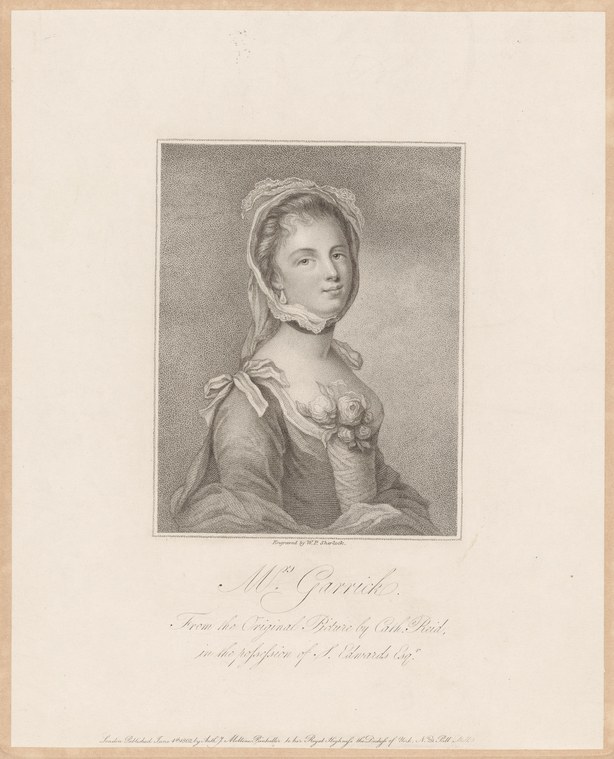
Mrs. Garrick
Unknown artist
- Collection:
- Prints depicting dance
- Source:
- New York Public Library
- Rights:
- Public domain — free to use, share and adapt.
- Recorded as:
- Public Domain
The portrait reveals how thoroughly dance-derived ideals of the body had penetrated eighteenth-century culture, even in images that show no dancing. The woman's posture and bearing are products of ballroom training; her body is legible as refined and accomplished partly because viewers of the time understood dance as a core technology of gentility. For dance historians, such portraits are evidence of how dance shaped not just performance but everyday bodily presentation and self-representation among the fashionable classes.
What you are looking at
A three-quarter-length portrait of a young woman in eighteenth-century dress, shown in three-quarter view against a neutral gray background. She wears a low-necked gown with draped fabric at the shoulders and a decorative bow or knot at the bodice; her hair is drawn back and covered with a fine linen cap or coif tied under the chin. Her pose is relaxed and elegant, with one shoulder dropped slightly forward in a posture characteristic of fashionable portraiture of the period. The engraving is finely executed with delicate tonal gradation suggesting fabric texture and the softness of skin. The composition is intimate and formal simultaneously—a portrait of a woman of quality rather than a narrative scene.
The dancing
A single standing figure shown at half-length. The woman's stance is asymmetrical, her weight resting on one leg while the other appears slightly advanced, creating the gentle S-curve of the body valued in eighteenth-century deportment. Her shoulders are relaxed; her arms hang naturally at her sides. The pose suggests the studied ease of a woman trained in the carriage and bearing expected of her social rank, but there is no active dance movement or partnered interaction.
The dance depicted
This is a portrait, not a dance scene, and depicts no active movement or dance. The woman's posture and bearing reflect the dance-derived ideals of bodily elegance and refined deportment that saturated eighteenth-century culture—the straight spine, the controlled asymmetry, the graceful curve of the body were all products of training that included dance as a core element of genteel education. The image documents these aesthetic values rather than showing dance itself.
How it was made
This is a finely-executed engraving, likely mezzotint or stipple engraving based on the soft tonal gradations and refined detail characteristic of high-quality portrait prints of the late eighteenth century. The technique allowed for subtle modulation of light and shadow across the face and fabric, creating an illusion of three-dimensionality and luxurious texture. Such prints were produced for circulation among the fashionable classes and could reach a wide audience, making the subject's image mobile and reproducible in a way that oil painting could not achieve.
About this work
This is a portrait engraving of Mrs. Garrick, identified in the inscription below the image. The work dates to the late eighteenth century based on fashion and printmaking technique, though the catalogue record does not supply a precise date or artist attribution. It is a high-quality reproductive print, likely commissioned to commemorate or celebrate the subject's position in fashionable society. The image belongs in a gallery of dance in art not because it depicts dance itself, but because it embodies the aesthetic ideals—bodily elegance, controlled grace, the cultivated asymmetry of the trained body—that dance taught and refined during this period. The woman shown here would have received training in dance as an essential accomplishment, and her bearing reflects that training even in stillness.
How to look at it
Notice the precise, almost mathematical asymmetry of the pose: one shoulder lower than the other, one leg advanced, the curve of the spine creating an S-bend that is neither rigid nor limp but poised between them. This is not a static standing position but an elegant stance that suggests potential for movement—the body held in readiness. The artist has chosen a moment of repose that still communicates accomplishment and training. The draping of the fabric reinforces the elegance of the figure, catching light in ways that emphasize the form beneath.
The artist
The inscription reads "Engraved by P. W. Tomkins," identifying the printmaker as Peter William Tomkins, a respected stipple engraver active in London in the late eighteenth and early nineteenth centuries. Tomkins was known for producing high-quality reproductive prints of portraits and other subjects for a fashionable and educated market. He often worked from paintings by other artists, translating them into the refined tonal language of engraving. The quality of this print—the subtlety of the tonal work, the precision of the line—is consistent with his reputation as one of the finest portrait engravers of his era.
The period
This portrait dates to the era when the Regency and late Georgian taste in dress and deportment was at its height. In dance, this was the period of the cotillion, the quadrille, and the continued dominance of country dance and the cotillion in fashionable ballrooms. Dance was increasingly formalized and codified as a social accomplishment; deportment and bearing were inseparable from one's social standing. Women of the gentry and upper-middle class were expected to move with trained grace; portraiture of the period frequently captured this idealized bodily ease, which dance both created and validated.
Where it lives
This is a reproductive print held in the New York Public Library's collection of prints depicting dance. It is catalogued under the title "Mrs. Garrick," with an inscription crediting the engraver but providing no other publication or dating information in the visible record. The print is part of a broader archival effort to document how dance appeared in visual culture across media and time periods.
Dance in this work
Questions about this work
Was Mrs. Garrick a professional dancer?
The inscription and image suggest she was a woman of social standing—likely the wife of someone prominent, or a woman of the gentry—rather than a professional performer. "Mrs. Garrick" may refer to the wife of actor-manager David Garrick, though the catalogue record does not confirm this. Fashionable women of this rank received dance training as an accomplishment and would have danced at balls and private gatherings, but not on the professional stage.
Why is this in a dance collection if she is just standing still?
Her posture and bearing are products of dance training and dance-derived aesthetic values. In the eighteenth century, dance was not merely a performance activity but a core technology of genteel embodiment. The graceful, asymmetrical stance shown here is legible to viewers of the time as evidence of training and refinement—training that was inseparable from ballroom dance. The image documents how dance shaped everyday bodily presentation among the fashionable classes.
Can you identify the artist?
The print is signed "Engraved by P. W. Tomkins," identifying the engraver as Peter William Tomkins, a highly respected stipple engraver of the late eighteenth century. However, Tomkins typically worked from paintings or designs by other artists. The catalogue record does not identify the original painter or designer whose work Tomkins translated into this print.
When was this made?
The style of dress, the technique of the engraving, and the inscription suggest a date in the late eighteenth century, most likely between 1780 and 1810. However, the catalogue record does not supply a specific date of publication or creation. The fashion—the high-waisted gown, the simple coif—is consistent with the 1790s-1800s, but precision is not possible from the image alone.
More dance artwork





