49 works in this view — arrow keys or swipe to move between them.
Dance in Art
Le Bal Mabille
Unknown artist
- Collection:
- Prints depicting dance
- Source:
- New York Public Library
- Rights:
- Public domain — free to use, share and adapt.
- Recorded as:
- Public Domain
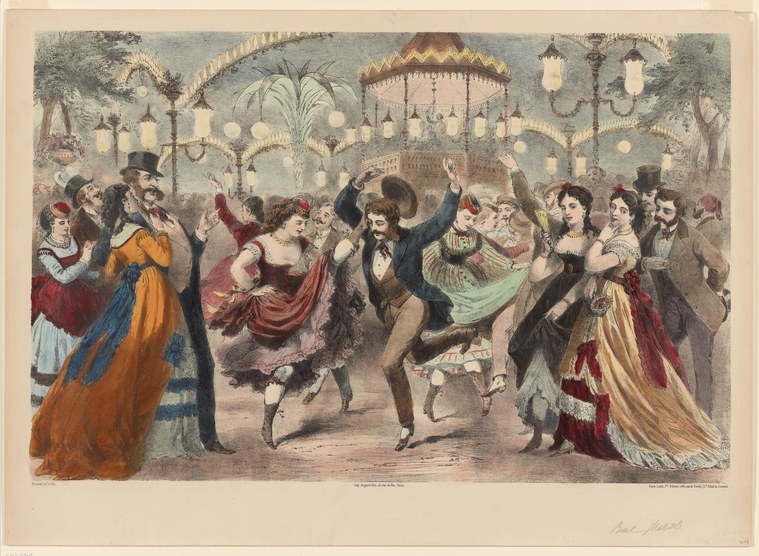
The Bal Mabille was one of the defining social dance venues of the nineteenth century and a touchstone of Parisian modernity; prints documenting its atmosphere are primary historical sources for understanding how social dance functioned as a site of transgression, pleasure, and social mixing. This image shows the actual movement vocabulary and social choreography of the venue—not the polished theatrical waltz but the exuberant, sometimes carnivalesque abandon of a public garden where dancing bodies were on display for each other, making it invaluable evidence of how nineteenth-century urban society actually danced.
What you are looking at
A crowded, festive outdoor dance scene set in an ornamental garden or public pleasure ground, viewed from an elevated perspective. A central pavilion with a peaked roof and hanging lanterns dominates the composition, surrounded by gas lamps on tall posts that cast pools of light. The foreground is densely populated with fashionably dressed figures in mid-nineteenth-century attire—men in dark coats and top hats, women in full skirts of vivid colours (crimsons, golds, oranges, blues) and bonnets. The crowd forms a loose ring around a central open space where several couples are actively dancing. The composition radiates outward from the pavilion, with dancing figures in the immediate foreground, curious onlookers clustered in groups, and trees framing the sides. The palette is soft and hand-coloured—pale blues for the sky, muted greens for foliage, rich jewel tones for the women's dresses, and warm ochres for the architectural elements. The print captures a moment of energetic gaiety, with several dancers in the centre captured mid-movement, their bodies animated and unselfconscious, while spectators watch, converse, or promenade.
The dancing
Multiple couples and groups are visible in various states of motion. In the immediate foreground, a man in dark clothes and top hat is captured in a dynamic, high-spirited leap or caper—one leg extended, arms raised in exuberant gesture—while women in bright skirts surround and respond to his movement. Other couples are in more formal closed-hold positions, suggesting waltzing or ballroom contact. The bodies show the characteristic lightness and buoyancy of recreational dance rather than formal theatrical performance; the dancers appear to be enjoying themselves without rigid discipline. Weight shifts and lifted postures are evident in several figures. The gender dynamics show women as full participants, not merely passive partners, with their own animated responses to the music and the carnival atmosphere.
The dance depicted
This depicts a scene from Bal Mabille, the famous open-air public dance garden that operated in Paris in the mid-nineteenth century (1840s–1870s). The Mabille was celebrated as a venue for uninhibited social dancing—a place where working-class and middle-class Parisians came to waltz, polka, and quadrille under the stars. The print captures the characteristic spirit of such venues: a mix of couples in ballroom hold (waltzing or polka), solo dancers executing high kicks and capers for the entertainment of spectators, and the intermingling of dancers and watchers. The informal, almost carnivalesque mood—with the exuberant central figure's high leap—reflects how the Mabille was experienced as more liberated and playful than formal ballroom dancing. This is social dance of the 1850s–60s, specifically the Parisian public garden dance scene.
How it was made
This is a hand-coloured engraving or lithograph, executed with fine linear detail and soft watercolour or gouache applied over the printed base. The technique allowed for the reproduction and wide circulation of fashionable scenes to a middle-class audience—prints like this were sold as popular prints to commemorate celebrated Parisian entertainments. The hand-colouring gives the scene warmth and immediacy while the underlying print provides crisp architectural and figural definition. The medium suggests this was a commercial print, likely produced for a broad market rather than a unique artwork, and it would have circulated among Parisians nostalgic for or curious about the famous Mabille venue.
About this work
This is a hand-coloured engraving or lithograph depicting Bal Mabille, the legendary Parisian public dance garden of the mid-nineteenth century. The print shows a festive scene of couples and spectators gathered under lanterns and pavilions for social dancing—waltzes, polkas, and quadrilles—in an atmosphere of uninhibited pleasure. The work documents both the social reality and the romantic allure of the Mabille, a venue that symbolised the modernisation of leisure in nineteenth-century Paris and offered a rare space where the boundaries of class and decorum could be temporarily suspended through dance. For anyone studying the history of social dance, public entertainment, or urban pleasure culture in the nineteenth century, the Mabille scene is iconic—and this print is a direct commercial representation of how the venue was experienced and marketed to its audience.
How to look at it
Note the artist's choice to capture the moment at its peak of activity and exuberance: the central male dancer is frozen mid-leap, his body flung upward in an excess of energy that reads as liberation and joy. The composition uses the pavilion and lanterns to create depth and order, but allows the dancers themselves to break free of rigid formation—some in formal pairs, others singly, others in loose groupings. The hand-colouring draws the eye first to the brilliant reds, golds, and oranges of the women's skirts, which dominate the composition and convey both the material prosperity and the visual spectacle of the venue. Pay attention to how the print manages the distinction between dancers (at the centre, in motion) and spectators (at the edges, static or conversing)—this is a choreography of the crowd itself.
The artist
The artist is not recorded. The print was likely produced by a commercial publisher in Paris, possibly one specialising in popular topographical and entertainment scenes. Such prints were often created collaboratively, with an engraver or lithographer working from a sketch or design. The Mabille was a celebrated subject for popular imagery in the 1850s–60s, so multiple versions and variants exist.
The period
The mid-nineteenth century saw the proliferation of public dance gardens in European cities, particularly Paris, as industrialisation and urbanisation created new leisure practices and a consuming public. The waltz and polka, relatively new social dances, had become the dominant forms of social dancing by the 1840s. The Mabille, which opened around 1840, became famous for its permissive atmosphere and its role as a space where conventional social hierarchies—particularly gender and class boundaries—were relaxed through dance. Hand-coloured prints like this one were a primary medium for circulating images of modern urban life and entertainment to a broad middle-class audience, making them both documents of historical reality and shapers of how people imagined and desired such spaces.
Where it lives
The work is held in the Prints collection of the New York Public Library. It is a popular print of commercial circulation, likely produced in Paris in the 1850s–60s.
Dance in this work
Questions about this work
What was Bal Mabille?
Bal Mabille was a famous open-air public dance garden in Paris, operating from roughly 1840 to the 1870s. It was celebrated as a venue where Parisians of various classes gathered to dance, primarily waltzes and polkas, in a relatively uninhibited atmosphere under lanterns and stars. The venue became synonymous with modern leisure and sexual freedom, and was frequently depicted in popular prints, literature, and painting.
What dances are being performed?
The primary dances visible are the waltz and the polka, both of which required close partnering and rapid movement. The exuberant central figure appears to be executing a solo caper or improvised movement, possibly a moment of showing off during a pause in partnered dancing. This mix of formal ballroom dancing and informal solo display was characteristic of public garden venues, where dancers alternated between regulation and spontaneity.
Why were public dance gardens significant?
Public dance gardens like Mabille represented a democratisation of dance and leisure in the nineteenth century. Unlike formal ballrooms, they were accessible to working-class and middle-class patrons and offered a space where conventional social rules—especially around gender, courtship, and class mixing—were relaxed. They became symbols of modern urban life and were associated with both progressive social freedom and moral anxiety about uncontrolled pleasure.
How do we know this depicts Mabille specifically?
The title 'Le Bal Mabille' is inscribed on the print itself (visible in the lower margin). The architectural features—the distinctive pavilion with peaked roof, the gas lamps, and the open-air garden setting—are consistent with contemporary descriptions and other depictions of the venue.
More dance artwork





