49 works in this view — arrow keys or swipe to move between them.
Dance in Art
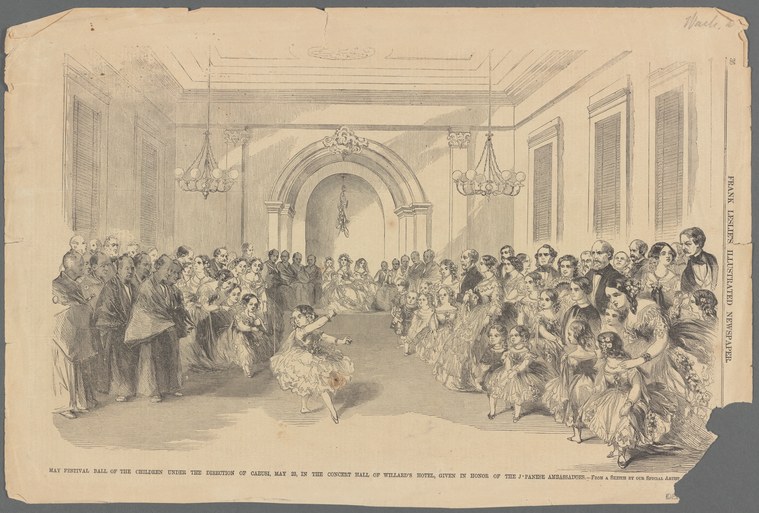
May festival ball of the children under the direction of Carusi, May 23, in the concert hall of Willard's Hotel, given in honor of the Japanese ambassadors
Unknown artist
- Collection:
- Prints depicting dance
- Source:
- New York Public Library
- Rights:
- Public domain — free to use, share and adapt.
- Recorded as:
- Public Domain
This image documents the role of children's dance and dancing masters in 19th-century American society, and specifically the use of formal dance performance in diplomatic and public ceremonies. It shows how dance was understood as an accomplishment to be displayed and as a vehicle for national culture, and it identifies Carusi as a significant figure in Washington dance pedagogy whose work was important enough to warrant newspaper coverage and illustration.
What you are looking at
A formal ball in a grand neoclassical hall, its vaulted ceiling with coffers and chandeliers intact, is crowded with spectators lining the walls on both sides. The space is densely populated: men in dark formal dress coats cluster on the left; women in elaborate full-skirted gowns occupy the right side and foreground. The composition creates a tunnel or corridor effect, drawing the eye toward the center-back of the room where the actual dancing takes place. The engraving's perspective is from within the crowd, so the viewer stands among the observers. In the middle distance, children in light-colored costume—likely the performers—are positioned as if executing choreographed movement. The lighting is even and formal, rendered through careful cross-hatching. The scene reads as an official, ceremonial occasion: the Willard's Hotel concert hall, a prestigious Washington venue, hosting an elaborate children's dance performance in honor of visiting Japanese ambassadors.
The dancing
The children performing (identifiable by their smaller scale and lighter dress) occupy the center and middle distance of the composition. They appear to be arranged in loose formation rather than tight ensemble hold; several figures stand upright with arms at or near their sides, while others seem to be in motion, possibly turning or processing. The adult spectators frame the action: the men stand relatively still in formal posture; the women's voluminous crinolined skirts create the visual mass of the crowd. The artist has prioritized the spectacle of the occasion and the crowded social context over anatomical clarity of the dancing figures themselves—the children's bodies are rendered small and somewhat generalized, making precise assessment of hold, frame, or footwork impossible.
The dance depicted
The identity of the specific dance cannot be determined from the image alone. The choreography appears to be a formal children's quadrille or cotillion—standard repertoire for such ceremonial occasions in the 1860s—given the apparent processional arrangement and the formal ballroom setting. The event was a children's performance under the direction of Carusi, a prominent dancing master in Washington. This was an official reception dance, likely designed to display accomplishment and refinement rather than virtuosity, performed for diplomatic purposes before an invited audience of Washington society. The style appears to be what would be termed 'ballroom' or 'cotillion' dancing of the Gilded Age.
How it was made
This is a steel engraving or wood engraving, identifiable by the fine parallel lines (hatching and cross-hatching) that create tone and shadow, the crisp linear definition, and the monochrome palette. The technique allowed for precise architectural rendering—note the detailed coffers and columns—and for the management of a crowded composition with many figures. Such engravings were made for newspaper and periodical reproduction; this appears to be a page from a contemporary illustrated newspaper documenting the event, likely *Frank Leslie's Illustrated Newspaper* or similar, which was the primary vehicle for news illustration in America during the 1860s. The date May 23 in the title suggests this was published shortly after the event.
About this work
This is a newspaper engraving documenting a formal children's dance performance held at Willard's Hotel in Washington, D.C., during the visit of Japanese ambassadors. The work captures not the dancers themselves in detail but rather the social ceremony surrounding the event—the crowded, elegant ballroom and the assembled society witnessing the display. It belongs in a gallery of dance imagery because it documents a specific choreographic occasion and the context in which dance functioned in 19th-century American public life: as a marker of refinement, a tool of diplomacy, and a spectacle for the press. The engraving's primary subject is the social event, but the dance is its reason for existing.
How to look at it
Attend first to the architectural setting and the careful rendering of the interior—this is a prestigious, formal space, and the artist spent considerable effort on the coffers and chandeliers to signal that. Then observe how the space is organized: the corridor effect created by spectators lining both walls concentrates attention on the tiny figures of the dancing children in the middle distance. Notice that you cannot actually see the children's feet or faces clearly—the artist made no attempt at photographic precision in the dancers themselves. Instead, the image communicates the *occasion*, the *social context*, and the *idea* of a formal children's dance performance. This is news illustration, not dance documentation; the point is that this event happened and was worth recording.
The artist
The engraver is not recorded. Based on the style and the apparent source publication (likely Frank Leslie's Illustrated Newspaper), this would have been produced by one of the newspaper's staff engravers in the 1860s. Frank Leslie's employed a large workshop of engravers to process multiple drawings and produce illustrations rapidly for weekly publication; attribution to individual artists was rare.
The period
This engraving dates to the American Civil War era or shortly after (ca. 1860s), a period when illustrated newspapers were the dominant medium for visual news and when formal ballroom dancing remained a central social ritual among the educated and elite classes. The visit of Japanese ambassadors was a major event in post-Meiji Restoration American diplomatic life, and such ceremonial occasions demanded elaborate displays of American refinement and culture. Dancing masters like Carusi were respected professionals; children's dance performances demonstrated both parental investment in genteel education and the nation's cultural sophistication.
Where it lives
This engraving comes from the New York Public Library's collection of prints depicting dance. It appears to be a page cut from a contemporary illustrated newspaper, likely *Frank Leslie's Illustrated Newspaper*, which was a major weekly publication based in New York and widely circulated during the 1860s.
Dance in this work
Questions about this work
What is the Carusi mentioned in the title?
Carusi (given name not recorded here, but likely related to the famous Carusi family of Washington dancing masters) was a professional instructor of ballroom and social dance. The title attributes the choreography and direction to him, identifying him as the person responsible for training and arranging the children's performance.
What was Willard's Hotel?
Willard's Hotel (still standing in Washington, D.C.) was one of the most prestigious hotels in the United States in the 19th century, located near the White House and a regular venue for official receptions, balls, and social events. Its concert hall was an important venue for public performances and ceremonial occasions.
Who were the Japanese ambassadors?
Japan sent several official embassies to the United States in the mid-19th century, most notably in 1860 and 1872, as part of formal diplomatic relations following the opening of Japan. These were major events in American social and political life, and receptions and entertainments were arranged to display American culture and hospitality.
Why is this an engraving rather than a photograph?
In the 1860s, newspapers could not yet reproduce photographs directly in print; all illustrations were produced by hand (drawn or engraved). Engravings, made from metal plates, could be printed alongside type and were fast enough to meet weekly publication deadlines. Photography existed but required separate reproduction processes and was expensive.
More dance artwork





