49 works in this view — arrow keys or swipe to move between them.
Dance in Art
American fashion plates
Unknown artist
- Collection:
- Prints depicting dance
- Source:
- New York Public Library
- Rights:
- Public domain — free to use, share and adapt.
- Recorded as:
- Public Domain
Fashion plates are primary sources for understanding how bodies moved in their historical moment. This image shows that ballroom dancing in the 1890s required not only skill in footwork but also absolute control of the silhouette—managing metres of trained fabric and accommodating sleeves designed for display rather than range of motion. For anyone studying Gilded Age social dance, the Gilded Age body, or the relationship between costume and movement, this plate documents the material reality of the dancing woman.
What you are looking at
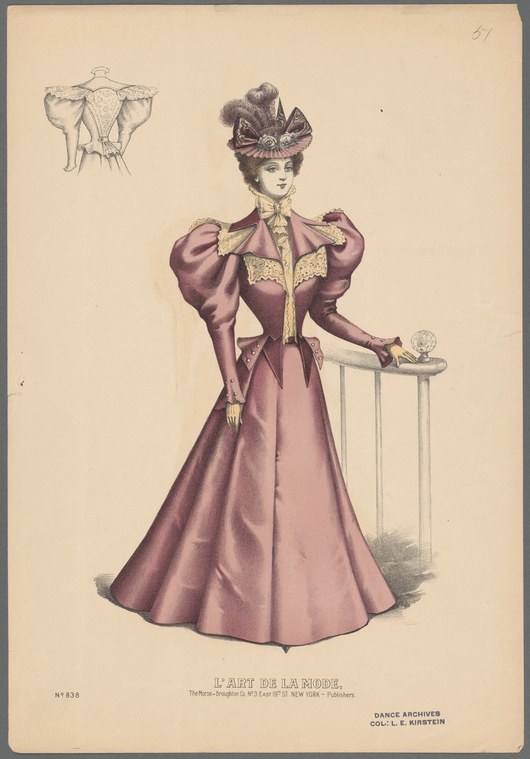
A fashionably dressed woman stands in three-quarter view against a plain background, her body angled slightly as if pausing mid-movement. She wears a striking purple-mauve gown with exaggerated leg-of-mutton sleeves that balloon from shoulder to elbow before tapering to fitted forearms, a silhouette characteristic of the 1890s. The bodice is fitted with a high collar and decorated with a cream-coloured insert or chemisette; the skirt extends in a long trained sweep. Her dark hair is arranged in an elaborate upswept style topped with a large bow or feathered ornament. She rests one gloved hand on a small table beside her, while her posture suggests the controlled poise of social dance. In the upper left corner, a small technical drawing shows what appears to be a sleeve construction detail or fashion plate annotation — three goblet-shaped forms suggesting the drapery study of the costume. The image is rendered in hand-coloured lithograph style, with careful attention to fabric texture and the subtle modelling of form.
The dancing
The single female figure stands upright in a ballroom posture, her weight evenly distributed in a stance that suggests readiness for social dance. Her shoulders are squared and held back in the correct deportment for formal dance of the period, while her arms hang naturally with one hand resting lightly on furniture. The exaggerated sleeves and trained skirt create a silhouette of volume and formality; the body inside is constrained and held in alignment rather than free-moving. Her gaze is directed outward, and her slight turn suggests the moment of approach or acknowledgement before engagement.
The dance depicted
This is a fashion illustration rather than a depiction of active dance, but the woman is clearly posed in the ballroom context of 1890s social dance, likely the waltz or other salon dances of the period. She represents the ideal female dancer of Gilded Age America — poised, ornately dressed, and participating in the central social ritual of the era. The careful construction of her sleeves and the trained skirt would have presented specific challenges to the dancer, as the volume and weight of fabric constrained arm movement and required skilled management of the train during rotation and travelling steps.
How it was made
This is a hand-coloured lithograph, a reproductive and commercial technique that allowed mass production of fashion imagery. The delicate tinting and fine draughtsmanship suggest a quality print intended for a fashion journal or upmarket women's periodical. The title line at the base reads *L'Art de la Mode* — a French fashion publication — indicating this is one of a numbered series of fashion plates distributed to subscribers or sold individually. The technique allowed wide circulation of idealized fashion imagery and established standards of elegant deportment among a middle and upper-class female audience.
About this work
This is a fashion plate from *L'Art de la Mode*, a late-nineteenth-century fashion periodical, showing a woman in ballroom dress of the 1890s. The illustration documents not only the silhouette and construction of formal wear during the Gilded Age, but also the posture, poise, and physical presentation required of women participating in social dance. Fashion plates are as much about the body and its movement as about the garment; they show how clothes were worn and how the wearer should present herself in public. This image captures the precise moment of ballroom readiness—the pause before the dance begins, the body held in the proper frame for waltz or quadrille. It belongs in a dance collection because it is a historical record of how the dancing body of a specific time, place, and class was constructed, constrained, and displayed.
How to look at it
Observe the precise angle of the shoulders and the carriage of the head—this is not a relaxed pose but a carefully maintained alignment that was understood as both beautiful and morally correct. Notice how the sleeves, though decorative, would severely limit arm movement; a dancer in such dress had to lead with the body's core, not the arms. The trained skirt creates a vertical line that emphasizes height and elegance, but it also required constant spatial awareness. The artist chose the moment of pause or approach, not mid-movement, which is typical of fashion illustration—the body is shown as it should be seen, not as it moves.
The artist
The image is credited to *L'Art de la Mode*, a Paris-based fashion journal. No individual artist is recorded, which is typical for commercial fashion illustration of the period—such plates were often collaborative products of a publishing house, with design, engraving, and hand-colouring carried out by specialist workshops. The quality of draughtsmanship and colouration suggests a professional atelier's work.
The period
The 1890s saw the crystallization of the 'Gibson Girl' ideal—a distinctly American vision of elegant, athletic, and fashionably dressed femininity that dominated both sides of the Atlantic. The exaggerated sleeve silhouette and trained skirt were at the height of fashion during this decade. Simultaneously, ballroom dancing was at the apex of its cultural prestige as a marker of social status and refinement, particularly in elite and aspiring-middle-class circles. Fashion plates served as the fashion magazines and social media of the era, circulating ideals of how to look, how to move, and how to participate in public social life.
Where it lives
The image is held in the Dance Archives collection at the New York Public Library. It is one of many such commercial fashion plates acquired as documentary evidence of dance costume and the material culture of ballroom.
Dance in this work
Questions about this work
Is this an actual photograph of a dancer?
No, this is an engraved and hand-coloured fashion plate—a commercial illustration published in a fashion journal. It represents an idealized type rather than a specific person. Fashion plates were used to teach and influence how women dressed and carried themselves.
Could a woman actually dance in this dress?
Yes, but with specific constraints. The trained skirt required practice to manage during turns and the backward walk essential to the follower's role in waltz. The leg-of-mutton sleeves limited shoulder mobility, so the arm frame of the dance relied on the forearm and hand rather than full arm extension.
What dance is she posed for?
The posture and ballroom setting suggest waltz or quadrille, the dominant salon dances of the 1890s in America. The upright frame and poised stance are typical of the 'American waltz' style of the period, a form of the Viennese waltz adapted for the social context of American drawing rooms.
Why is this in a dance collection and not a fashion history collection?
Fashion and dance history are inseparable in the nineteenth century. To understand how waltz or quadrille was actually danced and how it felt to dance in the body of the period, you must see the clothes. This plate is evidence of dance technique and ballroom culture.
More dance artwork





