49 works in this view — arrow keys or swipe to move between them.
Dance in Art
Dancers on music covers
Unknown artist
- Collection:
- Prints depicting dance
- Source:
- New York Public Library
- Rights:
- Public domain — free to use, share and adapt.
- Recorded as:
- Public Domain
This cover documents the global impact of Isadora Duncan at the precise moment when her ideas were reshaping dance across Europe and Russia, and demonstrates how modern dance's early aesthetic—naturalistic, emotionally expressive, classically inspired—was packaged and sold to concert audiences. For dancers and historians, it is material evidence of how a single artist's vision could be translated into design, music, and popular culture within a decade of her debut.
What you are looking at
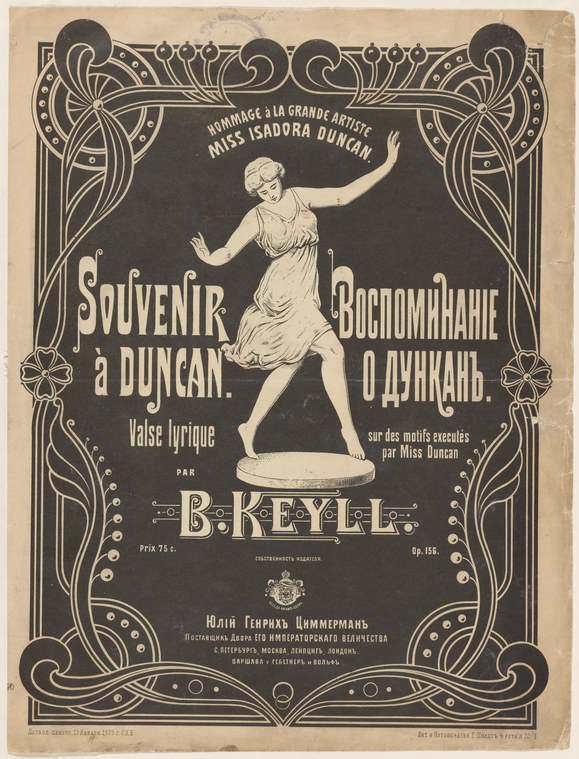
This is a music cover for a waltz lyrique titled 'Souvenir à Duncan' (A Souvenir to Duncan), composed by B. Keyli. The cover features an elegant classical female figure in a draped Greco-Roman style gown, posed dynamically against a dark background. She stands with her weight on one leg, her upper body angled away, one arm raised expressively and the other extended, in a pose suggesting lyrical, ethereal movement. The ornamental Art Nouveau border frames the composition with elaborate curving designs and floral motifs typical of early 20th-century design. The text appears in both Latin and Cyrillic scripts, indicating dual-language publication. At the bottom, Russian publisher information identifies this as published by 'Нам Генрих Циммерман' (N. G. Zimmermann), with reference to the Imperial Theatres of St. Petersburg.
The dancing
A single idealized female dancer occupies the center of the composition, isolated against dark space. Her posture is contrapposto—weight settled on the back leg while the torso leans forward and away, suggesting a moment of lyrical extension. The raised arm curves gracefully overhead in a soft arc; the other arm extends to the side at shoulder height with a relaxed, naturalistic gesture. Her costume—a simple high-waisted Greco-Roman tunic—allows the line of her body and the flow of drapery to dominate. The pose captures neither active motion nor stillness, but a suspended, dreamy quality typical of late 19th- and early 20th-century interpretive dance.
The dance depicted
This cover commemorates Isadora Duncan, the American interpretive dancer who revolutionized modern dance in Europe in the early 1900s. The figure embodies the aesthetics Duncan championed: classical simplicity, flowing fabric, emotional expression through the whole body, and freedom from rigid ballet technique. The pose—neither ballet nor folk—belongs to the 'natural' movement vocabulary that Duncan popularized. The title 'Souvenir à Duncan' suggests this waltz was either composed for Duncan herself or created in homage to her style. The Russian publication date and Cyrillic text confirm Duncan's enormous influence in St. Petersburg, where she performed frequently and where her ideas found a passionate audience.
How it was made
This is a chromolithograph or high-quality lithographic print, as evidenced by the precise line work, tonal gradation, and the ability to print in distinct color registers (the decorative black borders and text against the cream background). The Art Nouveau ornamental frame was printed as part of the lithographic stone. The technique allowed for mass production of affordable sheet music covers, making this both a commercial product and a work of graphic design suitable for wide circulation in middle-class households with pianos. The quality of the printing and design suggests it was produced by a professional theatrical or music publisher.
About this work
A sheet music cover for a waltz by B. Keyli, published in St. Petersburg in the early 1900s to honor Isadora Duncan and her revolutionary approach to dance. The cover presents an idealized image of Duncan's aesthetic: a single female figure in classical drapery, posed in a moment of lyrical, natural movement that rejects the rigid formality of academic ballet. Published in both Latin and Cyrillic scripts, it testifies to the rapid spread of Duncan's influence across Europe and into Russian artistic circles, where her ideas met an especially receptive audience.
The work is a window into how dance innovation was marketed and consumed in the early 20th century. Rather than depicting a specific narrative or moment of technical virtuosity, the cover communicates a philosophy—that dance could be emotional, classical, and free—through a single suspended gesture. This is not the frozen moment of academic ballet, but the captured breath before the next movement, aligned with Duncan's own writings about the body and emotion.
How to look at it
Focus on the single gesture—the raised arm, the tilt of the torso, the weight distribution—and notice what it communicates without narrative. This is not a moment of technical difficulty or virtuosity, but of emotional openness and physical honesty. The classical drapery and Greco-Roman silhouette signal Duncan's debt to ancient Greek sculpture and her belief that true beauty lay in simplified, natural forms. The ornate Art Nouveau border frames and elevates the figure, transforming a commercial music cover into a meditation on beauty and movement. The pose is held, not captured mid-action—this is a statement of presence rather than a snapshot of motion.
The artist
B. Keyli is credited as the composer. No other biographical information is recorded in the catalogue, and he is not readily identifiable from this cover alone. The publisher, N. G. Zimmermann, was a significant St. Petersburg music and theatrical publisher active in the late 19th and early 20th centuries, associated with the Imperial Theatres. The cover's design is unsigned, which was common for commercial lithographic production; the designer's identity is not preserved in the record.
The period
Isadora Duncan began performing in Europe in 1899 and arrived in St. Petersburg in 1904, where she caused a sensation. By the early 1900s, her rejection of pointe shoes, corsetry, and narrative ballet in favor of barefoot, emotionally authentic movement had already begun to influence composers and choreographers across Europe. This waltz was composed at the height of her influence, in a period when the Russian cultural elite were deeply engaged with Western modernism and when St. Petersburg was a center for artistic innovation. The Art Nouveau design of the cover reflects the broader decorative aesthetic of the period, linking dance innovation to visual modernism.
Where it lives
This sheet music cover is held in the New York Public Library's collection of prints depicting dance. It is a commercial lithograph published by N. G. Zimmermann in St. Petersburg, one of thousands of music covers produced for the middle-class domestic and concert market in the early 20th century.
Dance in this work
Questions about this work
Who was Isadora Duncan and why is she honored here?
Isadora Duncan (1877–1927) was an American dancer who revolutionized modern dance by rejecting ballet technique, pointe shoes, and costumes in favor of barefoot, emotionally expressive movement inspired by classical Greece and nature. She became an international celebrity, and this waltz was composed either for her or in tribute to her style, demonstrating her influence on composers across Europe and Russia.
What does the pose tell us about early modern dance?
The suspended, lyrical posture—neither the rigid turnout of ballet nor the grounded steps of folk dance—exemplifies the aesthetic Duncan pioneered. It shows a body at ease, expressing emotion through natural line and drapery rather than technical difficulty. This kind of 'natural' movement was radical for 1900 and challenged centuries of academic ballet training.
Why is this a sheet music cover and not a dance poster?
This was published as a piano cover, suggesting the waltz was intended for domestic performance or concert use. It targeted the middle-class household market—people who would buy music to play at home or hear at concerts. The elegant, costly design suggests it was an upmarket product aimed at people who could afford both pianos and concert tickets.
What is Art Nouveau and what does it have to do with dance?
Art Nouveau was a decorative movement (1890s–1910s) emphasizing natural forms, flowing lines, and beauty in everyday objects. The ornate border of this cover is typical Art Nouveau design. The movement was contemporary with Duncan's work, and both shared an interest in nature, emotion, and escape from 19th-century rigidity.
More dance artwork





