49 works in this view — arrow keys or swipe to move between them.
Dance in Art
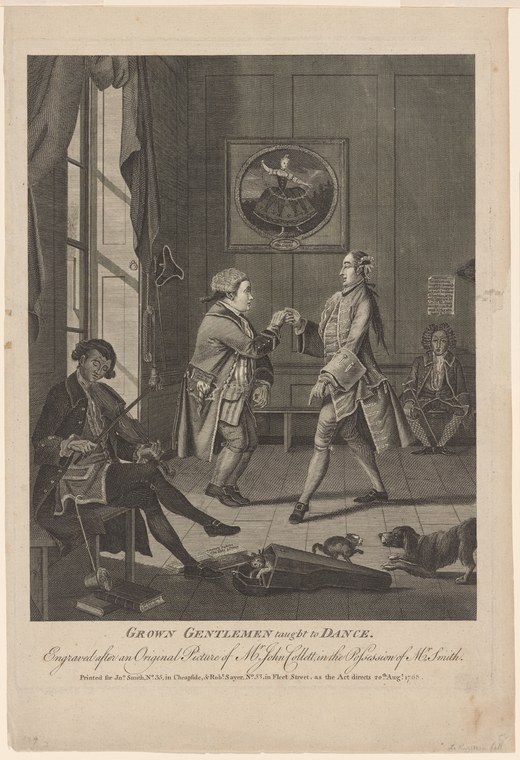
Grown gentlemen taught to dance: engraved after an original picture of Mr. John Collett, in the possession of Mr. Smith
Unknown artist
- Collection:
- Prints depicting dance
- Source:
- New York Public Library
- Rights:
- Public domain — free to use, share and adapt.
- Recorded as:
- Public Domain
This engraving documents the professional dancing master and the formal instruction of ballroom dance in 18th-century Britain, showing the posture, spacing, and formal setting that governed fashionable social dancing. It also reveals contemporary anxieties about whether dancing was a natural or acquired skill, and whether social polish could be purchased or taught to those past their formative years. For dance historians, it is rare satirical evidence of how a formal dance lesson was structured and what was considered laughable or admirable in ballroom deportment.
What you are looking at
A satirical engraving depicting a dancing lesson for adult gentlemen in an 18th-century interior. Three figures in the foreground dominate the composition: a portly gentleman in a brown coat executing an awkward stance in the center, flanked by a slighter man in lighter dress who appears to be demonstrating correct posture, and a dancing master or instructor in profile on the right, gesturing with authority. Two additional figures occupy the left side—one seated at a small table, another standing near a tall window—while a woman sits in profile on the far right. The room is paneled in wood with a framed oval portrait on the back wall, and the floor is marked with a geometric pattern suggesting a proper dance space. Two dogs lie prone in the foreground, apparently indifferent to the proceedings. The engraving's linear cross-hatching creates depth and shadow, with the window providing a secondary light source that silhouettes the figures against the paneled wall.
The dancing
The central gentleman displays an exaggerated, ungainly posture—legs splayed, torso rigid, arms held away from his body in an awkward approximation of dance form. His slighter companion demonstrates the proper upright carriage expected of a ballroom dancer, with a more composed frame and controlled limbs. The dancing master, positioned to observe and correct, gestures with an extended arm and points with one leg in what appears to be an instructional demonstration. The composition emphasizes the contrast between the pupil's clumsy effort and the refined, controlled positions that ballroom dancing demanded.
The dance depicted
This is almost certainly a representation of minuet instruction or general ballroom dancing instruction of the Georgian period, when the minuet and related courtly dances were essential accomplishments for gentlemen of social standing. The satire lies in showing mature men attempting to master steps and postures that were typically taught to younger pupils and expected to be performed with grace and dignity. The presence of the dancing master, the formal interior space, the emphasis on correct positioning, and the evident struggle of the pupils all point to the minuet or a related historic-baroque social dance. The work satirizes the vanity and awkwardness of adult gentlemen trying to acquire fashionable manners late in life.
How it was made
This is an engraving—a print made from an incised metal plate, likely copperplate. The catalogue record notes that it was 'engraved after an original picture of Mr. John Collett,' meaning the engraver translated a painting or drawing into print form, a common practice for distributing artwork to a wider audience in the 18th century. The technique of line engraving is evident in the regular cross-hatching used to model form and create tonal variation. The imprint statement at the base indicates it was published in London, suggesting it was a commercial print intended for middle-class consumption—buyers who would appreciate the satire of social pretension.
About this work
This is a satirical engraving from 18th-century London depicting the instruction of adult gentlemen in fashionable ballroom dancing, most likely the minuet. The artist (an engraver working after Collett's design) captures a moment of comic humiliation: three pupils and their instructor in a wood-paneled dancing room, where ungainly posture, awkward limbs, and the evident strain of adults attempting to master courtly grace forms the visual joke. The work belongs to a tradition of social satire that used dance as a marker of class ambition and social failure. For a history of dance instruction, pedagogy, and the social anxieties around accomplishment and gentility in the 18th century, this is a primary source—it shows not only what the minuet or ballroom dancing looked like, but also how contemporaries understood (and mocked) the effort required to master it.
How to look at it
Observe the contrast between the three male figures: the central pupil's splayed legs and rigid torso versus the slighter man's composed frame and the dancing master's controlled demonstration. The artist has frozen a moment of instruction, with the master gesturing as if mid-correction. Note also the setting—the paneled room, the framed portrait (suggesting taste and cultivation), and the dogs lying on the floor, indifferent to the gentlemen's exertions, which compounds the satire. The engraving's title promises the subject explicitly, so the viewer knows to read the scene as ridicule rather than admiration.
The artist
The engraver is not recorded in the catalogue, but the work is stated to be 'engraved after an original picture of Mr. John Collett.' Collett was an 18th-century caricaturist and illustrator known for satirical scenes of London social life. The engraver was responsible for translating Collett's composition into the finer linear language of copperplate engraving, a specialized craft that required different skills from the original draughtsman.
The period
In the 18th century, the minuet was the paramount social dance for the gentry and rising merchant classes. Dancing masters were established professionals who taught not merely steps but posture, courtesy, and the embodiment of gentility. The minuet demanded an upright carriage, turned-out legs, controlled arm movements, and a measured, stately tempo. Simultaneously, satire and caricature flourished as a form of social commentary, often targeting the pretensions of the middle classes attempting to ape aristocratic accomplishment. This print belongs to that tradition: the adult gentleman struggling with his legs and arms is a figure of fun precisely because dancing was supposed to be effortless and natural for anyone with proper breeding.
Where it lives
The work is held by the New York Public Library as part of its 'Prints depicting dance' collection. It is an engraved print, published in London in the 18th century, and represents the type of satirical domestic genre print that was produced and sold to a broad urban audience.
Dance in this work
Questions about this work
What dance is being taught?
Most likely the minuet, the dominant social dance of the 18th century for polite society. The formal posture, the dancing master's role, the interior setting, and the emphasis on correct positioning all point to minuet instruction. Other ballroom dances of the era—such as the cotillion—are also possible, but the minuet was the primary subject of formal dancing master instruction.
Why is this image funny?
The satire lies in showing adult gentlemen struggling awkwardly with a skill that was supposed to be both taught to youth and executed with natural grace. The central figure's splayed legs and rigid posture contrast sharply with the composed bearing of the dancing master, making the pupil appear ridiculous. The dogs lying indifferently on the floor add to the comedy.
Who was John Collett?
John Collett was an 18th-century English caricaturist and illustrator known for satirical scenes of London life and social types. He produced drawings and designs that were often engraved and published as prints for a middle-class audience.
What does this tell us about dancing lessons then?
It shows that formal instruction by a professional dancing master took place in dedicated interior spaces, involved precise attention to posture and limb position, and was considered important enough for adults to pursue even if they were naturally clumsy. It also suggests that ballroom dancing was seen as an acquirable skill rather than an instinctive one, and that failure to master it was a source of social embarrassment.
More dance artwork





