49 works in this view — arrow keys or swipe to move between them.
Dance in Art
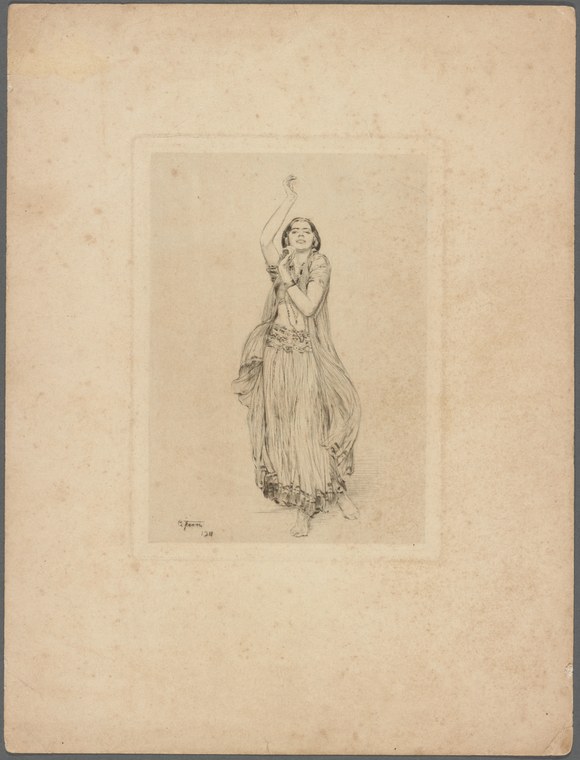
Indian study
Unknown artist
- Collection:
- Prints depicting dance
- Source:
- New York Public Library
- Rights:
- Public domain — free to use, share and adapt.
- Recorded as:
- Public Domain
The work illustrates how 19th-century artists and theatres used classical figure studies to conceptualize and stage performance, treating the dancer's body as a vehicle for neoclassical ideals. It shows the slippage between 'Indian study' as a title and orientalist exoticism as practice—a symptom of how non-Western movement was filtered through European academic conventions rather than observed or documented directly.
What you are looking at
A single female figure stands in a classical contrapposto pose against a plain background, her body weight shifted onto one leg in a stance familiar from academic life drawing. She wears a loose, high-waisted draped garment—a tunic or shift—that falls to mid-calf, with her hair styled in a manner suggesting classical or orientalist convention. Her right arm is raised gracefully upward, the hand open and fingers extended, while her left arm hangs at her side with the hand near her hip. The pose suggests a moment of aspiration or yearning rather than active movement, and the garment's soft folds emphasize the verticality of her stance. The work is rendered in fine pen or pencil line with careful attention to the play of drapery and the modeling of the figure's form. The composition is spare and focused entirely on the standing figure, with no setting or context beyond the neutral ground beneath her feet.
The dancing
The figure stands in a classical contrapposto position, with weight settled on the right leg and the left leg slightly bent and relaxed. The right arm is raised in a graceful arc, the hand open and fingers spread, reaching upward and slightly back in a gesture of yearning or invocation. The left arm rests along the body, the hand placed near the hip. The pose emphasizes verticality and extension rather than movement through space; the body is elongated and the gesture one of stillness rather than dynamic action. There is no visible footwork or the active shifting of weight that characterizes most dance styles.
The dance depicted
This appears to be an academic study rather than a depiction of an identifiable dance. The figure's pose—a classical contrapposto with an upraised arm—suggests influence from neoclassical drawing tradition and orientalist aesthetics popular in the 19th century. While the raised arm and the drapery suggest a theatrical or performative context, the pose itself is static and aspirational rather than kinetic. If this represents dance at all, it may be documentation of a pose from ballet or classical theatrical movement, but the work reads primarily as a figure study from life class or a study for a larger theatrical composition. The title 'Indian study' is puzzling given the classicizing treatment; it may refer to orientalist exoticism rather than any actual Indian dance practice.
How it was made
This is a fine pen or pencil drawing, likely executed on paper, with the characteristic linear precision of academic studio work. The artist has used delicate line work to define the figure's form and garment, with particular attention to the fall of drapery and the modeling of the body beneath. The technique shows the conventions of life-class drawing or study for theatrical costume and movement. The fineness of the line and the controlled handling suggest trained draughtsmanship, though the sparse composition and modest scale indicate this is a working study rather than a finished exhibition piece. The work's inclusion in a prints collection suggests it may have been engraved or lithographed, though the current object appears to be the drawing itself or a fine print from it.
About this work
This is a classical-style figure study of a standing woman in draped garments, her body in contrapposto and her right arm raised in a gesture of aspiration or invocation. The work sits in an ambiguous space between academic life drawing and theatrical study, with insufficient visual evidence to identify a specific dance tradition or style. The title 'Indian study' suggests orientalist preoccupation rather than ethnographic observation; the figure's pose and treatment are entirely within the neoclassical academic tradition. For a collection devoted to dance imagery, the work functions as documentation of a theatrical pose or classical attitude rather than as a record of movement or performance practice. It testifies to the 19th-century habit of treating dance, classical sculpture, and academic drawing as parts of a single aesthetic system.
How to look at it
Attend to the stillness of the pose and the emphasis on the raised arm as a vehicle for emotion or yearning rather than kinetic impulse. The artist has chosen a moment of suspension rather than action—a moment that belongs to tableaux vivant and classical revival aesthetics rather than to most actual dance. Notice how the drapery is used to emphasize the body's form and verticality, and how the contrapposto stance creates a sense of weight and balance that feels deliberate and studied rather than natural. The simplicity of the composition—figure alone against neutral ground—marks this as a study or preparation rather than a finished theatrical scene.
The period
This drawing belongs to the 19th-century tradition of academic figure study and theatrical preparation, when dancers, painters, and sculptors shared a common vocabulary of the body derived from classical sculpture and neoclassical theory. The 'Indian study' designation reflects the period's appetite for orientalist subjects—imagined rather than documented—which appeared in painting, ballet (notably in the pantomimic portions of full-length ballets), and academic drawing. The pose itself derives from classical contrapposto and the aesthetic codes of Romantic ballet, in which the dancer's stillness and aspiration mattered as much as movement. By the mid-to-late 19th century, such studies formed part of the machinery of theatrical production, used to train dancers in the carriage and emotional register expected of them.
Where it lives
The work comes from the New York Public Library's collection of prints depicting dance. Its classification as a 'print' suggests it may have been engraved or lithographed as a reproduction, though the current object may be the original drawing. No artist, date, or medium is recorded in the catalogue.
Dance in this work
Questions about this work
What dance is this supposed to show?
The title 'Indian study' suggests orientalist content, but the figure's pose and treatment are entirely neoclassical. This appears to be an academic study of a classical attitude rather than documentation of any actual Indian dance tradition. The work likely reflects 19th-century theatrical aesthetics and the period's habit of filtering non-Western movement through European academic conventions.
Is this a record of a real dancer or performance?
Probably not. The work reads as a studio study or preparation for theatrical use rather than a record of an actual performance. It may be a study for a ballet pose or a costume study, but there is no evidence that it documents a specific dancer or performance event.
Why is the pose so still if this is a dance image?
Classical ballet and 19th-century theatrical aesthetics valued stillness and aspiration as much as movement. The raised arm and contrapposto stance create a moment of suspension that belongs to the theatrical grammar of the period—a pause within or between movements that the artist found worthy of study.
More dance artwork





