49 works in this view — arrow keys or swipe to move between them.
Dance in Art
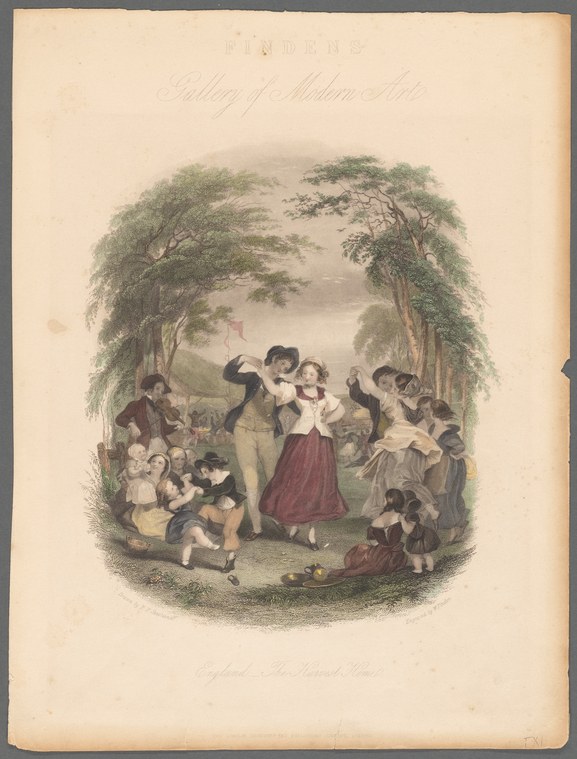
England, the harvest home; Finden's gallery of modern art
Unknown artist
- Collection:
- Prints depicting dance
- Source:
- New York Public Library
- Rights:
- Public domain — free to use, share and adapt.
- Recorded as:
- Public Domain
This image captures the early Victorian aestheticization of social dance as romantic and allegorical rather than merely social or courtly. It shows how engraved and hand-colored prints shaped public understanding of dance as a refined, feminized, and spiritually elevated practice—a crucial moment in the history of how dance became a subject for fine-art reproduction and consumption.
What you are looking at
An arcadian pastoral gathering unfolds beneath weeping willows in soft, luminous tones. A group of elegantly dressed figures—women in muslin gowns with bare shoulders and long skirts, men in dark tailcoats—dance and gesture in a woodland clearing. The composition centers on a woman in a wine-colored skirt executing a turn or pivot, her arms raised in a graceful arc, while companions in white dresses attend and mirror her movements. Cherubic putti (child figures) cavort among the adults, some dancing, others reclining or watching from the foreground. The scene is suffused with romantic sentiment: the trees frame the action like a stage, the figures occupy soft pools of light against atmospheric shadow, and the overall effect suggests a civilized leisure perfectly suited to refined company.
The dancing
The dancers move with raised arms and upright posture characteristic of early nineteenth-century social dance. The central female figure pivots with both arms lifted, one slightly higher than the other, her torso erect and her weight centered. Surrounding figures adopt similar positions—arms aloft, bodies in profile or three-quarter view—suggesting a line or formation rather than paired coupling. The presence of putti as dancing partners or observers blurs the boundary between earthly and allegorical; the human figures treat them as social equals. All bodies show elongated proportions and a lightness of bearing that suggests idealized rather than naturalistic movement.
The dance depicted
This is most likely a quadrille or cotillion, the formal social dances of the Regency and early Victorian drawing room. The composition's emphasis on a line of dancers, the raised-arm positions, and the festive social setting all point to a country-dance formation adapted for polite ballroom society. The arcadian setting—woodland rather than ballroom—is a convention of romantic-era imagery that reimagined social dancing as a pastoral pleasure, removing it from urban artifice. The integration of putti suggests this is not a literal documentation but an allegorical or poetic rendering of the dance as a site of innocent joy and courtship.
How it was made
This is a hand-colored engraving or aquatint, typical of luxury illustrated annuals of the 1830s–1840s. The title page indicates it is from *Finden's Gallery of Modern Art*, a prestigious annual gift-book series known for elegant reproductive prints of contemporary paintings and drawings. The technique allowed for wide circulation among middle and upper-class readers; the soft, diffused tones and atmospheric effects were achieved through careful engraving and selective hand-coloring. The print medium meant the work was distributed nationally and internationally, making it a vehicle for standardizing taste in both visual art and social dance.
About this work
This is a romantic-era illustration of social dance as pastoral pleasure, drawn from the conventions of Regency quadrilles and country dances but elevated into allegory through landscape and the inclusion of putti. The work belongs to a tradition of dance imagery that treated ballroom socializing as a site of refined courtship and natural joy—a vision of dance untethered from the mechanics of actual instruction or performance. It is a product of the commercial print culture of the 1830s–1840s, designed to circulate idealized visions of genteel leisure among the reading public. As such, it documents not how people actually danced but how they wanted to be seen dancing: gracefully, innocently, and in harmony with nature and the divine.
How to look at it
Note the moment of the dance the artist chose to freeze: a pivot or turn executed with raised arms and an upright torso, a moment of poise and display rather than transition. This is the ballroom's equivalent of the theatrical pirouette—the instant when skill and grace are most visible. Observe also the composition's framing: the dancers are arranged in a shallow stage-like space, with the woodland as both literal setting and symbolic backdrop. The atmospheric lighting—soft, diffused, with highlights and shadows carefully modulated—is the hand-coloring at work, creating an effect of moonlight or magical illumination that no engraved line alone could achieve. This visual treatment elevates social dance from the mundane to the transcendent.
The artist
The work is attributed to Finden's Gallery of Modern Art, a prestigious annual publication series edited and produced by the Finden brothers (Edward and William), accomplished engravers and print publishers. The Gallery was known for commissioning or reproducing works by contemporary painters and illustrators, presenting them to an affluent readership. The specific artist of this composition is not recorded in the catalogue, a common situation for commercial annuals where engravers and their original-art sources were sometimes uncredited or separated in publication.
The period
This print was made during the height of the Regency and early Victorian period (1811–1837 and beyond), when social dancing—particularly the quadrille, cotillion, and country dances—dominated the leisure activities of the middle and upper classes. In visual culture, romantic painters and illustrators were reimagining social scenes, including dance, through a lens of pastoral idealization and emotional intensity. This was also the era in which ballet was undergoing its own romantic transformation (Romantic ballet emerged c. 1830), and the aesthetics of weightlessness, ethereal femininity, and nature-communion visible in this image parallel developments in theatrical dance. Commercial print annuals like Finden's Gallery were crucial in disseminating these visual ideals to a broad, affluent audience.
Where it lives
This work is held in the New York Public Library's collection of prints depicting dance. It is part of the Library's broader holdings of illustrated gift-books and print annuals from the nineteenth century, a category of object designed for display and circulation among cultured households.
Dance in this work
Questions about this work
What is Finden's Gallery of Modern Art?
It was a prestigious annual illustrated publication series (typically appearing c. 1830–1860) produced by the Finden brothers, accomplished London engravers and print publishers. Each issue featured finely engraved and hand-colored reproductions of contemporary paintings and drawings, marketed to affluent collectors and readers. These annuals were among the most important vehicles for distributing fine-art imagery to the middle and upper classes before photography.
Why are there cherubs in a scene about social dancing?
The putti (child angels) are a convention of romantic-era allegorical art, signaling that this is not a documentary image but a poetic or elevated vision. They suggest that social dance is an expression of love, joy, and divine harmony—themes central to Romantic aesthetics. Including putti transformed a ballroom scene into something timeless and transcendent rather than merely fashionable.
What dance is actually being shown?
Most likely a quadrille or cotillion, the dominant formal social dances of the Regency and early Victorian era. The raised-arm positions, upright posture, and line-based formation are consistent with these dances. However, the arcadian setting and allegorical imagery mean the artist was depicting an idealized or poetic version rather than a literal ballroom performance.
How was this image made?
It is a hand-colored engraving or aquatint, a labor-intensive process in which a copper plate was painstakingly engraved with fine lines, then printed on paper, and finally colored by hand (or with stencils). This technique allowed for high quality and subtle tonal effects, but prints were expensive and circulation was limited to affluent audiences.
More dance artwork





