49 works in this view — arrow keys or swipe to move between them.
Dance in Art
Flexmore, English pantomime clown
Unknown artist
- Collection:
- Prints depicting dance
- Source:
- New York Public Library
- Rights:
- Public domain — free to use, share and adapt.
- Recorded as:
- Public Domain
Pantomime is rarely documented in visual art, and even more rarely analyzed as a movement practice. This print preserves a moment of nineteenth-century popular physical theatre at the precise point where comedy, acrobatics, and performance spectacle overlapped. For historians of stage movement beyond ballet, it is evidence of what ordinary theatre audiences expected from their performers.
What you are looking at
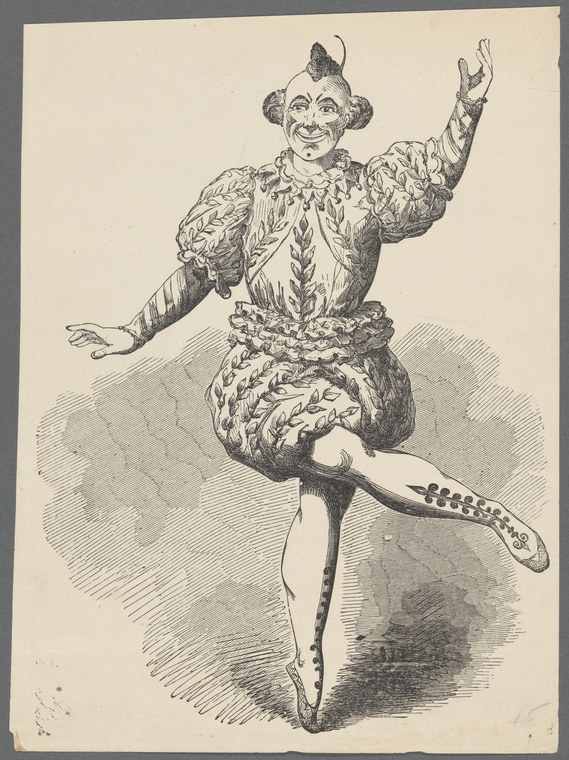
A solo male figure in theatrical costume strikes a dynamic pose against a plain background. He wears an ornate jacket with puffed sleeves decorated with leaf or feather motifs, fitted at the waist with elaborate patterning. His lower body is wrapped in what appears to be a textured, patterned skirt or tunic with a bulbous silhouette. The figure's face is exaggerated and expressive, with pointed ears and an impish grin characteristic of pantomime. He balances on one leg with the other extended upward in a high kick, his arms spread wide in an open, welcoming gesture. The pose conveys sprightliness and comic energy. The engraving technique creates fine tonal gradation through cross-hatching, giving the fabric patterns depth and the figure sculptural presence.
The dancing
A single dancer frames the entire composition, balanced precariously on one supporting leg while the other leg extends sharply upward. The torso is upright and open, the arms spread wide in a display of confident exuberance. The weight appears concentrated and the pose is held as a discrete moment rather than a flowing transition. The extended leg reaches toward the upper corner of the frame, creating a strong diagonal line. The overall carriage is buoyant and deliberately unnatural—the body elongates vertically in ways that suggest theatrical artifice rather than naturalistic movement.
The dance depicted
This appears to be a representation of English pantomime or commedia dell'arte performance, most likely a clown character given the title 'Flexmore.' The pose is characteristic of pantomime's exaggerated, impossible attitudes—a high, snapping kick held in isolation for comic effect rather than as part of a continuous phrase. The high kick was a signature pantomime trick, displaying flexibility and inviting laughter through its acrobatic audacity. The costume and performance style belong to the tradition of music-hall and stage clowning rather than formal theatrical dance, though the movement vocabulary draws from acrobatic traditions.
How it was made
This is a wood engraving or fine-line engraving executed on paper, most likely from the nineteenth century based on the technique and style. The artist has used close parallel lines and cross-hatching to model form and create tonal depth, particularly visible in the rendering of the costume's textile patterns. Engraving allowed for fine detail and was the standard method for circulating theatrical images to a broad public; such prints were collected, pasted into albums, and sold individually at the theatre and through print shops. This technique suggests a work of popular circulation aimed at theatre-goers and collectors of theatrical ephemera.
About this work
This is an engraved print documenting a moment from nineteenth-century English pantomime, capturing the exaggerated physicality and comic bravura of a clown character. Pantomime, though rooted in dance and physical comedy, occupies an unusual position in dance history: it was enormously popular, heavily physical, and performed by artists with acrobatic training, yet it is often excluded from dance taxonomies because it prioritized comic narrative and character over movement form. This image belongs in a dance gallery because it documents a living performance tradition that required gymnastic skill and physical control, and because it shows how the body was deployed for theatrical effect in popular entertainment.
How to look at it
Focus on the geometry of the pose: the artist has frozen a moment of maximal extension and display, not a moment of transition or balance. The high kick is held as a static tableau rather than captured mid-movement, which is characteristic of how pantomime was documented—the signature trick or attitude was the unit of performance. Notice how the costume participates in the comedy: the bulbous lower garment rhymes with the upthrust leg, making the silhouette absurd. The face is equally important: the exaggerated features and gap-toothed grin establish character type before the body does.
The period
English pantomime flourished in the nineteenth century, developing from earlier commedia dell'arte and harlequinade traditions into a form that combined music, dance, acrobatics, and comic narrative. By the 1800s, the clown had become the central figure around whom the pantomime was constructed—a role that demanded physical virtuosity including high kicks, tumbling, contortions, and comic business. The rise of wood engraving and the expansion of print culture made theatrical portraiture accessible to a mass audience. Actors like Joey Grimaldi (d. 1837) elevated clowning to a respected art form, and their performances were widely documented in prints that circulated among theatregoers.
Where it lives
This engraving is held in the New York Public Library's print collection on dance. It is catalogued simply as 'Flexmore, English pantomime clown' with no artist, date, or other attribution recorded.
Dance in this work
Questions about this work
Was pantomime considered dance?
In the nineteenth century, the distinction was fluid. Pantomime required trained dancers and acrobats, and dance was part of every pantomime performance. However, pantomime prioritized narrative and comic character over formal dance technique. Modern dance history has often excluded pantomime, but it was a major form of physical performance and training.
What is the high kick doing here?
This is a signature pantomime 'attitude' or trick—a moment of display designed to astonish and amuse. The impossibility of the pose (the extended leg, the balanced stance) was the point: it demonstrated the performer's physical control and invited laughter at the comic audacity of the character.
Who was Flexmore?
The catalogue record does not identify a specific performer by this name. 'Flexmore' may be a character type, a surname, or a stage name. Without further documentation, it is not possible to attribute this to a specific pantomime actor or production.
How do we know this is nineteenth-century?
The engraving technique, the style of costume detail, and the aesthetic conventions of theatrical portraiture all point to the 1800s. The costume style—particularly the puffed sleeves and patterned tunic—are consistent with mid-to-late nineteenth-century pantomime practice, though an exact date cannot be assigned without further research.
More dance artwork





