49 works in this view — arrow keys or swipe to move between them.
Dance in Art
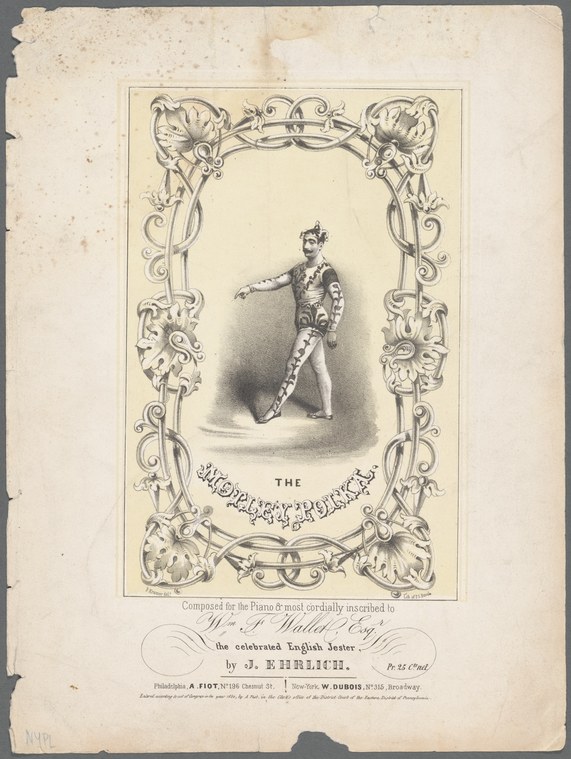
The motley polka, composed for the piano & most cordially inscribed to Wm. F. Wallet, Esq., the celebrated English jester, by J. Ehrlich
Unknown artist
- Collection:
- Prints depicting dance
- Source:
- New York Public Library
- Rights:
- Public domain — free to use, share and adapt.
- Recorded as:
- Public Domain
This print documents a crucial and often overlooked category of 19th-century dance: the professional theatrical adaptation of social dances by comedians and specialty performers. It shows how the polka, as a social phenomenon, was simultaneously being mined for theatrical material, reimagined, and commodified. The work reveals the tight connection between sheet music circulation, theatrical promotion, and visual culture in the mid-Victorian period.
What you are looking at
A single male figure in theatrical costume stands center stage, caught mid-movement in an elegant pose. He wears a richly decorated outfit: a fitted jacket with ornate embroidered or jeweled patterning across the torso and sleeves, pale breeches, and what appears to be decorative stockings or leg coverings. His posture is upright and graceful, with one arm extended outward in a gesture of presentation or flourish, while the body twists slightly. The figure is spotlit against a neutral background, rendered with skillful shading that creates volumetric form and suggests theatrical lighting. An elaborate decorative border of intertwined scrollwork, acanthus leaves, and floral ornaments frames the entire composition, giving the print a formal, presentational quality typical of sheet music covers or theatrical publicity of the period.
The dancing
The single dancer adopts an elegant, turned-out stance with the body held in an upright carriage. One arm gestures outward with theatrical extension; the legs are straight and appear to be in a slight position suggesting classical training—the weight centered and the frame controlled. The costume emphasizes line and extension. The gesture is one of presentation rather than vigorous movement, suggesting a moment of display or acknowledgment rather than dynamic dancing.
The dance depicted
The work is titled 'The Motley Polka' and inscribed to William F. Wallet, described as 'the celebrated English jester.' The polka was a wildly popular European ballroom dance of the mid-19th century, energetic and playful. However, this image shows a solo male figure in theatrical costume rather than the coupled dance the polka normally required. The inscription to a jester and the formal theatrical presentation suggest this may depict a comedic or burlesque version of the polka—a solo parody or specialty number performed by a professional entertainer, rather than social dance. The 'motley' reference (the traditional multi-colored costume of jesters) reinforces this reading of theatrical, possibly satirical performance.
How it was made
This is a lithographic print, as evidenced by the crayon-drawn line quality, the characteristic tonal gradations, and the decorative letterpress inscription at the base. The technique allowed rapid, affordable reproduction suitable for sheet music covers and theatrical publicity. Lithography's ability to render fine detail and tonal subtlety made it ideal for both the elaborate costume detail and the ornamental border. The print was published by A. Fiot (Union Street) and W. Burdos (Broadway), indicating a mid-19th-century New York or London theatrical publisher.
About this work
This is a lithographic sheet music cover depicting a solo male dancer in ornate theatrical dress, performing 'The Motley Polka.' The work combines the commercial form of printed sheet music—a ubiquitous and ephemeral document of popular entertainment—with a formal artistic treatment. The dedication to William F. Wallet, a celebrated jester and entertainer, indicates that this represents a staged comedic or burlesque performance rather than social ballroom dancing. The polka itself was emblematic of 1850s popular culture—a dance that swept across Europe and America with remarkable speed—but this version reframes it as theatrical spectacle, suggesting how professional entertainers adapted fashionable dances into novelty acts. The elaborate border and careful rendering of costume detail elevate the image beyond simple commercial ephemera, treating the performer and the dance as worthy of artistic attention.
How to look at it
Notice the costume detail: the intricate patterning across the jacket suggests both wealth and theatrical artificiality—the 'motley' reference means this is deliberate visual comedy, not realistic dress. The gesture—one arm extended, the body turned, the posture lifted—is a moment of theatrical presentation rather than the energetic hop and spin of an actual polka. The decorative border, while ornamental, also signals formality and prestige, elevating a popular dance novelty to something worth framing and keeping. Look at the rendering of light and shadow on the figure: the artist has used lithography's tonal range to create volume and presence, treating the performer as a serious subject despite the comedic context.
The artist
The artist is not recorded in the catalogue. The work is attributed only to 'J. Ehrlich' as composer of the music. The lithographic publishers A. Fiot and W. Burdos were active in theatrical and musical publishing, producing promotional and commercial prints for the London and New York theatrical markets. The decorative style and execution are consistent with professional mid-19th-century theatrical lithography.
The period
The polka arrived in Europe in the 1840s and became an international dance craze by the 1850s, adopted simultaneously by ballrooms, music halls, and the professional stage. Sheet music covers for popular dances were a major category of commercial lithographic production, serving as both advertising and souvenir. The 1850s saw intense competition among theatrical personalities to claim novelty versions of fashionable dances; jesters, pantomime artists, and specialty dancers routinely performed comedic or burlesque takes on current ballroom crazes. This image dates to that period of rapid dance commodification, when social dances were almost immediately adapted for theatrical performance and commercial reproduction.
Where it lives
This print is held in the New York Public Library's collection of prints depicting dance. It is a published lithograph, a commercial product designed for circulation as sheet music cover and theatrical souvenir, making it a document of mid-19th-century entertainment culture as much as a work of visual art.
Dance in this work
Questions about this work
What is the polka?
The polka is a lively European couple's dance in 2/4 time that became wildly fashionable in the 1840s-50s. It was energetic, playful, and democratic—danced in ballrooms and music halls across Europe and America. This print shows a theatrical novelty version rather than the social ballroom dance.
Who was William F. Wallet?
Wallet was a celebrated 19th-century English theatrical performer known for pantomime and comedic specialties. Professional entertainers of his status would often perform novelty versions of fashionable dances; this polka was composed as a vehicle for his act.
Why is this on a sheet music cover?
Sheet music for popular dances was a major commercial product in the 19th century. The cover image advertised both the music and the performer associated with it. Buyers would purchase the music to play at home on the piano while remembering the staged version they had seen in the theater.
What does 'motley' mean?
Motley is the traditional multi-colored costume of jesters and comedians—checkered or patterned. The title 'Motley Polka' signals that this is a comedic, theatrical version, not a straightforward presentation of the dance.
More dance artwork





