49 works in this view — arrow keys or swipe to move between them.
Dance in Art
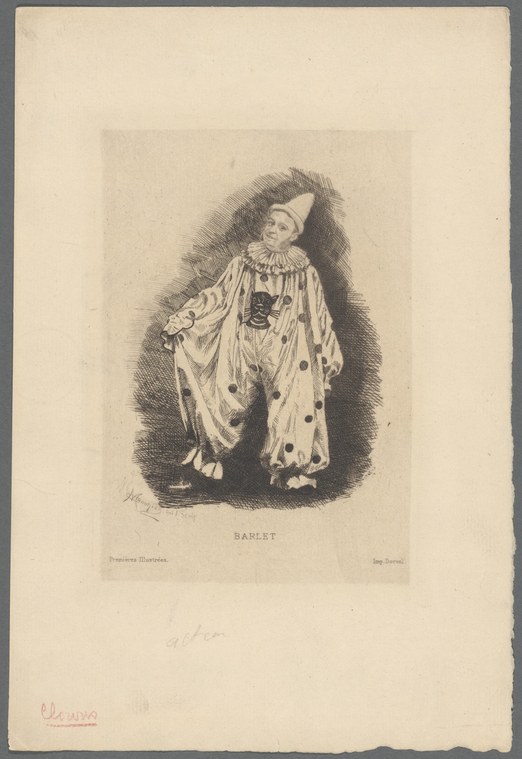
Barlet
Unknown artist
- Collection:
- Prints depicting dance
- Source:
- New York Public Library
- Rights:
- Public domain — free to use, share and adapt.
- Recorded as:
- Public Domain
Commedia dell'arte was foundational to theatrical dance and physical comedy across Europe; this print documents the body language and costume of a tradition that influenced ballet, modern dance, and theatrical jazz. As a dated visual record of how a professional performer moved and dressed in a specific role, it offers direct evidence of performance practice that would otherwise be lost to written description. For historians of theater, costume, and gesture, such prints are primary sources of irreplaceable value.
What you are looking at
A single figure dominates this etching, rendered in three-quarter view against a dark, loosely hatched background that suggests a stage or performance space. The dancer wears an elaborate costume of the commedia dell'arte tradition: a white tunic or shirt with billowing sleeves, decorated with dark spots or buttons in an irregular pattern, worn beneath a large, flowing cape or cloak in the same spotted fabric. The cape sweeps dramatically around the figure's body, caught in mid-motion and occupying most of the composition's width. The dancer's head is tilted upward and back, with an expression of theatrical exuberance or surprise; the face is delicately rendered with fine cross-hatching. The silhouette emphasizes the swirl and volume of the costume rather than anatomical detail. The title "Barlet" appears centered below the image in small capital letters, with artist and printer attributions visible at the base, though these are difficult to read with certainty in the image.
The dancing
The single standing figure occupies an asymmetrical, dynamic posture with the weight shifted and the torso twisted. The head is thrown back with the face tilted upward, suggesting either jubilation, surprise, or a moment of theatrical expression. The arms are not clearly visible, obscured by or integrated into the flowing cape. The overall pose conveys movement and instability rather than a grounded or balanced stance—the sense is of a figure caught mid-leap or mid-gesture, though the feet are not clearly visible.
The dance depicted
This is a character figure from commedia dell'arte, the improvisational Italian theatrical tradition of the 16th–18th centuries. The costume and theatrical pose suggest this is one of the stock characters, most likely Arlecchino (Harlequin), identifiable by the spotted tunic and the acrobatic, exuberant physical vocabulary. The figure's energetic posture and the artist's attention to the dramatic sweep of the costume indicate a performer known for physical comedy, tumbling, and expressive gesture. Barlet may be the name of the actor who performed this character, a common practice in recording theatrical prints of the period.
How it was made
This is an engraving or etching, executed with fine lines and cross-hatching to model form and create tonal depth. The technique is characteristic of 17th- or 18th-century theatrical portraiture, where individual actors in signature roles were documented for circulation among theatergoers and collectors. The loose, expressive hatching in the background and the careful articulation of the costume's volume and movement demonstrate skilled printmaking technique. As a print, this would have been produced in multiples and distributed relatively widely, making it a document of both performance practice and popular theatrical culture.
About this work
Barlet is a theatrical print recording an actor in a commedia dell'arte character—almost certainly Harlequin—at a moment of exuberant performance. The work belongs to a long European tradition of actor portraiture that emerged with the professionalization of the commedia troupes in the 16th century and flourished through the 18th. Such prints were both souvenirs of celebrated performances and documents of character, costume, and the physical vocabulary of stage comedy. They tell us what audiences saw, how performers moved, and which figures captured public imagination enough to be reproduced and sold.
This particular print is valuable because it freezes a characteristic moment: not a static pose but a gesture of surprise or delight, with the costume's drama integral to the performance. The artist has chosen to emphasize movement, theatricality, and the visual spectacle of the role rather than portraiture of the actor's face. It is a record of how commedia characters were embodied in performance.
How to look at it
Attend to the pose: this is not a standing figure in repose but a body in motion, caught at the peak of an expressive gesture. Notice how the artist has used the flowing cape to suggest movement and energy—it is not merely costume but a tool of theatrical effect. The thrown-back head and upturned face are key to reading the character's emotional state and the kind of performance this was: comedic, physical, and exuberant rather than lyrical or narrative. The title 'Barlet' below identifies the actor, reminding us that this is a record of a specific performer's interpretation and stage presence, not a generic representation of the character.
The period
Commedia dell'arte flourished across Europe from the 16th through 18th centuries, and theatrical prints became a major form of celebrity and artistic documentation during this period. Harlequin (Arlecchino) was among the most popular stock characters, known for acrobatic, physical comedy—tumbling, pratfalls, and rapid gesture that required training similar to dance. The character's costume evolved over time but was consistently characterized by patchwork, spots, or irregular patterns, as seen here. By the 17th and 18th centuries, commedia characters had migrated from popular street performances into court entertainment and legitimate theater, and prints of celebrated actors in these roles became collectible items. The theatrical vocabulary of commedia—rapid movement, exaggerated gesture, physical wit—would influence the development of pantomime and later theatrical forms including ballet d'action.
Where it lives
This engraving is held in the New York Public Library's collection of prints depicting dance. The attribution to artist and printer is present on the print but is not clearly legible in this image.
Dance in this work
Questions about this work
What is commedia dell'arte and what does it have to do with dance?
Commedia dell'arte was an improvisational theatrical tradition originating in Renaissance Italy, built on stock characters, physical comedy, and rapid movement. Though not 'dance' in the formal sense, it required acrobatic training and developed a vocabulary of gesture, tumbling, and rhythmic physical expression that directly influenced theatrical dance, pantomime, and later styles. Many commedia performers were trained in both acrobatics and movement, and the form was a major source of physical vocabulary for ballet and theatrical forms that followed.
How do we know this is Harlequin?
The spotted tunic or jacket is the signature costume element of Harlequin (Arlecchino), the most recognizable commedia character. The character was traditionally performed as a physical comedian—quick, acrobatic, and energetic—which matches the dynamic, off-balance pose captured here. The rolled sleeves and the exuberant gesture reinforce this identification.
Who was Barlet?
Barlet is likely the name of the actor who performed this character, a common practice in theatrical prints of the 17th–18th centuries. Individual performers of commedia roles became celebrated in their own right, and prints were issued to document and memorialize their interpretations. Without additional archival evidence, we cannot establish biographical details about this specific performer from the print alone.
More dance artwork





