49 works in this view — arrow keys or swipe to move between them.
Dance in Art
Adeline Plunkett
Unknown artist
- Collection:
- Prints depicting dance
- Source:
- New York Public Library
- Rights:
- Public domain — free to use, share and adapt.
- Recorded as:
- Public Domain
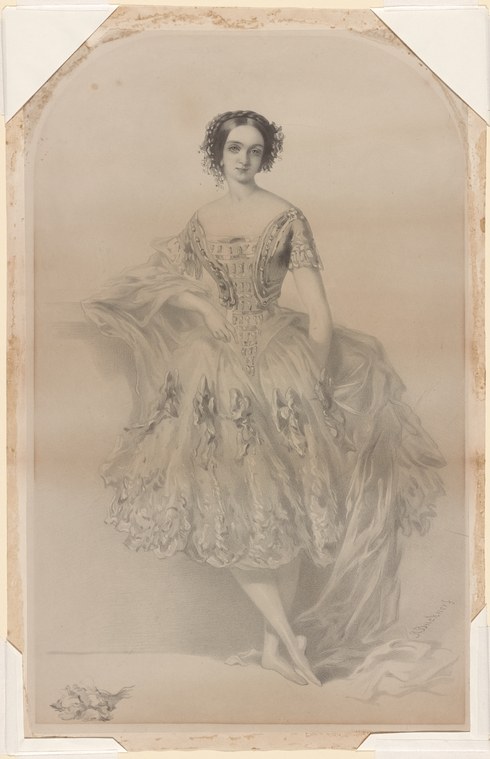
This drawing is one of the few surviving detailed records of how a mid-19th-century social dancer actually moved and dressed, captured not as a frozen academic pose but as a dynamic moment. It serves as primary visual evidence of Romantic-era ballroom technique and aesthetic—the lightness, the soft asymmetry of weight distribution, and the relationship between costume and movement that defined fashionable dancing before the rise of modern theatrical ballet.
What you are looking at
A young woman in theatrical dress is portrayed in a three-quarter-length pose against a plain background. She wears an elaborate mid-19th-century ball gown with a fitted bodice, short off-shoulder sleeves, and a voluminous skirt that extends to mid-calf. The skirt is decorated with what appears to be lace flounces or ruffled tiers. Her dark hair is arranged in loose curls, and her pose suggests movement—her weight appears shifted, with her body angled and her skirt caught as if mid-turn or in the midst of a dancing action. The drawing technique creates a soft, ethereal quality through subtle shading and the use of white highlight on the fabric. At the bottom left of the composition, there is a small sketched detail that may be a dancer's shoe or slipper.
The dancing
A single female figure occupies the entire composition. Her upper body is held upright with shoulders relaxed, her arms positioned at her sides in a graceful but unforced manner. The weight of her body appears to rest primarily on one leg, while the other seems lighter—a position consistent with a pivot or turning movement in social dance. The skirt's arrangement, bunched and gathered asymmetrically, suggests captured motion. There is no indication of pointe work or the rigid posture of classical ballet technique; instead, the bearing suggests the fluid elegance expected of social ballroom or salon dancing.
The dance depicted
This appears to be a portrait of a social dancer or performer from the mid-19th century, most likely a ballroom or salon dancer given the dress, pose, and the theatrical quality of the drawing. The gown, hair, and pose are entirely consistent with the Romantic era of ballet and social dance, roughly 1830s–1850s, when women wore similar costumes both for theatrical performance and for fashionable social dancing. The pose—caught mid-movement, with the skirt swirling—suggests the quadrille, waltz, or polka, all extremely popular in this period. Without inscription or signature visible, and given only the name 'Adeline Plunkett' from the catalogue, it is impossible to identify the specific dancer or confirm whether this was made from life or as an idealized portrait.
How it was made
This is a graphite drawing on paper, likely executed in the 1840s–1850s based on style and materials. The technique employs fine hatching and blending to create a soft, luminous effect, especially in the rendering of fabric and skin tone. The artist has used white of the paper and possibly gouache or chalk to heighten the fabric and create dimensional modeling. The formal framing—the composition set within a beveled octagonal border—indicates this was a finished, exhibition-quality work intended for public viewing or sale. This suggests a professional artist working in the tradition of theatrical portraiture or fashion illustration.
About this work
A graphite portrait drawing of a young woman in fashionable Romantic-era ballroom dress, shown in an active, dancing pose. The work captures a moment of social or theatrical dancing from the mid-19th century and exemplifies the formal portrait tradition applied to performers and society women of the period. The careful execution and theatrical framing suggest this was a professional commission or exhibition work, likely created to commemorate or advertise a particular dancer or the aesthetic ideals of dancing during the 1840s–1850s.
The work sits at the intersection of fashion plate, theatrical portraiture, and dance documentation. It records not only a specific garment but also the body carriage and movement quality expected of an educated woman performing social dance during the Romantic period. As a named subject (Adeline Plunkett), it may represent a professional performer, though without additional archival context that identity remains uncertain.
How to look at it
Attend to the asymmetry in the pose: one leg is fully weighted while the other is lighter, creating a gentle instability that reads as momentum and turning. Notice how the artist has rendered the skirt not as a static bell shape but as fabric caught mid-movement, with the folds and flounces pulled and gathered unevenly. The soft, almost blurred quality of the drawing—particularly in the arms and upper body—creates a sense of movement within stillness. This is not a rigid, formal pose but a fleeting moment, suggesting that the artist understood or was deliberately representing the flow and ease that constituted good social dancing in this period.
The period
This work dates to the height of the Romantic ballet era (c. 1830–1860), when women in both theatrical and social contexts performed in the costume shown here: the off-shoulder corset, the ankle-length skirt with multiple flounces or tiers, and the soft, unstructured hair. Socially, ballroom dancing—particularly the waltz, quadrille, and polka—was the dominant form of fashionable recreation for the middle and upper classes across Europe and America. Theatrically, the Romantic ballet aesthetic, exemplified by dancers like Marie Taglioni, emphasized ethereal lightness, soft arms, and a pose of effortless grace. This drawing captures that same visual language applied to a social dancer or performer.
The practice of commissioning or purchasing prints and drawings of celebrated dancers and society women was common during this period. Such works circulated as theatrical souvenirs, fashion references, and gifts, serving both to document performance and to promote an ideal of feminine beauty and accomplishment.
Where it lives
The work is held in the NYPL's collection of prints depicting dance, indicating that it has been recognized and preserved as a record of dance history rather than purely as a fashion or portrait document. The name 'Adeline Plunkett' in the catalogue is the only identifying information present; no artist attribution, date, or medium is recorded.
Dance in this work
Questions about this work
Who was Adeline Plunkett?
The catalogue record does not identify her further. She may have been a professional dancer or a society woman known for dancing, and the work may commemorate a specific performance or event. Research in period newspapers, theater archives, or dance records might establish whether she was a named performer of the mid-19th century.
What kind of dancing is shown?
The pose and costume are consistent with social ballroom dancing of the 1840s–1850s—likely a waltz, quadrille, or polka. The soft posture and the lack of pointe work distinguish this from theatrical ballet, although the drawing style and costume aesthetic owe much to Romantic ballet imagery of the same period.
How was this made?
This appears to be a professional graphite drawing, possibly with white gouache or chalk for highlights, executed on paper and framed with a beveled octagonal border for presentation. The style and technique are consistent with mid-19th-century theatrical or portrait illustration, suggesting a finished, exhibition-quality work rather than a sketch.
What does the pose tell us about how people danced then?
The asymmetrical weight distribution, the soft arm carriage, and the sense of flowing motion captured in the skirt all reflect the Romantic aesthetic of dancing—an emphasis on lightness, ease, and the illusion of effortlessness. The artist has chosen to capture a moment of turning or swaying rather than a static stance, suggesting that dynamic, continuous movement was the ideal.
More dance artwork





