49 works in this view — arrow keys or swipe to move between them.
Dance in Art
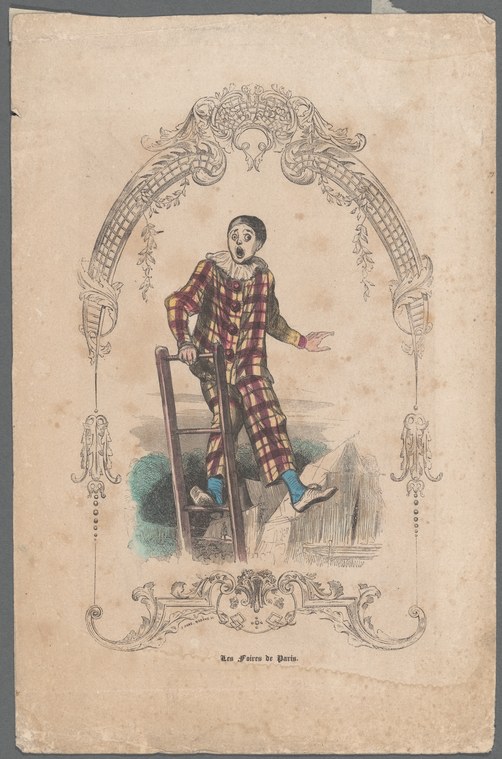
Les foires de Paris
Unknown artist
- Collection:
- Prints depicting dance
- Source:
- New York Public Library
- Rights:
- Public domain — free to use, share and adapt.
- Recorded as:
- Public Domain
Fair theatre and the popular entertainments of Paris were where comedy, music, and physical virtuosity converged outside courtly or academic control. This image documents one of the stock figures that audiences paid to watch and that later performers studied and imitated. It shows us what bodies and what kinds of movement mattered to ordinary Parisians, and it proves that theatrical imagery was mass-produced and consumed — that dance was already popular entertainment.
What you are looking at
A solitary figure in a plaid or checkered costume stands against a neutral background, framed by an ornate Rococo cartouche with scrolling foliage and pendant tassels. The dancer wears a loose-fitting, knee-length coat or tunic in shades of burgundy and cream, with one leg bent and raised, leaning on a long stick or staff planted on the ground. The pose suggests a moment of comic or theatrical exertion — the figure's face shows an exaggerated expression, mouth open as if calling out or laughing. The lower portion of the composition includes a smaller sketched vignette showing the same figure in a landscape setting with rolling hills, reinforcing the theatrical, performative nature of the scene. The hand-colored engraving is executed with careful attention to pattern and texture, particularly in the checkered weave of the costume.
The dancing
A single standing figure with substantial weight supported on one leg planted firmly with the staff, the other leg lifted and bent. The torso leans forward expressively, with one arm extended in a gesture and the other presumably holding the stick. The exaggerated facial expression — wide eyes and open mouth — reads as deliberate character work rather than naturalistic portraiture. The silhouette is loose and ungainly, emphasizing comedy over technical precision or balletic refinement.
The dance depicted
This appears to be a depiction of a comic or satirical dance character, likely from Parisian popular theatre or fairs of the 18th or early 19th century. The title *Les foires de Paris* (The Fairs of Paris) locates this squarely in the tradition of fair theatre and popular entertainment that flourished at the seasonal gatherings in Saint-Germain and Saint-Laurent. The costume, staff, and exaggerated mime suggest a character role from the broad comedic tradition of harlequinade or commedia dell'arte influence. The pose itself is frozen at a moment of effort or comic distress, capturing the spirit of physical farce rather than balletic technique.
How it was made
This is a hand-colored engraving, as evidenced by the fine linear work in the ornamental cartouche, the careful cross-hatching in the background vignette, and the limited palette of watercolor tints applied over the printed line. The technique allowed for mass circulation of popular theatrical imagery to a broad urban audience. The Rococo framing device suggests a date in the mid-to-late 18th century, when such ornamental borders were standard for theatrical and character prints. The dual composition — the central theatrical figure set against a landscape backdrop — was characteristic of documentation of fair entertainments intended both as souvenir and advertisement.
About this work
This engraving documents a character from the Parisian fairs, the seasonal popular theatrical gatherings that were a crucial site of dance innovation and physical comedy. The figure's exaggerated costume, mime, and staff-based stance mark him as a stock character from the robust tradition of fair theatre that sat outside the court and académie. The work is both a record of what was performed and a piece of commercial theatrical merchandise, circulating knowledge of these entertainments in print form to those who attended and those who heard of them.
The image belongs in a dance history not as evidence of refined technique but as a window into the embodied culture of popular performance. Fair theatre is foundational to modern entertainment; this figure is ancestor to music hall, vaudeville, and the physical-comedy traditions that shape performance to this day.
How to look at it
Attend to the staff: it is not a prop incidental to dance, but central to the pose. The figure's weight and balance are arranged around it, and it allows for a silhouette that is ungainly by academic standards but perfectly coherent for comedy. The exaggerated facial expression is key — this is a character performing a named emotion or state (strain, triumph, distress) to an audience, not achieving a pure form. The Rococo cartouche surrounding the figure is not decorative whimsy; it declares the image's status as theatrical merchandise, a way of framing and selling the performer to the urban print-buying public. The small landscape vignette below anchors the character in a wider narrative — we are seeing not a moment frozen from a continuous world, but a designed theatrical image with multiple registers of meaning.
The period
The Parisian fairs (*foires*) of Saint-Germain and Saint-Laurent were held seasonally and became sites of extraordinary theatrical innovation in the 18th century. Initially subject to restrictions by the Comédie-Française and the Opéra, fair theatres pushed the boundaries of what could be performed, developing techniques of silent mime, music, acrobatics, and physical comedy to work around prohibitions on spoken dialogue and sung text. By the mid-18th century, the fairs were established venues for popular entertainment, drawing crowds and generating a robust market in printed images of performers and characters.
In the broader context of dance, the fairs represented an alternative to ballet d'académie and court dances. Where the académie emphasized turned-out positions, vertical alignment, and refined épaulement, fair performers worked in the body's natural angles, used the full stage depth, incorporated acrobatics, tumbling, and broad mime. The characters they developed — the comic valets, scheming servants, and physical clowns — would feed forward into all subsequent popular theatre. This engraving captures that world at the moment when it was being documented and merchandised through prints.
Where it lives
The work is catalogued in the New York Public Library's collection of prints depicting dance. No artist, date, or medium are recorded in the catalogue; those attributions are inferred from the visual evidence of the engraving and the style of the ornamental framing.
Dance in this work
Questions about this work
What are the Fairs of Paris and why do they matter to dance?
The Fairs of Paris (Saint-Germain and Saint-Laurent) were seasonal public entertainment venues that flourished in the 17th and 18th centuries. They hosted theatre, music, acrobatics, and dance outside the control of the court and the academies. Fair performers invented techniques of physical comedy and mime that became foundational to European popular theatre. They were one of the few places where working-class and merchant-class audiences could see live entertainment and where performers could experiment freely.
Is this a real dance, or just a costume?
This is a character from fair theatre — a named, recognizable role that performers would have trained to play. The pose, the staff, the costume, and the exaggerated expression are all part of a vocabulary of physical performance. It is not a named dance form with codified steps, but it is choreographed in the sense that it is a designed, repeatable, and recognizable way of moving the body for an audience.
How do we know this was actually performed?
We know from the print itself. These engravings were produced for sale to audiences and admirers; they were advertisements and souvenirs. The fact that this image was engraved, colored by hand, and circulated proves that the character was popular enough to have market value. The NYPL's holding of such prints in a dance collection reflects 20th- and 21st-century recognition that fair theatre was a site of dance history.
Why is he holding a staff?
The staff is both a practical tool for balance and comic timing, and a marker of character. In the visual language of fair theatre, props like staffs, swords, or household objects helped audiences instantly recognize a stock role. The staff also allowed for a wider range of movement and mime — it could be used for emphasis, balance, or to demonstrate exertion, as appears here.
More dance artwork





