49 works in this view — arrow keys or swipe to move between them.
Dance in Art
Quadrille polonais
Unknown artist
- Collection:
- Prints depicting dance
- Source:
- New York Public Library
- Rights:
- Public domain — free to use, share and adapt.
- Recorded as:
- Public Domain
Quadrille polonaises represent a specific moment in 19th-century ballroom practice when folk traditions were consciously adapted and romanticised for theatrical and social dance. The image documents not movement but the visual identity of the pair: the costume, headdress, and carriage that would have signalled to an audience both the dance's 'exotic' origin and its propriety within fashionable society. For historians, the print's circulation as a published engraving shows how dances moved from stage to ballroom and back, mediated by such images.
What you are looking at
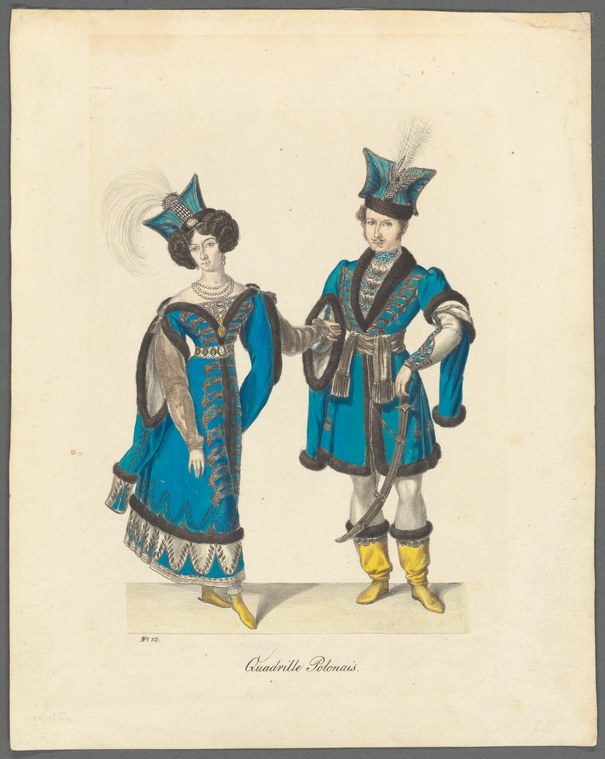
Two figures in matching costumes stand in a formal, frontal pose against a plain background. The woman on the left wears a brilliant blue dress with ornate red and gold embroidered trim, short sleeves revealing bare arms, and a matching blue kokoshnik (tall decorated headdress) topped with white feathers. She wears a pearl necklace and yellow shoes. The man on the right wears a similar blue coat with red and gold embroidery, yellow leg-wraps or breeches, and an identically styled blue kokoshnik with feathers. Both figures adopt a standing pose rather than mid-movement: the woman stands with hands at her sides, the man with one arm extended in a gesture of presentation. The composition is a costume plate, not an action scene—these are the performers displaying their finery rather than executing choreography. The hand-coloured engraving shows careful attention to textile pattern and the geometric precision of traditional Russian or Eastern European folk dress.
The dancing
The dancers are stationary and posed rather than captured mid-movement. The man's extended arm gestures toward the woman in a formal presentation; the woman's upright carriage and stillness suggest a moment of display rather than active partnering. Neither figure shows the weight-shift, turnout, or dynamic suspension characteristic of narrative dance. Their relationship is hierarchical—the man frames the woman—and their bodies do not engage in connected movement. The absence of momentum or weight transfer suggests this is a costume study rather than a choreographic document.
The dance depicted
The title *Quadrille polonais* identifies this as a polonaise quadrille, a hybrid form that combined the stately Polish processional dance (polonaise) with quadrille formations, popular in European ballrooms of the 19th century. The costumes are unmistakably Russian or Eastern European: the kokoshnik, embroidered traditional dress, and the pairing suggest a folk-inspired fashionable entertainment, likely an ethnographic novelty or a theatrical quadrille incorporating national costume. The static poses tell us nothing about how the dance was actually executed. This is a costume document for a particular pair or role type, not a record of movement.
How it was made
This is a hand-coloured engraving (colour applied by hand after printing, evident in the even washes and precise line-work). The technique allowed rapid circulation of fashion and entertainment imagery to a broad educated public; the formal pose and plain background follow conventions of theatrical costume plates and dance instruction prints of the 19th century. The engraving process ensured sharp registration of fine detail—particularly visible in the embroidered patterns and the feather textures on the headdresses—making it ideal for recording the precise appearance of stage costume.
About this work
This is a costume plate documenting the dress for a *Quadrille polonais*, a 19th-century ballroom dance that grafted Polish processional tradition onto quadrille formation. The figures are posed rather than captured in movement; the image is a record of what dancers wore rather than how they danced. The hand-coloured engraving format tells us this was a published theatrical or ballroom document, circulated to audiences and perhaps to dancers learning the form. The work sits at the intersection of folk authenticity and ballroom fashion—a moment when European courts and ballrooms consumed 'national' dances as exoticised spectacle.
How to look at it
Notice the extreme formality of the pose: these are not dancers caught mid-step but figures on display, like costume mannequins. The engraver has frozen a moment of presentation rather than movement, which tells us the print's purpose was to show what to wear, not how to move. Pay attention to the symmetry of the costumes and the hierarchy of the pose—the man's active gesture and the woman's passive reception—which reflects 19th-century ballroom etiquette. The kokoshnik (headdress) and embroidered trim are rendered with almost heraldic precision, signalling that this 'Polish' costume was itself a theatrical fiction, created for European ballroom consumption.
The artist
The artist is unknown, which was common for commercial costume and dance plates of the 19th century. Such prints were often produced by publishing houses or theatrical vendors without named attribution; the focus was on the subject and its accurate representation rather than artistic signature. The style and execution suggest a professional engraver working for a ballroom or theatrical clientele between roughly 1820 and 1860.
The period
The quadrille dominated European ballrooms from the 1810s through the 1880s. Simultaneously, Romantic-era fascination with folk tradition and national character led ballroom choreographers to create 'national' quadrille variants: the quadrille écossaise (Scottish), quadrille hongroise (Hungarian), and this quadrille polonais. These were not 'authentic' folk dances but ballroom inventions using folk costume and stylised movement to evoke place. The Napoleonic era and its aftermath saw intense European interest in national identity, and ballroom dance was a arena where fashion, theatre, and national costume overlapped. Hand-coloured engravings like this one were the primary medium for advertising new quadrille variants to dancing masters and their clients.
Where it lives
The work is held in the New York Public Library's print collection documenting dance imagery. It is catalogued as a historical print without attribution or precise date, reflecting the common absence of named creators for commercial dance and costume engravings of the period.
Dance in this work
Questions about this work
What is a quadrille polonais?
A 19th-century ballroom dance that combined the formation and figures of the quadrille (a square-set dance for four couples) with elements of the polonaise, a stately Polish processional dance. Ballroom choreographers created 'national' quadrille variants using folk-inspired costume and stylised steps to add novelty and colour to ballroom entertainment. The polonaise was already fashionable in European courts, so the polonais quadrille adapted its prestige to ballroom fashion.
Is this a record of actual movement?
No. This is a costume plate—a static display of what dancers wore rather than a choreographic document. The figures are posed for presentation, not captured mid-movement. To understand how a polonais quadrille was actually danced, you would need to consult written quadrille instructions or dance notation from the period, not this image.
What is the kokoshnik?
A traditional tall, shield-shaped headdress worn in Russian and some other Eastern European folk traditions, often ornately decorated. In this ballroom context, it is a costume element signalling 'Eastern European' or 'Russian' identity to the audience, though the entire outfit is a ballroom invention rather than authentic folk dress.
Why were these prints made and circulated?
Hand-coloured engravings like this advertised new dances and their fashionable appearance to dancing masters, their pupils, and the ballroom public. They served as both costume reference and marketing: a beautiful engraving of a new quadrille variant would encourage orchestras, venues, and dancers to take it up. The print was a medium of ballroom fashion as influential as the written dance description.
More dance artwork





