49 works in this view — arrow keys or swipe to move between them.
Dance in Art
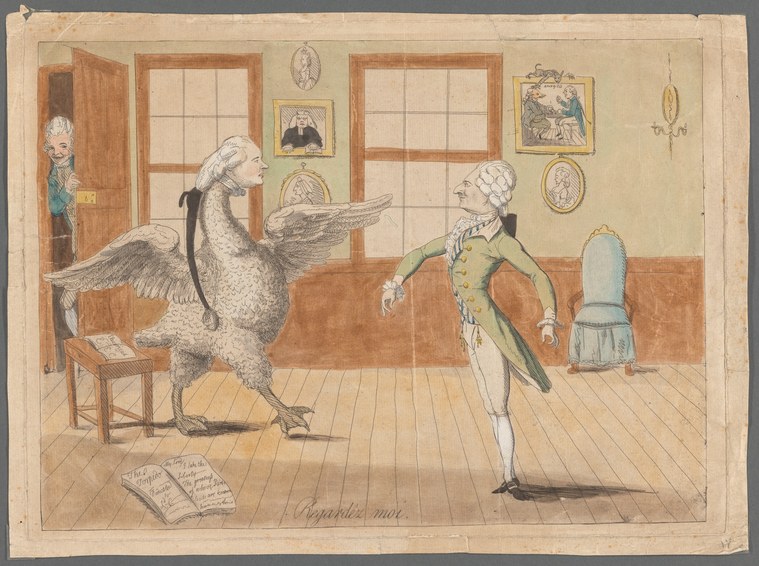
Regardez moi
Unknown artist
- Collection:
- Prints depicting dance
- Source:
- New York Public Library
- Rights:
- Public domain — free to use, share and adapt.
- Recorded as:
- Public Domain
This print documents the 18th-century understanding that aristocratic bearing and movement were purely artificial—performed, codified, and knowable as a language of social display. For dancers and historians, it reveals that satire of the period specifically targeted the body: exaggeration, reversal, and grotesquerie were applied to posture and gesture as readily as to costume or character, and the audience expected to read the mockery through movement alone. The work demonstrates that dance historians studying courtly or theatrical movement of this era must account for the fact that contemporaries were acutely conscious of its artifice and regularly mocked it.
What you are looking at
A fantastical drawing room scene shows a fashionably dressed young man in 18th-century clothing—pale green coat with gold trim, breeches, and white stockings—in an exaggerated dancing posture opposite an enormous bird-headed creature with wings and a long neck. The bird-man, rendered with naturalistic feather detail, stands upright on one leg in an equally theatrical pose, its wing extended as if in dialogue. The setting is a refined interior with wooden paneling, two large multi-paned windows, a wooden floor, and walls hung with oval framed portraits and a painting depicting a mythological scene. A bider (bidet) sits prominently at right. Books lie scattered on the floor. A servant or attendant peeks from a doorway on the left. The title "Regardez moi" (Look at me) appears below. The composition captures a moment of mutual theatrical display—a duel of artifice between human and beast, both striking impossible attitudes.
The dancing
The young man stands in a pronounced contrapposto with his weight on his back leg, his body twisted sharply, his arms extended in an open frame suggesting invitation or exhortation. His posture is deliberately stilted and exaggerated, almost balletic in its artificiality. The bird-creature mirrors this theatricality, balancing on one leg with its wing raised in a symmetrical counterpoint. Neither figure is grounded in natural movement; both are pure performance and social display. The symmetry of their poses suggests they are locked in a formal exchange—not a dance proper, but a satirical performance of courtship, conversation, or social ritual through bodily gesture.
The dance depicted
This is not a depiction of actual dance technique but a satirical image of courtly posturing and affectation. The exaggerated attitudes and the mutual display suggest the artificial manners and gestural language of 18th-century court society—where movement, posture, and bearing were highly codified expressions of status and wit. The inscription "Regardez moi" emphasizes the performative nature: look at me, admire my artifice. This belongs to the tradition of caricature and social satire that used dance-like poses and unnatural attitudes to mock the vanities of aristocratic life. The bird-headed figure may reference the tradition of masquerade and animal metamorphosis in theatrical entertainment, or it may simply be a vehicle for absurdist humor. Either way, the "dance" here is pure theatre of the body.
How it was made
This is a hand-colored engraving or etching, identifiable by the fine linear hatching visible in the feather work, the architectural details, and the careful tonal modeling of the figures. The coloring—pale wash of green and gold on the coat, subtle flesh tones, careful rendering of the interior—is characteristic of hand-colored prints from the mid-to-late 18th century. The technique allowed for wide circulation among the educated classes who appreciated satire and social commentary. The precision of the line work and the delicate color application suggest this was a luxury print, made for a cultivated audience. The composition and subject matter point to Continental European production, likely French or Flemish, where such satirical prints were popular and culturally influential.
About this work
This is an 18th-century satirical print depicting two figures—a fashionable young man and an implausible bird-headed creature—locked in a mutual display of exaggerated, theatrical posture within a refined drawing room. The work uses the language and conventions of courtly movement and gesture to mock the artificiality and vanity of aristocratic social performance. Though not a representation of actual dance, it employs the vocabulary of bodily attitude and formal bearing that was central to both court dance and 18th-century satirical art. The image reveals how closely dance and social satire were linked in this period: both relied on the readable codification of gesture, posture, and physical display as signs of status, wit, and refinement. The work belongs in a gallery of dance because it exposes the performative nature of courtly movement and because it was created in a moment when the boundary between dance, theatre, and everyday social ritual was deliberately blurred for satirical effect.
How to look at it
Note how both figures are caught in what dancers would call an 'attitude'—a frozen, highly artificial posture that reads as exaggerated before the movement even begins. The artist has chosen a moment of mutual address and display, emphasizing the symmetry of the poses as if they are locked in a formal exchange. The precision of the line work in the bird-creature's feathers and the careful rendering of the young man's coat draw attention to surface and appearance, reinforcing the satire's focus on show and artifice. Look at how the figures' weights are distributed unequally, creating an unstable, theatrical effect; neither could maintain these poses in reality. This is the convention of caricature at work: an exaggeration of natural posture in service of social commentary.
The period
This image dates to the 18th century, an era of intense refinement of both court dance and social satire. In France and the Low Countries, elaborate court dances—minuets, gavottes, contredanses—were taught as part of aristocratic education, and the codification of gesture and bearing reached a peak of complexity. At the same time, the culture of caricature and satirical prints was thriving, with artists regularly using exaggeration and grotesquerie to expose the vanities and absurdities of aristocratic life. The appearance of the bird-headed figure may reference the tradition of theatrical masquerade and animal transformation, which was itself a form of entertainment in court and popular culture. The interior setting and furnishings place the satire firmly within the world of refined domestic life and salon culture.
Where it lives
The work is held in the New York Public Library's collection of prints depicting dance. It survives as a hand-colored engraving or etching of unknown authorship and uncertain date, though the style and subject matter place it firmly in the 18th century.
Dance in this work
Questions about this work
Is this actually a dance?
Not in the technical sense, but in the social and theatrical sense, absolutely. The two figures are engaged in a display of artificial posture and gesture—the very language of courtly movement—but exaggerated to the point of satire. The artist is mocking the artificiality and vanity of aristocratic bearing by rendering it as pure theatre of the body. For historians, this reveals that 18th-century contemporaries understood courtly movement as performance and were willing to laugh at it.
What is the bird-headed creature?
It is likely a reference to the tradition of theatrical masquerade and animal transformation, or it may simply be a vehicle for absurdist humor. In 18th-century European theatre and court entertainment, animal characters and masks were common. The creature's exaggerated posture mirrors the young man's, suggesting that both are equally artificial, equally bound by the codes of social performance.
What does 'Regardez moi' mean?
It means 'Look at me.' The title emphasizes the performative nature of the scene: both figures are striking impossible poses and demanding attention, as if to say, 'Admire my artifice.' This is the essence of the satire—the revelation that courtly display is pure theatre, a demand to be looked at and admired.
What can this image tell us about 18th-century dance?
It reveals that movement and gesture in courtly contexts were highly codified, teachable, and immediately recognizable as signs of status and refinement. It also shows that contemporaries were acutely conscious of the artificiality of these codes and willing to mock them through exaggeration and satire. Dance historians can use such images to understand not just what the movement looked like, but how it was understood and received.
More dance artwork





