49 works in this view — arrow keys or swipe to move between them.
Dance in Art
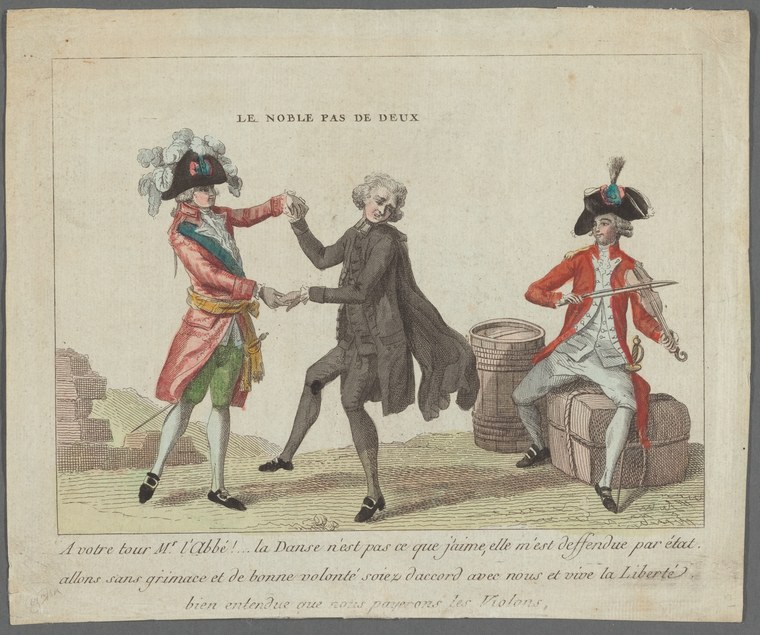
Le noble pas de deux. A votre tour Mr l'abbé...la danse n'est pas ce que j'aime, elle m'est deffendue par état. Allons sans grimace et de bonne volonté soiez d'accord avec nous et vive la liberté. Bien entendue que nous payerons les violons
Unknown artist
- Collection:
- Prints depicting dance
- Source:
- New York Public Library
- Rights:
- Public domain — free to use, share and adapt.
- Recorded as:
- Public Domain
This work demonstrates that dance imagery in graphic satire of this period often functioned as allegory for political liberty and social inclusion. It shows how the paired body, the joined hand, and the shared floor were already coded as symbols of consent and social order—and therefore as targets for satirical inversion. For historians of dance, it reveals that the vocabulary of partnering and ensemble was so powerful that it could carry political meaning even when real dancing was absent from the scene.
What you are looking at
A hand-colored engraving depicts three figures in an interior space, arranged as if choreographed for satirical effect. On the left, a nobleman in pink silk and a bicorne hat gestures expansively toward the center. In the middle, a clergyman in dark coat and cloak stands with arm raised, appearing to demur or resist. On the right, a military officer in red coat sits on a barrel or drum, holding a sword across his lap. The floor is bare; a large cylindrical object—possibly a drum or barrel—anchors the composition. The title reads "Le noble pas de deux" (The noble paso doble), but this is clearly burlesque: the caption below mocks the clergyman for claiming dance is forbidden by his state, while urging him to join in "with good will" and "long live liberty." The print is full-page, with text in French running beneath the image.
The dancing
The three male figures occupy distinct registers of social status signaled by costume. The nobleman on the left leans forward with weight shifted, one arm extended in invitation, the other gesturing toward the clergy. The clergyman stands upright and rigid, one arm raised as if in protest or blessing, his body language registering reluctance. The officer remains seated but alerts us with a tilted posture and the prominent display of his sword. There is no physical contact between the figures—no partnering—and no unified line or frame. The "dance" is one of social negotiation rather than synchronized movement.
The dance depicted
This is a satirical print that uses the language of dance as political commentary. The title "pas de deux" frames three men in a moment of social resistance: a clergyman is being coaxed by a nobleman to participate in dancing, an activity forbidden by his vow of celibacy. The military figure appears as witness or arbiter. Rather than depicting actual dance steps or partnering, the engraving uses gesture and posture to stage a comedic negotiation over liberty and bodily freedom during a period of revolutionary ferment. The "dance" is staged as a metaphor for participation in civil society.
How it was made
This is a hand-colored engraving, recognizable from the fine parallel line-work (hatching) that models form and shadow, overlaid with watercolor or gouache tints. Engraving allowed mass production and wide circulation, making it an ideal vehicle for political satire and popular prints. The technique's precision and clarity served the text-based argument: every figure's expression and costume detail reinforces the caption's irony. The hand-coloring—applied after printing—gives the work the appeal of a finished drawing while maintaining the graphic power of engraved line.
About this work
This is a French satirical engraving from the revolutionary or early post-revolutionary period, using the social fiction of dance to stage a political argument about clerical celibacy, bodily liberty, and civil participation. The "pas de deux" of the title is a misnomer: what unfolds is not a dance but a negotiation, with three male figures (nobleman, clergyman, officer) locked in a moment of social tension. The print belongs in a gallery about dance not because it depicts actual dancing, but because it reveals how deeply dance was embedded in the language of 18th-century political debate—how the idea of "joining in" and moving together served as metaphor for social contract and revolutionary participation.
How to look at it
Notice the absence of actual footwork or bodily contact—what you are watching is not a dance but a social negotiation using the visual language of dance. The clergyman's raised arm and upright stance convey refusal even as the nobleman's leaning posture invites participation. The officer's sword and seated position establish him as a figure of secular authority. The compositional asymmetry—three figures at different levels of engagement—breaks the symmetry that real court dance would demand. Read the French caption carefully: it is the argument, not the bodies, that makes this a political statement about liberty and the right to move.
The period
This engraving belongs to the tradition of French satirical prints that flourished in the late 18th century, particularly around periods of social upheaval. The reference to clergy, liberty, and the physical act of joining bodies situates it in the revolutionary moment when old hierarchies were being questioned. Dance itself was a flashpoint in Revolutionary discourse: the Church had long condemned dancing as licentious; Republicans saw participation in communal movement as a form of civic virtue. The "noble pas de deux" was a staple of aristocratic ballroom culture and theatrical ballet, making its invocation here a knowing joke about the gap between courtly formality and the new democratic body politic.
Where it lives
This work is held in the New York Public Library's collection of prints depicting dance. It is an artifact of mass production designed for circulation and consumption during a period of intense political ferment in France.
Dance in this work
Questions about this work
Is this actually a dance?
No. The print uses dance vocabulary and the formal title 'pas de deux' as a framework for political satire. The actual scene is a social negotiation in which a clergyman is being urged to join a nobleman and officer. It is dance as metaphor—the language of participation and ensemble used to argue for liberty.
What does the French text say?
The caption reads: 'Your turn, Mr. Abbé... dance is not what I like; it is forbidden to me by my state. Come now, without grimaces and with good will, be in accord with us and long live liberty. Well understood, we will pay the violins.' It is a direct appeal to the clergyman to set aside his vows and join the dance—framed as an act of revolutionary participation.
Why was clerical celibacy a target of Revolutionary satire?
The Revolution attacked the Church's authority and the restrictions it imposed on bodies and desires. Dancing was coded as both sensual and—in the language of civic virtue—a form of social joining. Urging a clergyman to dance was a way of attacking both celibacy and ecclesiastical power in a single gesture.
When was this made?
The style, costume, and political language suggest the 1790s or early 1800s, during or just after the French Revolution, but the catalogue record does not confirm a specific date.
More dance artwork





