49 works in this view — arrow keys or swipe to move between them.
Dance in Art
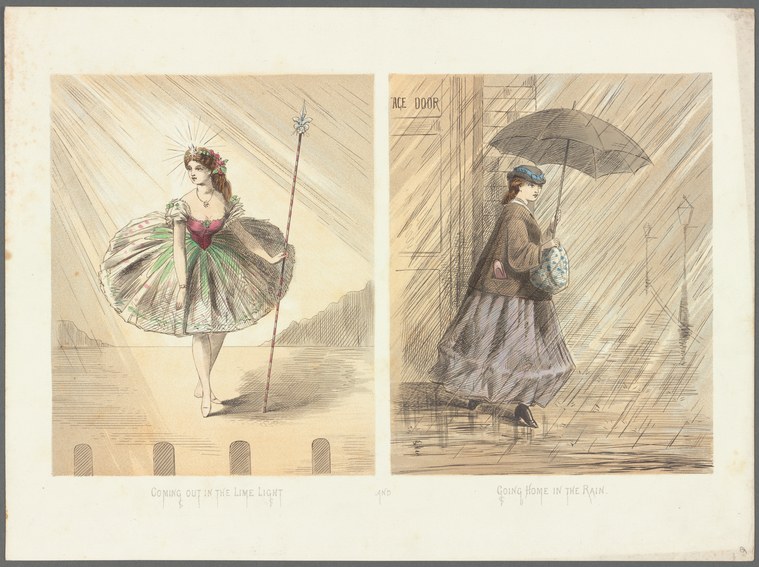
Coming out in the lime light and going home in the rain
Unknown artist
- Collection:
- Prints depicting dance
- Source:
- New York Public Library
- Rights:
- Public domain — free to use, share and adapt.
- Recorded as:
- Public Domain
This work is a rare document of how late-19th-century audiences understood the visual and social contrast between a performer on stage and the same person off duty. The meticulous rendering of the ball gown's structure—particularly the radiating panels of the skirt—provides technical evidence of how tutus and theatrical gowns were engineered, while the wet travelling coat tells us how performers actually moved through the world.
What you are looking at
Two contrasting scenes of a woman in theatrical dress, printed as a diptych with didactic captions. On the left, a figure in an elaborate ball gown with a stiffened skirt composed of radiating panels in green and pink stands in brilliant light, crowned with a tiara and holding an ornamental scepter. She stands on a stage floor suggested by simple horizontal lines, spotlit from above. On the right, the same woman is shown leaving in rain, dressed in a modest travelling coat and bonnet, carrying a small bag, sheltering under a black umbrella as diagonal hatching represents heavy downpour and she walks past a doorway marked "ICE DOOR." The composition is a moral or theatrical contrast: the glory of performance against the drudgery of ordinary life. Both figures are rendered with careful attention to fabric—the ethereal, pleated skirt on the left almost bubble-like in its construction, the wet wool coat on the right heavy and practical.
The dancing
The left figure stands upright with weight centered, arms slightly lifted to support the scepter and maintain the formal posture required by the costume; the pose is stationary and ceremonial rather than kinetic. The right figure bends slightly forward against the rain, one arm raised to hold the umbrella, her body language compressed and protective. Neither pose suggests active dancing—both are standing figures in character. The contrast in bearing between the two is deliberate: the left figure is elongated and elevated by her costume, the right figure is diminished and grounded by weather and circumstance.
The dance depicted
This is not a depiction of dance itself but of a performer in theatrical costume—likely a dancer or actress in a ballet or theatrical production, given the formal ball gown and tiara. The "lime light" (theatrical spotlight) of the title refers to the calcium light used in 19th-century theater. The work satirizes or comments on the contrast between a performer's stage presence and glamour and the unglamorous reality of street life. The gown, particularly its construction with radiating pleated panels, resembles tutus or formal ball costumes used in Romantic-era ballet, suggesting the figure may be a ballet dancer or actress in a society role rather than an active dancer in this image.
How it was made
This is a hand-colored print, likely a lithograph or engraving from the 19th century, with watercolor or gouache applied to the printed impression. The fine parallel hatching visible in the rain on the right and the linear detail in the background suggest an engraved or etched base. The technique allows for precise delineation of costume detail while the hand-coloring adds immediacy and tonal subtlety. Such colored prints were mass-produced and distributed commercially, suggesting this was aimed at a middle-class audience interested in theater, fashion, or satirical social commentary.
About this work
This print pairs two moments from the life of a theatrical performer, using costume contrast and caption to create a commentary on appearance and reality. The work belongs to a tradition of 19th-century satirical and theatrical prints that used fashion and character to explore the gap between public persona and private circumstance. While it documents theatrical costume rather than choreography, it provides valuable evidence of how ballet dress was constructed and understood in the period, and reflects the cultural status of performers as objects of fascination and also as working people subject to ordinary weather and hardship.
How to look at it
Notice how the artist has captured the physical transformation effected by costume: the left figure appears to levitate, made taller and more ethereal by the structured skirt and by the light. On the right, the same person is literally smaller, enclosed in practical fabric and bent against weather. The contrast between the two moments—the frozen glamor of the stage and the animated movement implied by the rain and the protective posture—shows how the artist understood the performer's body as contextual: the same figure entirely transformed by circumstance. The hatching technique used for rain is deliberately crude and cheerless compared to the refined detail of the stage costume.
The period
The work dates to the height of the Romantic ballet era, when theatrical spectacle and the figure of the ballerina became central to popular culture. The emphasis on costume and the theatrical lighting effect (the title's reference to limelight) reflects late-19th-century developments in stage technology and the commodification of the performer's image. Satirical and observational prints about theater, fashion, and social types were extremely popular in the mid-to-late 1800s, often published in series or as single sheets for the mass market.
Where it lives
Held in the New York Public Library's collection of prints depicting dance. The work appears to be a single sheet from a commercial run of theatrical or satirical prints, produced in the 19th century.
Dance in this work
Questions about this work
Is this a ballet dancer?
The costume—a tiara and an elaborate ball gown with a structured, radiating skirt—suggests a theatrical performer, likely a dancer or actress in a Romantic-era ballet such as a court or society scene. The figure is not shown dancing but rather standing in costume and then departing in ordinary clothes. The gown's construction resembles tutus and formal ballet costumes of the period.
What does the caption mean?
"Coming out in the lime light" refers to entering the stage under theatrical lighting (limelight was calcium light used in 19th-century theaters). "Going home in the rain" refers to the performer's departure into ordinary life and bad weather. The contrast is satirical: the glamor of performance versus the mundane reality of being a working person.
What period is this from?
The style of the gown, the theatrical technology referenced, and the hand-colored print technique all suggest the mid-to-late 19th century, likely 1860s–1880s. This was the height of the Romantic ballet and of popular theatrical imagery.
Why is the skirt shaped like that?
The radiating panels are a carefully constructed theatrical costume, likely a tutu or formal ball gown used in ballet. The panels are pleated and stiffened to hold their shape and create the silhouette required for the role. This demonstrates the engineering required to create the ethereal, geometric forms that Romantic ballet demanded.
More dance artwork





