49 works in this view — arrow keys or swipe to move between them.
Dance in Art
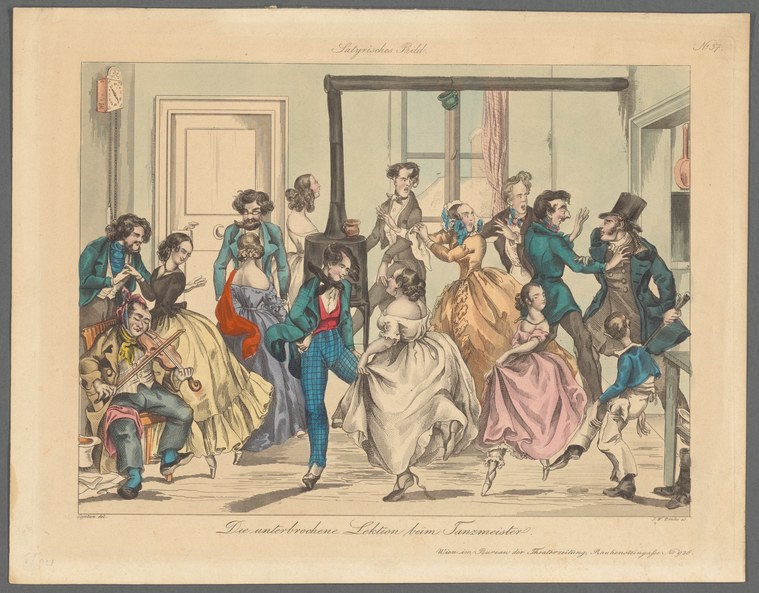
Die unterbrochene Lektion beim Tanzmeister
Unknown artist
- Collection:
- Prints depicting dance
- Source:
- New York Public Library
- Rights:
- Public domain — free to use, share and adapt.
- Recorded as:
- Public Domain
This print documents not how dance was performed but how it was taught, learned, and satirized in 18th-century Europe. It captures the tension between the formal discipline of dance instruction and the comic vulnerability of bodies learning to move, a tension that comedy has repeatedly exploited. For historians of dance pedagogy and social dance, the image reveals what was expected to happen in a lesson, what could go wrong, and how that failure was understood as entertaining.
What you are looking at
A dance lesson in progress at a dancing master's studio, interrupted by comic chaos. The scene is set in an elegant interior with tall windows and classical architectural details—paneled doors, a fireplace mantel, and wall sconces. A large group of fashionably dressed figures occupies the space: some stand in formal posture as if receiving instruction, while others are caught in ungainly tumbles and collisions. A woman in a cream-colored gown has fallen or is falling in the center-right, her legs splayed awkwardly. Another figure in red breeches tumbles nearby. A man in formal dress (possibly the dancing master) gestures from the left in exasperation or instruction. The remaining figures—both men in blue coats and women in pastels—are variously composed: some poised, others flailing, creating a sense of deliberate comic disruption of the orderly instruction. The composition is crowded and theatrical, with figures overlapping and gesturing expressively. The hand-coloring is bright and clear: cream walls, rich blues, reds, pinks, and ochres in the garments.
The dancing
The bodies display a wide range of positions from formal dance posture to exaggerated pratfalls. Several figures maintain upright, composed stances with controlled arm positions typical of formal dance instruction. In contrast, at least three figures are captured mid-fall or in sprawling, undignified positions—legs extended, bodies twisted, arms flailing. The poses suggest a mix of ballroom dancing positions (closed holds, formal frame) alongside theatrical buffoonery. The grouping and overlapping suggest multiple simultaneous actions: instruction, instruction-following, and comedic disruption.
The dance depicted
This is almost certainly a satirical or comic print depicting a dance lesson in the German or Central European tradition, likely 18th-century. The title *Die unterbrochene Lektion beim Tanzmeister* ('The Interrupted Lesson at the Dancing Master's') explicitly confirms that a formal dance instruction has been disrupted. The formal dress, upright postures, and studio setting are consistent with period ballroom dance instruction—minuet, country dances, or German waltz-adjacent social dances. However, the print's purpose is comic: it exaggerates the physical awkwardness and social chaos that might attend a real lesson, with figures tripping, falling, and losing composure. This is a satirical commentary on dance education and bodily discipline rather than a documentary record.
How it was made
This is a hand-colored engraving or etching, established by the fine line work, the cross-hatching visible in the background and shadows, and the characteristic plate marks. The coloring—applied over the printed black line—is bright, flat, and clearly done by hand or in the workshop tradition. The technique of engraving allowed for wide distribution as a popular print; the satirical subject matter and comic narrative suggest this was a commercial print for a middle-class market interested in social satire. The fine detail and careful composition indicate skilled work; the work's circulation as a numbered print (the "47" visible in the upper right) suggests it was part of a series.
About this work
This is a hand-colored satirical engraving depicting a dance lesson gone comically wrong in an 18th-century studio setting. The print captures a moment of deliberate social chaos—figures falling, colliding, and losing composure while a presumably exasperated dancing master attempts to maintain order. The composition and dress are consistent with German or Central European ballroom dance instruction of the 1700s, but the subject is social satire rather than documentary. The work belongs in a dance gallery because it directly comments on dance education, bodily discipline, and the gap between the order demanded by formal dance instruction and the physical chaos of actual bodies in motion. As a popular print, it reveals how dance—and the aspiration to dance well—was understood as both a serious marker of gentility and an inherently comic, body-based practice prone to failure.
How to look at it
Attend to the contrast between the formally posed figures and those caught in falling or scrambling positions: the artist has frozen the moment of disruption rather than the order the lesson aims for. Notice the dancing master's gesture and expression—his bodily language conveys exasperation or command. The careful rendering of the studio setting (the fireplace, windows, architectural details) grounds the chaos in a real, specific social space. The color adds to the comedy: the women's bright skirts, the men's vivid coats, and the pale walls all emphasize visibility and legibility, making every misstep unmistakable. This is a print designed to be read as a narrative: look for the sequence of actions across the composition.
The period
This print dates to the 18th century, when social dance—minuet, country dances, German dances, and emerging waltz forms—was a central marker of gentility and social competence, especially in German-speaking lands. Dance instruction was formalized and professionalized; the figure of the *Tanzmeister* (dancing master) was a stock character in literature and visual satire. The period saw both a genuine expansion of dance pedagogy and a rich tradition of satirizing its pretensions. Comic prints mocking dance lessons, dancing masters, and the physical mishaps of dancers were popular commercial products, circulating alongside serious dance manuals. This print belongs to that tradition of social satire—using the body's vulnerability to ridicule the aspirations of the rising middle class to acquire aristocratic manners.
Where it lives
The work is part of the New York Public Library's collection of prints depicting dance. It is identified as part of a numbered series (visible as "47" in the upper right), suggesting it was a commercial popular print, likely German or Central European in origin, part of a larger series of satirical scenes.
Dance in this work
Questions about this work
What dance is being taught in this print?
The print does not specify a single dance form, but the formal postures, studio setting, and 18th-century dress suggest ballroom dances typical of the period: minuet, country dances, or German dances. The point of the satire is not the specific form but the general comedy of formal instruction interrupted by physical chaos.
Is this a real scene or a fantasy?
It is a satirical exaggeration rather than a documentary record. Dance lessons certainly happened, but the degree of chaos—multiple simultaneous falls and collisions—is deliberately comic and exaggerated for effect. The artist is not reporting a real lesson but using the idea of one to satirize aspiration and bodily vulnerability.
Who would have bought a print like this?
Satirical prints were popular commercial products for middle-class buyers in 18th-century Europe. They could be purchased individually or as part of a series. This print mocks dance instruction and the social pretensions attached to learning to dance, so it would have appealed to viewers who enjoyed social satire and comedy of manners.
Why does the print show so many different body positions at once?
The overlapping, simultaneous actions create a sense of chaos and comedy. Rather than showing a single moment of falling, the artist fills the space with multiple disruptions—some figures poised, others falling—to maximize the visual comedy and satirical effect. This is a theatrical composition, not a sequential narrative.
More dance artwork





