49 works in this view — arrow keys or swipe to move between them.
Dance in Art
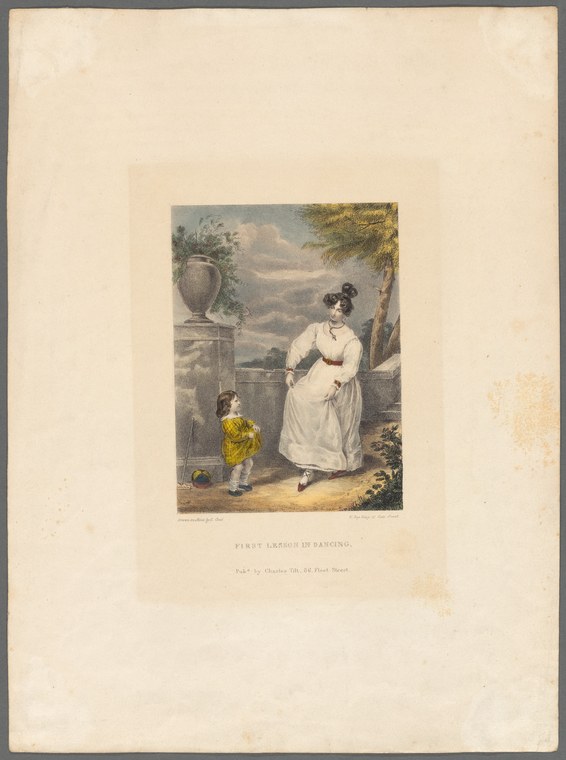
First lesson in dancing
Unknown artist
- Collection:
- Prints depicting dance
- Source:
- New York Public Library
- Rights:
- Public domain — free to use, share and adapt.
- Recorded as:
- Public Domain
This image is rare evidence of how social dance was actually taught to children in the early 19th century—the posture, the face-to-face instruction, the emphasis on standing and arm position before steps, and the moral framing of dance as an accomplishment. It also documents the gendering of dance instruction and the role of dancing masters and their circle in shaping the bodies of the next generation. For historians of dance pedagogy and Regency material culture, it is a primary source.
What you are looking at
A woman in a high-waisted white Empire-line dress instructs a small child, dressed in a yellow coat, in the fundamentals of dance in a parkland setting. The woman stands with one arm extended in a gesture of demonstration or encouragement, her posture upright and formal. The child faces her, positioned as if receiving instruction. Behind them rises a decorative stone urn on a plinth, and to the right mature trees frame the composition. The sky is rendered in soft greys and blues, suggesting an outdoor garden or grounds. The print is hand-colored in muted tones, with the woman's dress providing the brightest accent of white against the landscape. The moment captures not movement but pause—the suspended instant of pedagogical attention, with the child's small figure echoing the adult's stance in miniature.
The dancing
The woman stands in an elongated, balletic posture with her weight settled and her left arm raised in an open, expressive position—a gesture more indicative of Regency or early Romantic conventions than active steps. The child mirrors this posture in nascent form, suggesting the mechanical repetition of a beginner learning body placement. Neither figure shows the dynamic tension or mid-movement capture typical of social dance scenes; instead the composition freezes an instructional moment where form and imitation matter more than momentum.
The dance depicted
This depicts the teaching of social dance—most likely the cotillion, quadrille, or related figure dances that dominated Regency drawing rooms and gardens. The title 'First Lesson in Dancing' makes explicit what the image conveys: this is pedagogical rather than performative. The woman is an instructor (possibly a dancing master's wife or a governess), and the child is a young pupil, most likely female despite the ambiguous age and dress. The outdoor setting is uncommon for dance instruction but reflects Romantic-era aesthetics and the association of dance with natural grace. The taught posture and open arm position are consistent with the épaulement and deportment of early 19th-century ballroom dance, where a student would first learn standing position and arm carriage before progressing to steps and partnered movement.
How it was made
This is a hand-colored engraving or aquatint—most likely aquatint given the soft tonal gradations in the sky and landscape and the subtle wash effects. The technique allowed for wide circulation as a print, suggesting this was a commercially produced work aimed at the middle-class domestic market. The careful hand-coloring in gouache or watercolor (evident in the precise white of the dress and the warm yellow of the child's coat) indicates a print of moderate cost and intended for display in a parlor or schoolroom. The inscription at the base is partially legible and credits the publisher or artist. The softness of the technique suits the sentimental, didactic subject: instruction in propriety and grace.
About this work
This hand-colored print documents the pedagogy of early 19th-century social dance and the transmission of bodily discipline to the young. It is one of several such teaching scenes from the Regency era, where dance instruction became a standard accomplishment for girls of the genteel classes and a common subject for prints aimed at the domestic market. The work sits at the intersection of dance history, gender history, and the visual culture of accomplishment—it shows not a dance in performance but the machinery by which dance was inculcated as a marker of refinement. The outdoor garden setting and the sentimental relationship between instructor and pupil are characteristic of Romantic-era visual ideology, in which even discipline is rendered as natural and graceful.
How to look at it
Attend to the woman's arm position and the angle of her body—it is open and expressive in a way that suggests ballroom deportment rather than gesture or storytelling. Notice how the child's posture echoes hers, a visual metaphor for learning through imitation. The garden setting, with its urn and trees, places this intimate instruction within an aesthetic of refinement and nature, a common trope in Romantic-era prints. The absence of other figures or a dance floor emphasizes this as a private, pedagogical moment rather than a social or theatrical scene. The print's soft, muted palette contributes to its tone of restraint and propriety.
The artist
The artist and engraver are not recorded in the catalogue. The credit line at the base is not fully legible in reproduction, but the style is consistent with London print workshops of the 1810s–1820s. Many such teaching scenes were published by London printsellers (Ackermann, Rudolph, and others) and engraved by minor artists working in aquatint. Without further research, the attribution cannot be determined.
The period
This print dates to the height of the Regency (c. 1810–1820), when dancing was a central accomplishment for young women and social dance—especially the quadrille and cotillion—was at the apex of fashion. The Napoleonic Wars and the rise of the middle class created a new market for prints depicting genteel domestic life and female accomplishment. Dance instruction, music, and needlework were the pillars of a lady's education. At the same time, Romantic aesthetics emphasized the natural ease and grace with which an accomplished woman should move, and pedagogical prints often used outdoor settings and informal poses to suggest that constraint could look like freedom. The print form itself was crucial to the dissemination of these ideals among the aspirational classes.
Where it lives
This print is held in the New York Public Library's collection of prints depicting dance. It is one of many such commercially produced prints from the Regency era and represents the popular visual documentation of dance accomplishment and instruction in the early 19th century. The exact date of publication and the identity of the engraver or publisher are not recorded in the current catalogue but may be recoverable through further research.
Dance in this work
Questions about this work
Why is the lesson outdoors?
Outdoor garden settings were fashionable in Regency aesthetic representations of female accomplishment. The print invokes the Romantic ideal of natural grace and propriety, suggesting that dance flows from innate refinement rather than artificial restraint. In practice, dance instruction often took place indoors, but the garden setting served the print's visual and moral narrative.
What dance is being taught?
The print does not specify, but given the period and the upright posture and arm position shown, this is most likely instruction in the cotillion, quadrille, or allied figure dances that dominated Regency ballrooms. The focus on standing and arm carriage suggests the preliminary stages of teaching, before steps and turns.
Who would have owned a print like this?
Middle-class families aspiring to genteel status, parents or governesses teaching young girls, and schoolrooms. Such prints were inexpensive (compared to oils) and widely circulated by London printsellers. They served as both decorative and didactic objects, reinforcing the cultural value of dance as an accomplishment.
How do we know this is instruction and not a social dance?
The title makes it explicit, but the image confirms it: the poses are held and formal rather than in mid-movement; the figures face each other frontally as if teacher and pupil; there is no indication of music, partnered movement, or the dynamic energy of a social dance. The moment is one of attention and imitation.
More dance artwork





